Digital Processor Reviews

Sort By:  Post Date TitlePublish Date

Perpetual Technologies P-1A D/D & P-3A D/A processors

At the Consumer Electronics show in Las Vegas in January 1999, Mark Schifter, erstwhile president of Audio Alchemy, was handing out a press release announcing what seemed like a groundbreaking product from his new company, Perpetual Technologies. The product was the P-1A, a digital-to-digital processor that would do resolution enhancement, loudspeaker correction (amplitude and phase), and room correction—all for less than $1k. It sounded too good to be true.

dCS Purcell D/D converter

The dCS Purcell is named after Henry Purcell, the English composer, organist, bass, countertenor who was born in 1659 and died in, alas, 1695. It's a digital/digital converter intended for consumer use, as opposed to the less elegantly packaged pro-audio version, the dCS 972, that I reviewedhttp://www.stereophile.com//digitalsourcereviews/260/">reviewed; in February 1999. Both devices increase the sample rate and/or word length of the output from linear PCM digital audio sources like CD or DVD up to a maximum sample rate of 192kHz and a word length of 24 bits. According to the extensive documentation, this is achieved by "using extremely powerful and accurate digital interpolation filters, which yield an output signal having negligible levels of distortion."

MSB Link DAC III D/A converter

Prelude
I fell in love with the original Link DAC, as was obvious from my">http://www.stereophile.com//digitalsourcereviews/234/">my review in the January 1999 Stereophile. I said that "the Link redefines entry into high-quality digital sound," as it provided excellent sound and 24-bit/96kHz conversion for the remarkably low price of $349. It is as firmly ensconced in Class C of "Recommended Components" as it is in my weekend system, where it tames the digital signals from my DMX receiver and my trusty old Pioneer PD-7100 CD player.

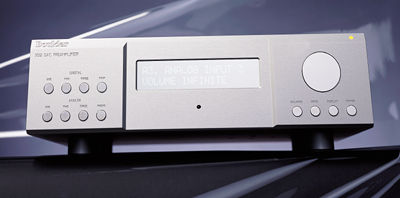
Mark Levinson No.30.6 Reference D/A processor

The Mark Levinson No.30 has enjoyed a continuing residence in Class A of Stereophile's "Recommended Components" listing since it was reviewed in our February 1992 issue (Vol.15 No.2). Madrigal includes the No.30 in its "Reference" series, by which they mean that the unit will not become obsolete. Thus, when new technology became available, the No.30.5 update was introduced, consisting of a single digital-receiver printed circuit board to replace the original's three boards, and a new digital-filtering board. This revision was favorably reviewed by Stereophile in October 1994 (Vol.17 No.10).

Wadia 27ix & Wadia 270 transport

History teaches us that the full flowering of any social phenomenon takes place after the seeds of its destruction have been sown. That tourist magnet, London's Buckingham Palace, for example, was built decades after the English Revolution and the Restoration had redefined the role of the British monarchy as being merely titular, and made the elected Parliament the real seat of power.

Musical Fidelity X-24K D/A processor

The standalone digital/analog converter emerged as a product category in 1987 with the appearance of the Arcam Black Box and the Marantz CDA-94, closely followed by the PS Audio Link. The idea was that putting the sensitive D/A-conversion and analog stages in a separate enclosure with its own power supply would maximize the sound quality when compared with packing these circuits in the same box as the transport. However, it turned out that the routing of the digital data between transport and processor in the form of an S/PDIF- or AES/EBU-encoded bitstream could introduce word-clock jitterwhich undid much of the sonic advantages. (See "Bits is Bits" by Malcolm Hawksford and Chris Dunn, Stereophile, March 1996.)

MSB Technology Link D/A converter

Recently, we've seen the digital "horsepower" race accelerate with the arrival of digital sources and devices with 24-bit and 96kHz sampling capability. Much of this has been spurred by the 24/96 labels emblazoned on the newer DVD players—and, within the purer confines of the audio community, by high-end DACs with this same ability. Indeed, it's possible that the dCS Elgar DAC, near and dear to John Atkinson's heart and a perennial Class A selection in Stereophile's "Recommended Components," performs so well with standard 16-bit/44.1kHz sources because its wider digital bandwidth permits greater linearity within the more restricted range of regular CDs.

Advertisement
Advertisement
Advertisement