LATEST ADDITIONS

CD Sales Up in '98; High End Stalls over DVD-Audio

Unit sales of CD players rebounded in 1998, rising 4% to $336 million, according to statistics from the <A HREF="http://www.cemacity.org/">Consumer Electronics Manufacturers Association</A>. All segments of the CD hardware market---single-play, carousel changers, and mega-disc changers---improved over the big slump of 1997, when unit sales fell 60% and dollar sales fell 40%. Through November 1998, single-disc player sales were up 33% in units and 24% in dollar volume. Carousel changers, component-CD's largest segment, rose 15% in units and 7.5% in dollars during the first three quarters of 1998.

Continue Reading »

Internet Entrepreneurs: Blame it on the Rio

The popular condensation of Darwin's theory of evolution is "adapt or die." The phrase could certainly have been addressed to the music-industry establishment by any one of four Internet entrepreneurs in a public discussion last week at San Francisco's Commonwealth Club. The four---Gerry Kearby of <A HREF="http://www.liquidaudio.com/">Liquid Audio</A>, Gene Hoffman of <A HREF="http://www.goodnoise.com/">GoodNoise</A&gt;, Arnold Brown of <A HREF="http://www.audioexplosion.com/">AudioExplosion</A&gt;, and Andrew Keen of <A HREF="http://www.audiocafe.com/">Audiocafe.com</A>---gathered at the public affairs forum Tuesday evening, February 22, for a spirited discussion of "The Future of Music Distribution."

Continue Reading »

Added to the Archives This Week:

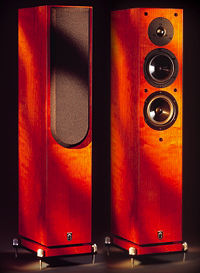
Newcomer Revel has been on a roll lately, piling up accolades all around for its new line of loudspeakers. Larry Greenhill takes a look at the recently unveiled <A HREF="http://www.stereophile.com//loudspeakerreviews/96/">Revel Salon</A> and explains how it compares to the Sydney Opera House. "Did the Salon meet its design goals of timbral accuracy, low distortion, and lack of dynamic compression?" Read all about it in Greenhill's report.

Continue Reading »

New Copyright Protection Schemes for Digital Music Announced

Several weeks back, the music industry's fear of MP3 audio technology came to a head with the release of Diamond Multimedia's Rio playback device. (See <A HREF="http://www.stereophile.com/news/10324/">previous</A&gt; and <A HREF="http://www.stereophile.com/news/10389/">related</A&gt; stories.) The <A HREF="http://www.riaa.com">Recording Industry Association of America</A> then announced a new plan, called the Secure Digital Music Initiative (SDMI; see <A HREF="http://www.stereophile.com/news/10338/">previous article</A>), in an effort to bring the music and audio-technology industries together to solve the problem of digital music piracy.

Continue Reading »

Musical Fidelity X-24K D/A processor

The standalone digital/analog converter emerged as a product category in 1987 with the appearance of the Arcam Black Box and the Marantz CDA-94, closely followed by the PS Audio Link. The idea was that putting the sensitive D/A-conversion and analog stages in a separate enclosure with its own power supply would maximize the sound quality when compared with packing these circuits in the same box as the transport. However, it turned out that the routing of the digital data between transport and processor in the form of an S/PDIF- or AES/EBU-encoded bitstream could introduce word-clock jitterwhich undid much of the sonic advantages. (See "Bits is Bits" by Malcolm Hawksford and Chris Dunn, <I>Stereophile</I>, March 1996.)

Continue Reading »

Fine Tunes #8

Bill Gates would have you believe we live in a plug'n'play world. Apple has proselytized same since day one. But I'm here to tell you it just isn't so for high-end audio. The orientation of a component's AC plug—even the quality of the wall receptacle itself—affects the sound! Oh no, Mr. Bill, not something else to futz with! Will it never end?
Continue Reading »
Advertisement
Advertisement
Advertisement