LATEST ADDITIONS
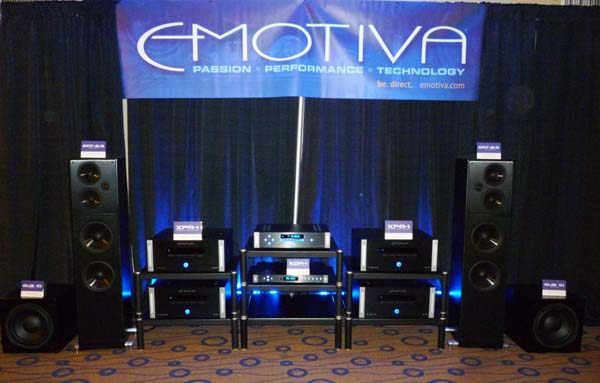
Pride and Service from Emotiva
Emotiva’s products have often struck me as cold and unwelcoming—odd, because the people behind the products are the complete opposite—but I must confess that my opinion has been based more on nomenclature and appearance than anything else. So I was anxious to visit the Emotiva room and listen again, with my revised perspective in place and my skepticism in check...
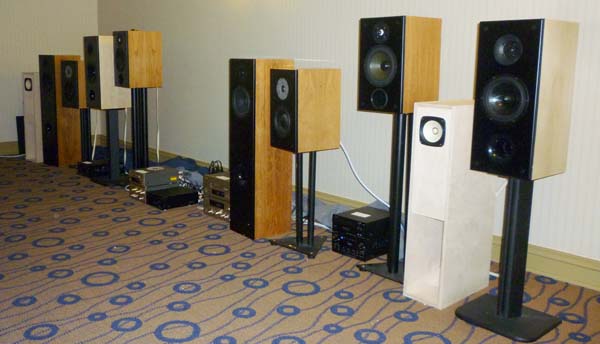
Make it Yourself with Madisound and Meniscus
To many of today’s teens and young adults, the thought of building a loudspeaker would be completely foreign and unrealistic, if not plain irrational and silly: Why build a loudspeaker? But, decades ago, doing things yourself, with tools and instructions, was not only the easiest way of accomplishing a goal, but often also the best, cheapest, and most enjoyable and satisfying way—a way of life we’ve sadly forgotten.
Companies like Madisound and the Meniscus Audio Group try to preserve that tradition, offering all the parts and knowledge required to those who are interested in doing things themselves. Here we see an array of Madisound speakers, all built from kits. I spoke with Mark Sayer, speaker guy of Meniscus Audio Group, who has been building his own speakers since he was a child. For him, the experience is more about the process than the product, a way of slowing things down.
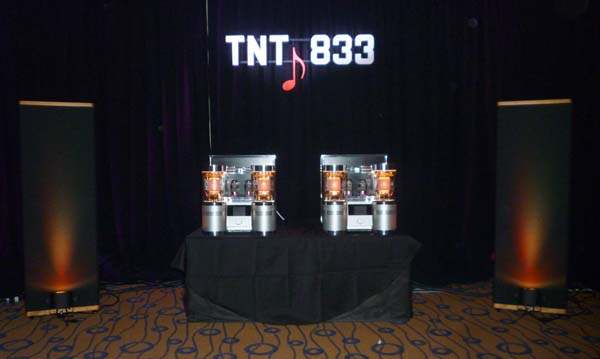
’Cause I’m TNT, I’m Dynamite: The Audio Power Labs TNT 833
The system, including an Audio Research LS27 preamplifier, Musical Fidelity M6CD CD player, Vandersteen 3A loudspeakers, and aided by an array of RealTraps room treatments, produced big, robust voices, and had a good sense of musical flow.
Audio Power Labs’ Clyde Holobaugh confessed that the TNT 833 has been “a labor of love,” requiring over two years in design and development. His goal was to build a class-A, push-pull design that would be powerful, while also eliminating distortion.
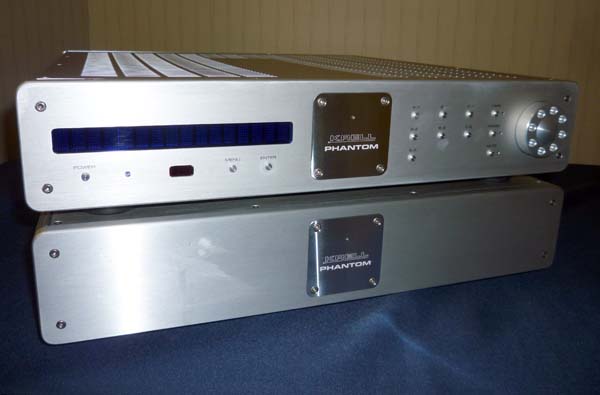
Krell Phantom preamplifier
The Phantom uses a dual-monaural circuit design, and receives power from a Krell current mode analog power supply housed in its own chassis. No negative feedback is used. The Phantom should be available later this summer; price estimated at $17,500. The crossover option adds $2500.
Krell Cries Mary
We listened to Sting doing a version of Jimi Hendrix’s “The Wind Cries Mary.” (Man, I once knew a girl named Mary; she could make the wind cry....) Although Krell’s Bill McKiegan had strategically placed a few RealTraps panels around the room, some sonic problems were still readily audible. The bass was boomy, largely due to the acoustic of the small, L-shaped room, but guitars and voices were attractive, and the soundstage was wide and deep. Afterward, we listened to a bluegrass track and I was impressed by the system’s speed and clarity.
The West Georgia Saxophone Ensemble
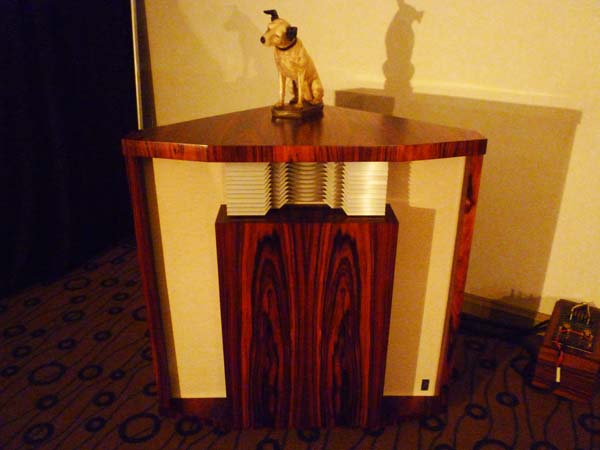
His Master's Voice
The Hartsfield from Classic Audio Loudspeakers
Something about this speaker gets people feeling all romantic. When I walked into the room, I sat down behind a couple whose hands were joined and whose arms swung in the space between their separate chairs, happily and slowly, in time to the music. After they departed, their places were taken by a second couple. This time, however, the woman simply moved her seat as close as possible to her companion’s, creating a virtual love seat, so that the two could hold each other while the music played.
What the hell? Was this a hi-fi show or some sort of love fest?
I couldn’t blame them, though. The system was playing some extremely gorgeous, palm-in-eye-socket piece of violin music, and it sounded sweet, inviting, and nearly rapturous, with delicate, extended highs and easy, voluptuous mids.
Designer John Wolff said something about field-coils and 106dB...

Inside the BMC AMP M1 monoblock
BMC stands for Balanced Music Concept. The company was founded by Bernd Hugo and Carlos Candeias, two audio designers based in Germany. BMC’s products are designed in Europe, but manufactured in China to keep prices down. While $15,580 is a lot of money for most anyone, BMC products contain a number of interesting design quirks, including modular construction for easy upgrades, Superlink signal transmission mode which “skips any coding process” and is said to create a wider soundstage with increased detail resolution, and Digital Intelligence Gain Management which eliminates the need for a preamplifier and allows a DAC to connect directly to an amplifier.
Whatever. Just look at the amp’s innards. The level of construction and detail look heroic! I wouldn’t want to make one of these things, but listening to it sure was fun.