How high do you want your fi?
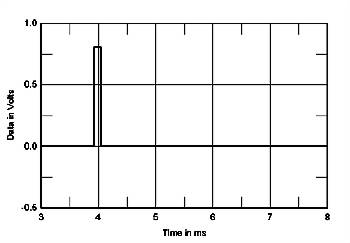
Would you really <I>want</I> a perfect hi-fi?


Would you really <I>want</I> a perfect hi-fi?
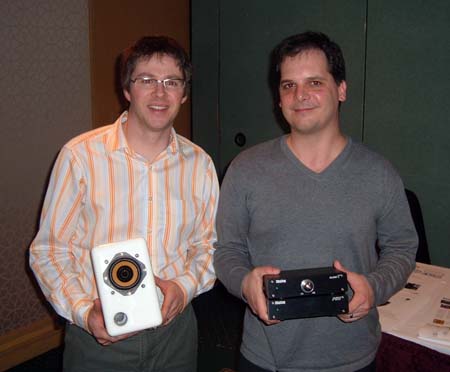
Alright, back in action. Montreal was a blast. Seriously the most fun I've ever had at a hi-fi show. This was due partly to the fact that we didn't have to adjust to a different time zone, partly to the overall laidback, friendly atmosphere, and partly to the smaller, less demanding size of the show. And I didn't even get sick!
I’m appallingly late with this, but the photo show “Jam Session: America’s Jazz Ambassadors Embrace the World” is up for a few more days (through April 12) in the arcade of Jazz at Lincoln Center (on Broadway and 60th Street, 5th floor, New York City)—and, if you’re in the area, go see it.
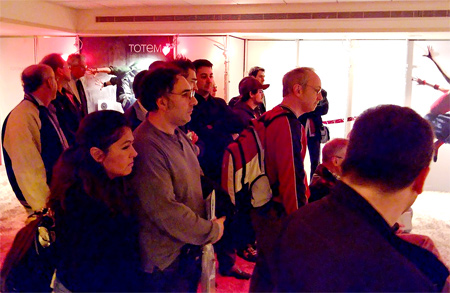
It did not require great perspicacity to predict that SSI2009 would not be as well attended as last year's show. Things are tough all over. In any case, as I write this, on Saturday evening on a train en route to Toronto—yes, I manage to catch the train this time!—the show still has another day to go, and, as Michel Plante, with Sarah Tremblay the SSI's organizers, admitted, what often makes or breaks a show like this is the Sunday attendance.
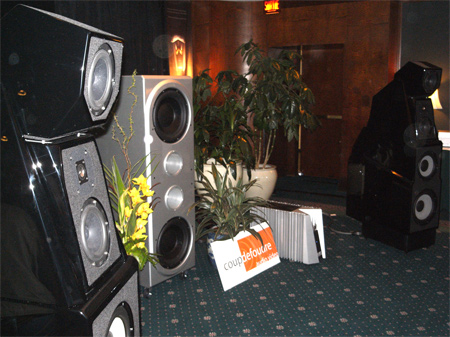
Okay, so the system in the big room from Montreal dealer Coup de Foudre was <I>very</I> expensive, and the room's acoustics I knew from the 2008 Show were excellent, but the sound was both my best at show and the best I heard in that room. Not only did Peter McGrath's high-resolution recordings, played back from his Sound Devices recorder feeding the very promising Playback Designs' D/A processor, reproduce with extraordinary dynamics and a superbly transparent window into the soundstage, my own recordings sounded the best I have experienced, with the audiophile attributes supporting/reinforcing rather than getting in the way of the music. And that was from CD!
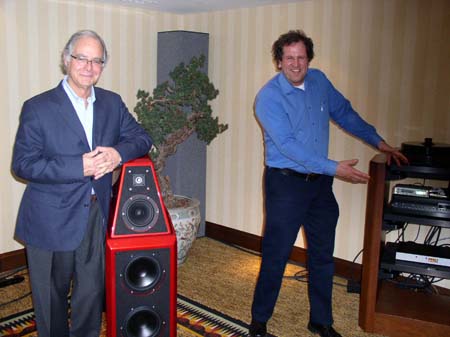
Wilson Audio Specialties' Peter McGrath (second from left) is embraced by the crew of Coup de Foudre (l–r): Jennifer ("Just Jennifer. No surname. You may have heard of me."), Graeme Humfrey, and Erik Fortier.
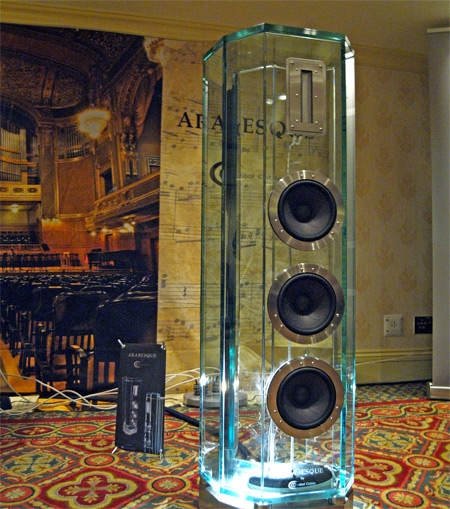
I first heard the prototypes of the almost-all-glass Arabesque from Dutch wire manufacturer Crystal Cable at the <A HREF="http://blog.stereophile.com/ces2009/see-through_transparency/">2009 CES</A>, where they produced sound in the Audio Basics room that belied my negative expectations. Demmed at SSI with Simaudio 5.3 series CD player and amplification, the Arabesques, now in full production, again produced a promising sound. With my my recording of "The Mooche," from <I>Editor's Choice</I>, the Arabesques put me squarely in the church acoustic of Chad Kassem's Blue Heaven Studio in Kansas, where the recording was made.
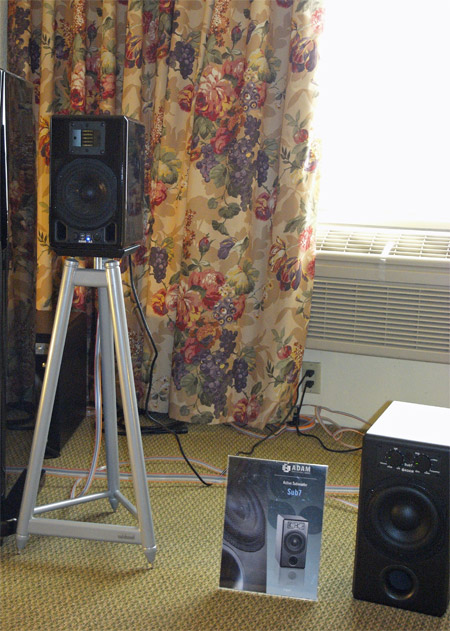
"Air Motion" because the Adams—familiar to me from the German company's strong showing at pro-audio shows—feature modern versions of the Oskar Heil-designed "Air Motion Transformer" higher-frequency drive-units that a brief period of popularity in the 1970s. This uses a corrugated aluminum-foil diaphragm that moves somewhat like an accordian bellows, alternately squeezing and stretching the air between the folds. Adam, who is entering the North American high-end audio market, was proudly showing its top-model Tensor series at SSI, but I was also impressed by the active A5 shown in the photo, which crosses the AMT tweeter over to a moving-coil woofer at 2.2kHz and costs just $900/pair. With the $600 Sub 7 active woofer also shown in the photo, a pair of Adam A5s would make the basis for an affordable high-quality system.
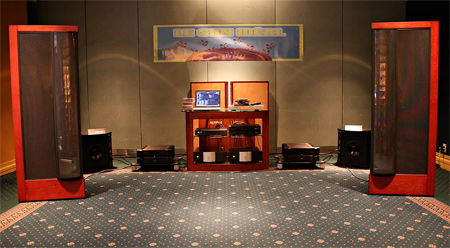
Asked to name the top three drawbacks of electrostatic loudspeakers, the knowledgeable audiophile will list—not necessarily in this order—restricted listening area, inability to play loud, and limited bass extension. Although the last criticism can still be applied to the new MartinLogan CLX (its claimed bass –3dB point is 56Hz), the speaker's design has gone a major way toward addressing the other two criticisms.
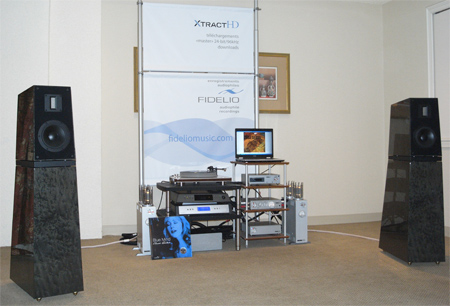
René Laflamme's recordings on the Fidelio label have always been favorites of mine, though his choice of repertoire—like the new "It's a Small World" project—sometimes cause my eyebrows to raise. SSI was my first chance to hear high-resolution versions of some Fidelio recordings, played back from René's laptop feeding data via asynchronous USB to the dCS Scarlatti upsampler set to do nothing other than translate the USB datastream to AES/EBU at 96kHz to drive the dCS Elgar Plus D/A. As this has a volume control it was connected direcrtly to a pair of Nagra VPA tube monoblocks which in turn drove the Verity Sarastro 2 speakers that Fred Kaplan reviewed for <I>Stereophile</I> in April. Cabling was all-Shunyata. René uses all-tube microphones and records directly to a Pyramix digital audio workstation. The sound of a transcription for brass and organ of "Mars" from Holst's <I>The Planets</I> was to die for on this system, one of my "best of shows."