A Perfect Fit
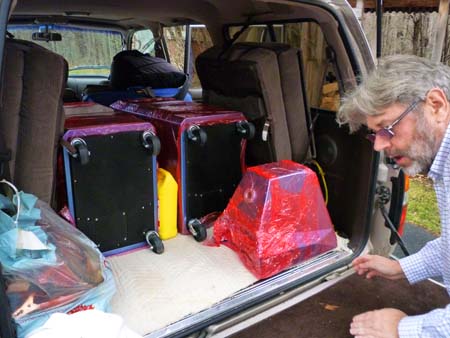
JA struggles while I take a photo: In the back of JA’s Land Cruiser, the Wilson Sasha’s WATT head unit fits perfectly behind its partnering Puppy.


JA struggles while I take a photo: In the back of JA’s Land Cruiser, the Wilson Sasha’s WATT head unit fits perfectly behind its partnering Puppy.

For a journalist at a trade show, few things are more awkward than entering a room and finding that the exhibitor and his staff are the only people there: No dealers. No customers. Just a few desperate souls ready to pin their last half-hope on a man with a badge—and the badge says <I>Press</I>.

One of my favorite moments of SSI 2010 came during Saturday afternoon's outstanding "<a href="http://blog.stereophile.com/ssi2010/roast_the_editors/">Ask the Editors</a>" session, when a member of the audience asked the panel about <I>audio nirvana</I>. What components or systems, if any, had helped us achieve that elusive, mythical state when everything is perfect and right? I sat up straight in my seat and buried my fingernails into the palms of my hands, anxious to offer a response. When my turn to answer came, I stuttered, overwhelmed by the moment, but I think I said enough to communicate the idea that audio nirvana is a fleeting target, one that depends more on the listener's mood and ability to be <I>moved</I> and less on the system or individual components within any particular system.
<I>The Jazz Review</I> was one of the most fascinating journals in the history of music-writing. Its editors were Nat Hentoff and Martin Williams, two of the most insightful critics of its day (the late 1950s and early ’60s). But its main distinction was that it consisted almost entirely of jazz musicians, writing articles and reviews about other jazz musicians.

The lovely (as you can see) and talented (as anyone who heard her sing and play the flute at the SSI 2010 <A HREF="http://blog.stereophile.com/ssi2010/oh_caroline/">Give Band concerts</A> can attest) Caroline St-Louis helped out at the show ticket desk. Here she is with her favorite audio magazine.
montreal is:<br>
two spiral staircases
a mist this gray morning drops<br>
upon the curves
a million billion fruit trees, frozen
a few miles from plattsburg,<br>
global positioning system
this afternoon,<br>
high in the sky above saratoga springs: