Wes Phillips

F. Alton Everest: 1909–2005

<I>We were saddened to learn just this week that F. Alton Everest died earlier in the month. Like many audiophiles, much of what we know about acoustics was gleaned from Everest's authoritative books on the subject, including several editions of his </I>Master Handbook of Acoustics<I>, </I>Critical Listening and Auditory Perception<I>, and </I>Acoustical Techniques for Home and Studio<I>. Everest packed a lot of living into 95 years, earning a BSc in EE from Oregon State and an EE from Stanford. He taught at Oregon State and Hong Kong Baptist Universities, worked in film production for 25 years, and was an acoustic consultant for 15. During WWII, he spent four years in undersea acoustic research. He was an Emeritus Member of the Acoustical Society, Life Member of the IEEE, Life Fellow of the Society of Motion Picture and Television Engineers, Member of the Audio Engineering Society, and cofounder and past president of American Scientific Affiliation.


Continue Reading »

I'm New Here

The AZ9345 is on right now. And it sounds pretty damn good to me. I’m listening to Smog’s latest album, <i>A River Ain’t Too Much to Love</i>, and god, I love it. I love it. I don’t even know exactly what it is. I keep wondering, “What is it? What’s so great about this album?”

Continue Reading »

No Real Beginnings or Endings

The music we made in Genie Boom was not unlike the music made by the pumps and steam lines and reactors of Firmenich. Michelle drummed on garbage cans, a red school bell, a gas tank, whatever banged. Todd pressed buttons on his Casio synthesizer and Roland drum machine. I plugged five cheap guitars&mdash;old Silvertones and Kays, before they became popular&mdash;into whatever amps I could find, turned the knobs on my effects pedals all the way up, and screamed the lines from my poems into the guitars’ pick-ups.

Continue Reading »

Tony Federici

Back in the spring of 1986, I was visiting a hi-fi show in Lucerne, Switzerland. In the KEF/McIntosh/Perreaux room, I was engaged by a voluble American, who wanted to talk about the changes I was making with the English magazine <I>Hi-Fi News</I>. The conversation shifted to the hotel bar, then to a restaurant. The American was one Tony Federici, who at that time was distributing Perreaux gear in the US. With an education in the philosophy of science, Tony's comments were insightful and challenging. He was never at a loss for an opinion! After I moved to the US to take the <A HREF="http://www.stereophile.com/asweseeit/352">editorial reins at <I>Stereophile</I></A>, Tony stayed in touch, and many were the conversations we had about audio magazines, the audio business, and music.

Continue Reading »

It Made Me So Happy

Throughout college, Michelle and I&mdash;along with our very good friend, Todd&mdash;played in a performance art/noise rock band called Genie Boom. We took the name from the sky-blue steel beast that you sometimes see at construction sites, or on highways, or&mdash;here in New York City&mdash;even on Madison Avenue; the same sky-blue steel beast that I once used to propel myself a hundred feet into the air to install all sorts of I-don’t-know-what along the tanks and pumps and whatever else that make up Firmenich, the chemical plant where I worked at the time. They make flavors and fragrances; much of what you taste and smell everyday comes from Firmenich. I spent four summers there, painting curbs and railings “emergency yellow,” watching flaming bits of iron fall from the welders’ gloved hands, finding beauty in how smooth a beveled pipe could be.

Continue Reading »

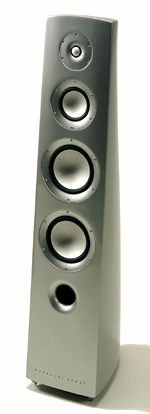
Mordaunt-Short Performance 6 loudspeaker

Wood is not an engineering material. It might look pretty, but it's inconsistent and therefore unpredictable. So we smash cheap wood into sawdust and then glue it all together again to create something that can be machined. This is called medium-density fiberboard, or MDF. We then thinly slice some classy hardwood&mdash;hopefully harvested from sustainable sources&mdash;and use it to cover the ugly MDF. This might have made sense back when Chippendale was making furniture, but it seems strangely old-fashioned in our age of plastics and composites. I haven't seen wood trim on a TV set for more than a decade. Why is it still the norm for loudspeakers?

Continue Reading »
Advertisement
Advertisement
Advertisement