
J. Gordon Holt

MartinLogan Monolith loudspeaker
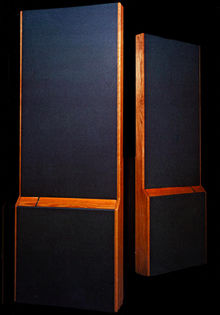
Most Stereophile readers are aware by now of why the full-range electrostatic should, in theory, be the ideal transducer. (If you aren't aware, see the accompanying sidebar.) Acoustat was the first manufacturer to design a full-range electrostatic that was so indestructible it came with a lifetime warranty. (MartinLogan is now offering a three-year warranty on their speakers, and is considering going to a lifetime warranty). But Acoustat was never able to solve another problem that has plagued all flat-panel speakers: treble beaming.
Continue Reading »
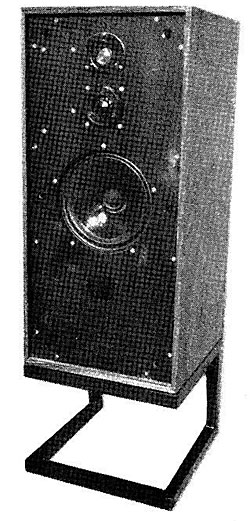
Philips/Magnavox FD-1000 CD player

What, a high-fidelity product from Magnavox? The company that 20 years ago had a reputation for building massive, polished-console boom-boxes and was scornfully referred to in audiophile circles as "Maggotbox"? Some important things have happened to Magnavox since those days. Mainly, it became a subsidiary of the Dutch Philips company, co-developer of the laser video disc and now the audio Compact Disc. The Magnavox CD players are actually made by Philips for US distribution by Magnavox.

Continue Reading »

I Say It's Video!

<I>A couple of months back (<A HREF="http://www.stereophile.com/asweseeit/393awsi">March 1993, p.7</A>), I wrote that as far as I was concerned, video was television dressed up in fancy dress, thus there was no place for coverage of the medium in </I>Stereophile<I>. As the magazine's founder, <A HREF="http://www.stereophile.com/interviews/66">J. Gordon Holt</A>, has been a committed videophile for many years, I sat back and awaited a reaction from him. One was not long coming. I am running his response as this month's "As We See It" feature.&mdash;<B>John Atkinson</B></I>

Continue Reading »

Down with Dynagroove!

Editor's Introduction: In 1963, Stereophile's founder J. Gordon Holt published attacks on what he saw as the single largest step backward in high-fidelity sound reproduction at that time: RCA's introduction of "Dynagroove" LP records, where the recorded signal was pre-distorted and dynamically equalized to compensate for the poor performance of cheap phonograph players. "Issue 5...revealed most of RCA Victor's 'revolutionary' new system as nothing more than a sophisticated way of bringing higher fi to record buyers who don't care enough about hi-fi to invest in a decent playback system." Ten years later, Gordon wrote that, "As of 1974, the best we can say for Dynagroove is that there is no audible evidence of it on current RCA releases." (These articles were reprinted in June 1992, Vol.15 No,6, as part of Stereophile's 30th-anniversary celebrations.)John Atkinson
Continue Reading »

Spendor BC-1 loudspeaker

666Spendor_BC1.jpgThis smallish loudspeaker system has been getting high ratings in the English audio magazines for some years but was not available to US consumers until recently, when the small firm (literally a Mom'n'Pop enterprise, footnote 1) arranged for US distribution through Audio International.

The Spendor BC-1 is about as unimpressive-looking as any other smallish three-way loudspeaker, of which there are countless hundreds of models being made in the US at present. In fact, we were so ho-hummed by the mundane appearance of this speaker that we found it hard to connect the pair up and give them a listen.

Continue Reading »

Audio Research SP-3 preamplifier

We thought Audio Research's previous-model SP-2C (footnote 1) was excellent, but this is even better—the closest thing available, in fact, to the ideal straight wire with gain. Our sample had a minor glitch—there was a slight "plop" if you rotated the tone controls rapidly—but we could find nothing else about it to criticize. Currently, by far the best preamplifier than money can buy. And would you believe it uses tubes (at reduced heater voltage, for extended life and cooler operation)!
Continue Reading »

Surrounded By Space

During the late 1950s, when high fidelity exploded into a multimillion-dollar industry, product advertisements bragged about bringing the orchestra into your living room. Apparently, no one realized what an absurd concept it was, but there are still many people today who believe that's what audio is all about. It isn't. There is no way a real orchestra could fit into the average living room, and if it could, we would not want to be around when it played. Sound levels of 115dB are just too loud for most sane people, and that's what a full orchestral <I>fortissimo</I> can produce in a small room.

Continue Reading »

Why Hi-Fi Experts Disagree

Dateline: late August 1989. The scene: my palatial office in the Stereophile Tower. Present were the magazine's official technowizard Robert Harley, Circulation Kahuna Michael Harvey, and myself. The subject under discussion was the program for the Stereophile Test CD, launched in this issue, and Bob had been dazzling Michael and myself with a description of the sophisticated signal-processing power offered by the Digidesign Sound Tools music editing system with which he had outfitted his Macintosh IIX computer. (He had to fit it with a 600-megabyte hard-disk drive!) "It'll even do edits as crossfades as well as butt joins," enthused Bob. "Let me tell you about the crossfade I once did when editing a drum solo for a CD master that lasted ten seconds..."
Continue Reading »
Advertisement
Advertisement
Advertisement