J. Gordon Holt
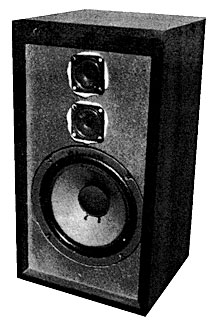
Snell Type A loudspeaker
The Sound of Transistors
KLH Model Nine loudspeaker
Negative Bias: the Impartial Reviewer
For a subjective equipment reviewer, whose writings are based as much on impressions as on observations, it is very important to approach a product without personal bias. Of course, all of us lay claim to this ideal, and some of us even manage to maintain the appearance of impartiality most of the time. But just under the reviewer's veneer of urbane professionalism and deliberative restraint lies a darker force—a leering hobgoblin of anarchy and mischief which scoops usually forbidden adjectives from a well of calumny and offers them for the writer's consideration as the perfect word to describe what he is trying to express. It's an ever-present temptation to accept the suggestion, because every critic harbors a secret urge to be another Dorothy Parker, trashing mankind's most earnest endeavors with devastating <I>bon mots</I> that will endure long after the writer has ceased to. Most of the time, the reviewer is able to resist the temptation to broadside a product, but some products, and the people they represent, make this very difficult. In fact, sometimes it is impossible.
Magnepan Tympani I loudspeaker
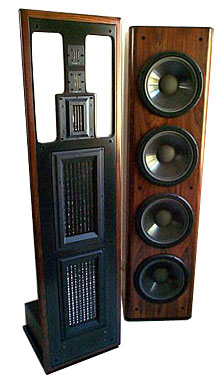
Infinity IRS Beta loudspeaker
In 1966, two avid audiophile/music lovers—a nuclear physicist named Arnold Nudell and an airline pilot named Cary Christie—labored over weekends and evenings for 18 months in Nudell's garage to put together the world's first hybrid electrostatic/dynamic loudspeaker system. It cost them $5000 for materials, launched a company (New Technology Enterprises), and helped contribute to the popular myth that all of the really <I>important</I> audiophile manufacturers got started in somebody's basement or garage (footnote 1). The system was marketed as the Servo-Statik I, for the princely sum of $1795. (At the time, the most expensive loudspeaker listed in <I>Stereo Review</I>'s "Stereo/Hi-Fi Directory" was JBL's "Metregon," at $1230.)
"What I Mean..." (review terminology)
As you may have noticed, <I>Stereophile</I>'s approach to equipment testing is quite different from that of "mainstream" audio publications. Instead of throwing a bunch of measurements at you, and telling you how we think components ought to sound because of those measurements, we test them as you would: by listening. But we have an extra problem: we have to convey to someone else—you—a feeling for what we hear from that component. It ain't always easy.
Watkins WE-1 loudspeaker
First I should clear up what may be an ambiguity in the driver-lineup spec for these speakers. In each system, three 8" cone units serve as woofers. Two of these crossover from the midrange drivers at 100Hz. Crossover to the third 8-incher, the subwoofer, is at 40Hz. Thus, two woofers are active from 100Hz down to 40Hz, and all three are active below 40. In other words, the third woofer does not come into play until the frequency drops to the point where the radiating area of two 8-inchers starts to become inadequate for moving air, at which point the additional area of the third speaker is thrown in. Below 40Hz, all three are working together.
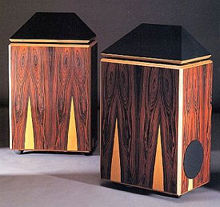
Shahinian Diapason loudspeaker system
Richard Shahinian has been offering loudspeakers to music lovers for more than 15 years. I use the word "offering" here in its strictest sense, because Dick has never "sold" his products—by pushing them. Indeed, he is probably one of the worst self-promoters in the business. If we think of "soft sell" in the usual context of laid-back and low-pressure, then Shahinian's approach would have to be called "mushy sell."