Ypsilon Electronics’ Aelius monoblock
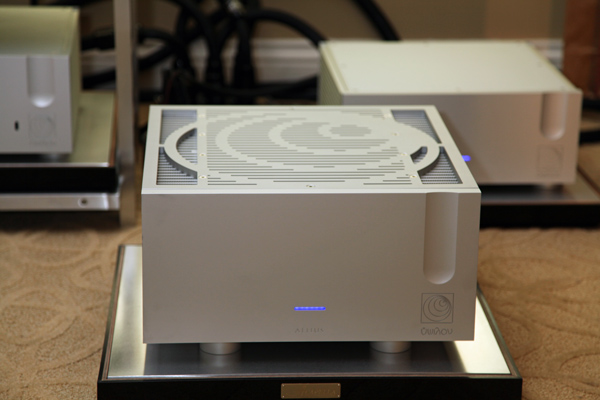
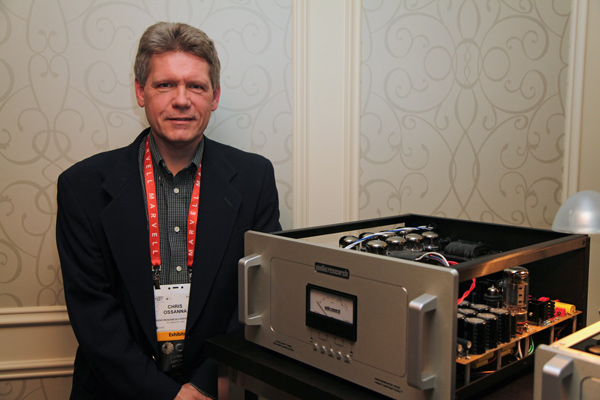
Ypsilon Electronics’ Demetrius Baklavas designed the new $36,000/pair Aelius monoblock amplifier. The Aelius is rated at 220W into 8 ohms, 308W into 4 ohms, and 500W into 2 ohms. It is a hybrid design that features tube inputs, hand-wound interstage coupling transformers, and MOSFET output devices wired in the same type of push-pull Circlotron output configuration that was found in some Output-Transformer-Less tube (OTL) designs. The Circlotron configuration was developed years ago by Electro-Voice, and while the Aelius's output devices are all N-channel MOSFETs, the Circlotron approach is very different from conventional quasi-complementary approaches.
Continue Reading »

 I should begin this review by confessing that I've never been a fan of subwoofers. Most subwoofer systems I've heard have been plagued by a familiar litany of sonic horrors: poor integration between subwoofer and main speakers, boom, bloat, tubbiness, slowness, excessive LF output, and an overall presentation that constantly reminds the listener he is hearing a big cone moving. To me, subwoofers often sound detached from the music, providing an accompanying thump that bears little relationship to the sound from the main speakers. Rather than revealing the music's harmonic underpinnings, subwoofers often obscure them in a thick morass of featureless boom. In addition, adding a subwoofer often destroys the qualities of the main speakers that made you buy them in the first placejust to name a few of my observations (footnote 1).
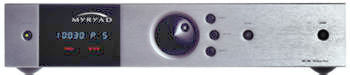 The Random House Dictionary of the English Language defines "myriad," derived from a Greek word meaning "ten thousand," as "a very great number of persons or things." British and unabashedly ambitious, Myryad Systems has set itself myriad design goals for its M-series stereo components: audiophile performance, real-world pricing, convenience, circuit simplicity, common remote-control function, and physical beauty.