John Atkinson

Live vs Recorded

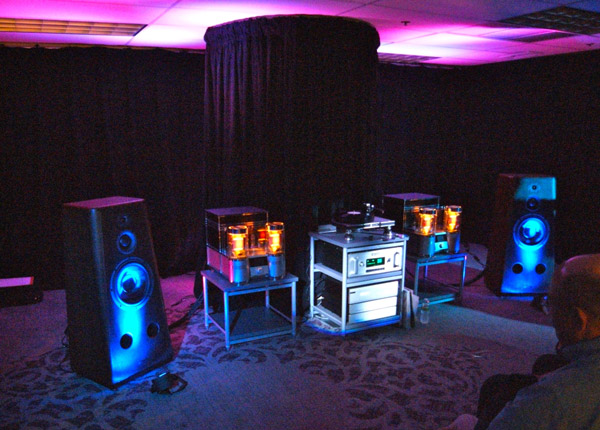
John Marks also arranged, courtesy of Audio Power Laboratories and Wharfedale, to present Arturo Delmoni performing the slow movement from Karl Goldmark’s Concerto for Violin in their room. Arturo played live, but Steve Martorella playing his transcription for pipe organ of the orchestral part was recorded by John Marks in the First Baptist Church in America and played back from CD over the Wharfedale Neo Airedale speakers. The result was impressive, both on the grounds of the system’s sound quality, with extended low frequencies demanded by the organ, but also for Dr. Delmoni’s lyrical virtuosity. This wasn't so much Live vs Recorded and Live with Recorded.

We all owe John Marks a big "thank you" for bringing live music to Axpona New York.
Continue Reading »

Joseph—Bel Canto

Like many exhibitors at Axpona, Joseph Audio was playing files from a laptop for their dems. In this case, Jeff Joseph was using Pure Music on his MacBook Pro and feeding a short USB link to Bel Canto's LightLink converter (reviewed by Erick Lichte in the June issue), which in turn fed the audio data via a low-jitter ST optical link to the Bel Canto DAC3.5VB, which also acted as the system preamp. Power amplifiers were a pair of Bel Canto Ref.500 monoblocks and speakers were Joseph's own stand-mounted Pulsars ($7000/pair). The sound of Jeff's rip of Louis Armstrong's "St. James Infirmary," a long-term staple in Joseph dems, was visceral. (Another iPhone photo—forgive the grainy quality, due to the lack of light.)
Continue Reading »

Pure Music Does DSD

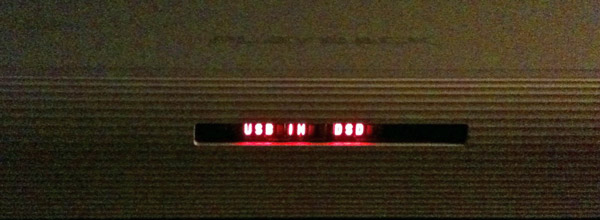
In Channel D's own room at Axpona, Rob Robinson demmed the latest version of his Pure Vinyl LP ripping program and Pure Music audio file player program for me. One of the new features of Pure Music v1.8 is the ability to play DSD files as well as hi-rez PCM, and to emphasize that fact, I photographed the display of Rob's Playback Designs MPD-3 D/A converter ($6500) to show that it was receiving DSD data via USB2.0.

Despite the small room, the music—David Elias's "Freedom on the Freeway"—sounded excellent, with an analog-like ease to the presentation. The rest of the system comprised Joseph Pulsar speakers ($7000/pair) driven by a Hegel H20 amplifier. Blue Coast and 2L are already offering DSD files for download, and I understand that there are many live concerts available from tapes via bit torrent sites.

Continue Reading »

Steinway–Lyngdorf

After Peter Lyngdorf left Tact, he went into partnership with the Steinway piano company to make a line of expensive speakers aimed not at audiophiles but at well-heeled music lovers. I was impressed by what I heard of the first of this line, which incorporates Lyngdorf's RoomPerfect acoustic correction, when I auditioned it in Manhattan a couple of years back, so I wasn't surprised when Steve Guttenberg button-holed me and told to go listen in the Steinway–Lyngdorf room at Axpona.

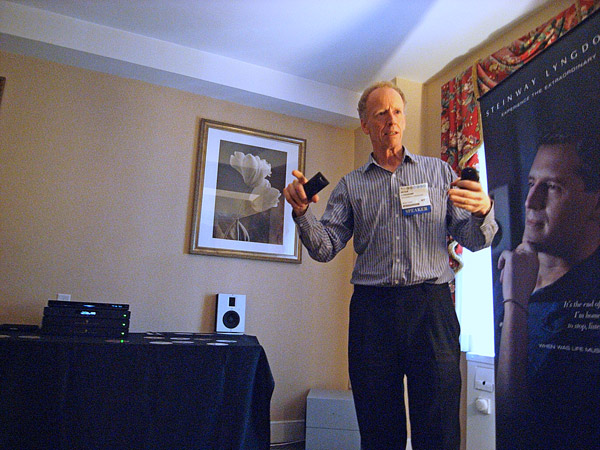
The S-Series subwoofer-satellite system ($22,100) was producing a big sound with the tiny satellites stood on a credenza against the wall behind them. Incorporating RoomPerfect correction, the speakers also use digital signal processing to produce a flat response, which Peter Lyngdorf explained allowed him to optimize the drive-units for maximum sensitivity. The two small subwoofers were placed in the room corners, with a crossover frequency (depending on the room correction necessary) around 200Hz

Continue Reading »

Get 'em Here!

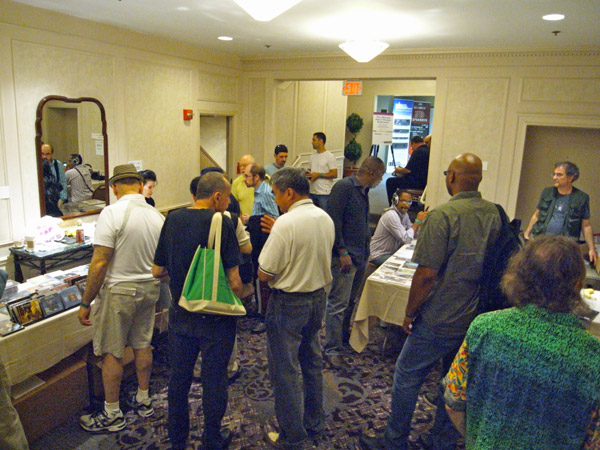
As with other Shows, the New York Axpona was an opportunity for music-lovers to sock up on audiophile recordings. The Affinia's Hotel's mezzanine floor was packed with vendors, from HDTracks and Chesky on the left in my photograph to M•A on the right. (That's M•A's Todd Garfinkle, whose prowess as a recording engineer has little equal, on the right at the back. The gentleman in the green shirt with his back to the camera is none other than audio writer Steve Guttenberg, who both contributes to Stereophile and has an entertaining audio blog on CNet.
Continue Reading »

Ayre K-5xeMP line preamplifier

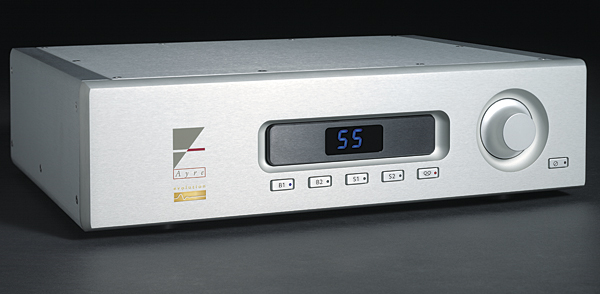
I asked for a sample of the K-5xe so I could do a Follow-Up to Sam's review, but other review commitments kept getting in the way. When I finally spent some time with it (S/N 10J002), I found the sound a little on the robust, forward side, which made system matching problematic. Then, as I was about to spill some ink on the K-5xe, I got an e-mail from Charlie Hansen letting me know that the development of the QB-9 USB DAC had led them to rethink the K-5xe's design, and that Ayre would be sending a sample of what would be called the K-5xeMP. After a longer delay than I had anticipated, the K-5xeMP, priced at $3500, arrived for review.
Continue Reading »

Attention Screen Takes Flight at Yamaha

How am I to convince music lovers that this CD is markedly different from Attention Screen's first two live CDs?

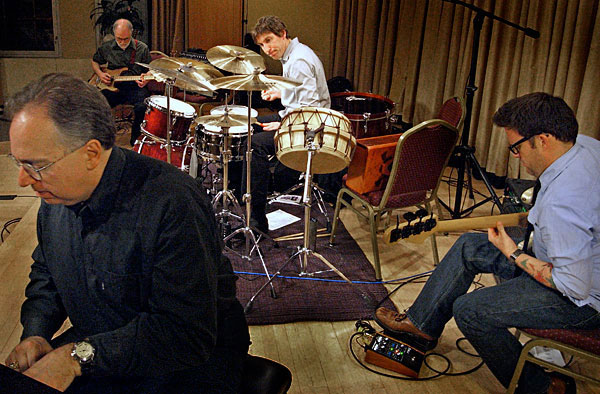
The question kept running through my head as I marveled at the breadth and maturity of Attention Screen's remarkable improvisations during a pre-concert sound check in the Piano Salon of Yamaha Artist Services, Inc. (YASI), at 689 Fifth Avenue, in the heart of Manhattan.
Attention Screen impressed even more at the public concert the following night, April 24, 2010. As the band members engaged in one improvisational miracle after another, fearlessly exploring new territory, the beauty and inventiveness of their playing astounded me.

Continue Reading »

Musical Fidelity V-Link USB-S/PDIF converter

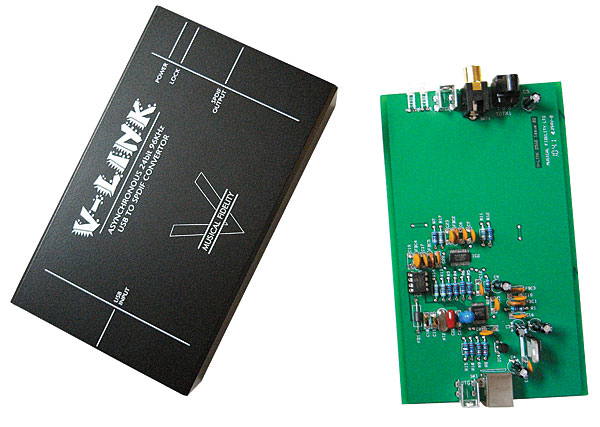
A computer is not optimized for the uninterrupted streaming of audio data. It has rapidly become established wisdom, therefore, that the optimal means of extracting audio data from a computer's USB port is to operate that port in what is called "asynchronous isochronous" mode. This lets the receiving device, such as a digital-to-analog converter (DAC), control the flow of data from the PC. In theory, asynchronous USB operation (not to be confused with the asynchronous sample-rate conversion used in some DACs) reduces jitter to unmeasurable levels, depending on the accuracy of the receiver's fixed-frequency oscillator, which is used to clock the data to the DAC. By contrast, in the alternative and almost ubiquitous USB operating mode, called "adaptive isochronous," while the sample rate of the output data, averaged over a longish period, will indeed be the specified 44.1 or 48kHz, there will be short-term fluctuations, or jitter, due to the oscillator having to change its frequency every millisecond to match the uncertain rate of data flow from the PC.
Continue Reading »
Advertisement
Advertisement
Advertisement