John Atkinson
"Plus ca change..."—The Information Superhighway
When I browse through early issues of this magazine, I envy <A HREF="http://www.stereophile.com/historical/712">J. Gordon Holt</A>. When he <A HREF="http://www.stereophile.com/asweseeit/711">founded</A> <I>Stereophile</I> in 1962, there were aspects of society that stood as solid as the Rockies overlooking his current Colorado home. Back then a magazine was a thing forever; the main means of serious communication would always be the written word; records would always be LPs...recorded in stereo; the US had a large, prosperous consumer electronics industry; computers were huge mainframes made in the USA by IBM (of course), and required air-conditioned rooms and armies of white-coated attendants; everyone watched three broadcast television networks; once a film left the neighborhood cinema, it was gone forever—or at least until it appeared on the "Late, Late, Late Show." And most importantly, people took for granted that progress in sound reproduction meant improvements in quality.
Recommended Components: Really Recommended
Audio Conflicts: Home Theater & The High-End Put-Down
Home Theaters, Music Systems, & the Live Experience
As easy as it is to communicate electronically, some things are still better done in person. At too-infrequent intervals, I visit <I>Stereophile</I>'s writers, listen to their systems, and basically get them to show'n'tell the components they're reviewing. In this way, if they describe what <I>I'm</I> hearing, I have the confidence to publish their review, even if its findings run counter to accepted wisdom.
Fashions, Fads, & Single-Ended Amplifiers
As in any community bound tightly together by shared enthusiasms, the High End is regularly swept by tides of fashion. Some of the fads prove to be based on something of value, and outlast the initial burst: loudspeaker spikes and Tiptoes, for example, or the resurgence of tube designs, or making use of high-quality passive components. Other fads, particularly if not based on good engineering, fall by the wayside. (Does anyone still use a <A HREF="http://www.stereophile.com/miscellaneous/784/index4.html">Tice Clock</A> in their system? Or suspend their cables and interconnects on little acrylic bridges?)
Conventional Wisdoms & Recommended Components
Conventional wisdom has it that the perfect sculpture is present, but hidden within the raw material. And the same conventional wisdom similarly applies to magazine editing: all it needs is careful chipping away at the extraneous material in the raw text files we receive from our authors—sometimes the barest degree of reshaping, repointing, and restructuring—and you have a finished product that both maximally communicates the writer's message and makes the anonymous artisan-editor proud of a job well done.
The Blind, the Double Blind, and the Not-So Blind
I was once in a sushi bar in Osaka; sitting next to me was a live abalone, stoically awaiting its fate. It stuck its siphon out of its shell, the waiter tapped the tip with a spoon, the siphon withdrew. Again the siphon appeared, again the waiter tapped it with a spoon, again it withdrew.
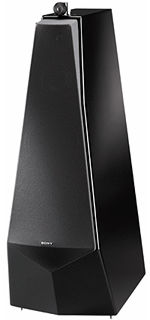
Sony ES SS-M9 loudspeaker
Conventional wisdom has it that large Japanese corporations are insular. But when it comes to audio, Sony bucks the conventional wisdom as much as it does in pretty much everything it does. In Europe, the company has long had an excellent reputation for producing loudspeakers using local design talent, so I wasn't surprised to see Sony launching a line of American-designed and -made speakers at <I>Stereophile</I>'s 1994 High-End Hi-Fi Show in Miami. <I>Stereophile</I> writer Barry Willis came away from that Show raving about the Sonys: "What we heard was gorgeous, absolutely beautiful: rich, warm, and deep, with a seductive midrange, a shimmering, delicate, grain-free top-end, and a soundstage to die for," he wrote about the sound of the three-way SS-M7 in Miami (footnote 1), 1 concluding that "WATT/Puppy performance is now available at Vandersteen prices in an American-made loudspeaker sporting a Japanese badge."
PBS, Politics, Information, & Tweaks
In this month's "Letters," Donald Bisbee raises the subject of the government's proposed reduction in funding for the Corporation for Public Broadcasting (CPB), I agree with Mr. Bisbee that commercial radio broadcasting in the US is an intellectual desert. Music is narrowcast, with listeners' tastes bound into predigested categories. There is no depth or analysis to radio news programs, other than discussions by populist commentators who, no matter what you may think of their politics, usurp the ability of their audiences to think for themselves. As a regular listener to NPR and watcher of PBS, I feel that public broadcasting is an essential factor in American public discourse (footnote 1), but not for the reasons some might think.