John Atkinson

James Boyk: All-Tube Analog
It is a widely held belief that musicians do not assess hi-fi equipment in the same way as "audiophiles." I remember the British conductor Norman Del Mar&#151;an underrated conductor if ever there was one&#151;still being perfectly satisfied in 1981 with his 78 player, never having felt the need to go to LP, let alone to stereo. And some musicians do seem oblivious to the worst that modern technology can do. I was present at the infamous Salzburg CD conference in 1982, for example, where Herbert von Karajan, following one of the most unpleasant sound demonstrations in recorded history, announced that "All else is gaslight!" compared with what we had just heard. J. Gordon Holt proposed a couple of years back ("<A HREF="http://www.stereophile.com/asweseeit/348">As We See It</A>," Vol.8 No.1) that sound is not one of the things in <I>reproduced</I> music to which musicians listen. I have also heard it said that even the highest fidelity is so far removed from live music that a musician, immersed in the real thing, regards the difference between the best and the worst reproduced sound as irrelevant to the musical message: both are off the scale of his or her personal quality meter.
Continue Reading »

Tam Henderson, Reference Recordings

As fascinating as the design of high-end hardware can be, it goes without question that without musical software (or <I>firm</I>ware, as our more computer-minded readers would have it) of an appropriately high standard, the whole business would be pointless. <I>Stereophile</I>'s interviews have therefore often featured engineers and producers whose recorded work reveals sound quality to be a major concern. I interviewed Performance Recordings' James Boyk back in Vol.9 No.6; J. Gordon Holt spoke in Vol.10 No.3 with <A HREF="http://www.stereophile.com/asweseeit/1282awsi">Doug Sax</A> and Lincoln Mayorga, of Sheffield Lab, and with Keith Johnson of Reference Recordings, about their history-making Moscow sessions; JGH also discussed Brad Miller's and Lou Dorren's Colossus digital project in Vol.10 No.1 and <A HREF="http://stereophile.com/asweseeit/the_colossus_of_audio">Vol.11 No.4</A>; while last month Dick Olsher interviewed Peter McGrath, responsible for some superb-sounding recordings for Harmonia Mundi USA as well as for his own Audiofon label.

Continue Reading »

Lindemann & Stello USB-S/PDIF converters

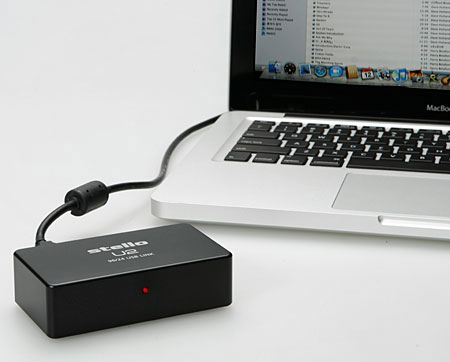
As someone who wrestled endlessly with the nine-pin serial ports and the RS-232 protocol with which early PCs came fitted (footnote 1), I welcomed the Universal Serial Bus (USB) interface when I first encountered it a decade ago, on the original Apple iMac. Plug it in. Don't worry. Be happy. The computer peripherals work as they should, which was often not the case with RS-232. It was a given, therefore, that the then-new USB port would be seen as a natural means of exporting audio data from a PC (footnote 2), but the first generation of USB-connected audio devices offered disappointing performance.
Continue Reading »

Mutton in Wolf's Clothing

I was visiting a high-end audio manufacturer several years back, and as the chief engineer and I talked about speaker design, the company's president popped her head around the door and told him that she was sending MacroVision their annual five-figure check.
Continue Reading »

Regardez—pas des câbles avec Micromega's Airstream

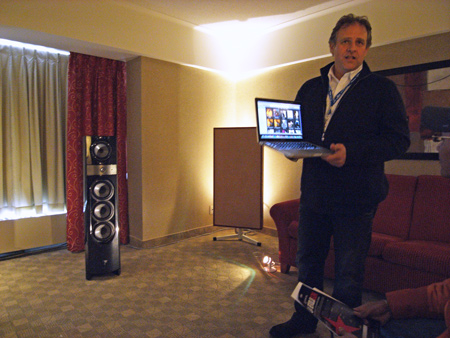
I had been impressed by Micromega's Airstream, the WiFi-connected DAC ($1595), when Jason Serinus and I heard it at <A HREF="http://blog.stereophile.com/axpona2010/micromega-focal-pathos-crystal/"…; at the beginning of March. But it was the French company's new owner, Didier Hamid, who caught showgoers' attention with the Airstream at SSI. Holding his MacBook Pro in his hand and playing songs from iTunes, Hamid dramatically demonstrated the benefits of doing away with wires. (The rest of the system included <A HREF="http://blog.stereophile.com/ssi2010/focals_daniel_jacques/">Focal 1038Be speakers</A> driven by Micromega amplification; control of volume was provided by the iTunes level control on the laptop.)

Continue Reading »

Son-or-Filtronique

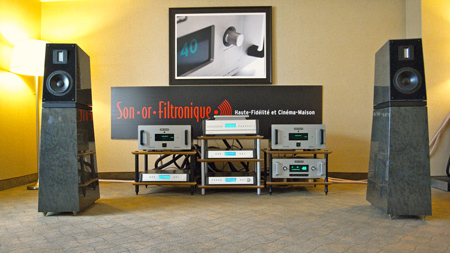
Son-or-Filtronique was celebrating its 41st year of being in business at SSI and the retailer's larger room featured Verity Sarasto Mk.2 speakers driven by Audio Research Reference 210 tube monoblocks&#151;love those green power meters&#151;and the relatively new Audio Research Reference Five preamplifier. Source was the fully-loaded, four-box dCS Scarlatti SACD/CD player that <A HREF="http://www.stereophile.com/hirezplayers/dcs_scarlatti_sacdcd_playback_s… Fremer reviewed last August</A>. (My apologies S-or-F, but I didn't note the cables being used.) This was the last room I visited at SSI and all my notes said was "Wow!" So that's all I have to say here.

Continue Reading »

Bauer-Ayre-Sonus Faber

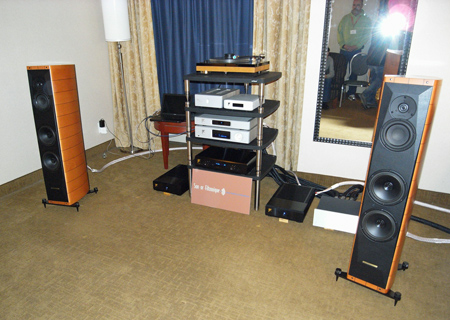
The smaller room operated by Montreal retailer Son-or-Filtronique was a little on the small side for the bass perfomance of the Sonus Faber speakers, driven by a pair of Ayre's mighty MX-R monoblocks, the midrange and highs were sweet and musical -sounding, whether the source was the MacBook seen in the photo driving the Ayre QB-9 USB DAC or the acrylic-plattered Bauer dps turntable that Art Dudley favorably reviewed in the Show (April) issue of <I>Stereophile</I>.

Continue Reading »

Monitor Audio's RX8

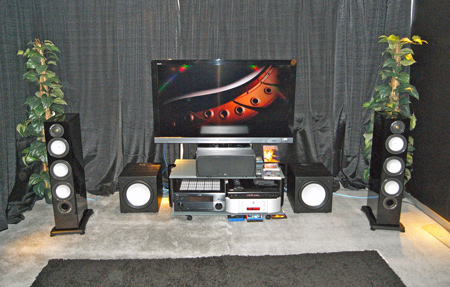
The affordable Monitor Audio Silver RS6 has been a long-term recommended loudspeaker at this magazine since <A HREF="http://stereophile.com/floorloudspeakers/306monitor/">Bob Reina reviewed it</A> in March 2006. The English manufacturer recently replaced its "S" series with "X" models, which feature revised drive-units, better internal bracing, and lacquer finishes. The benefits of the changes are said to be better low-frequency definition and deeper bass extension. Being demmed at SSI was not the replacement for the RS6 but the larger Silver RX8 ($1750/pair in standard finsih, $2000/pair in black or white gloss). With the RX8s driven by a Simaudio Supernova CD player and a Yamaha RXZ-7 receiver, Dave Brubeck's classic "Take Five" did indeed sound fine, with a soundstage that floated free of the speakers themselves and weighty but well-defined lows.

Continue Reading »

Wadia Say?

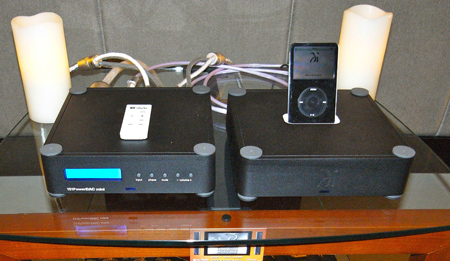
Although it was introduced at the January CES, SSI was my first opportunity to hear Wadia's cute 151PowerDAC mini amplifier ($1200). It combines a DAC, digital preamp and 25 Wpc power amp, and is housed in the same tiny package as Wadia's iTransport shown to its right. The PowerDAC was being used to drive ProAc's new floorstanding Studio 140 Mk..II speakers in the M-HiFi room at SSI, with XLO cables.

Continue Reading »

The dCS Debussy

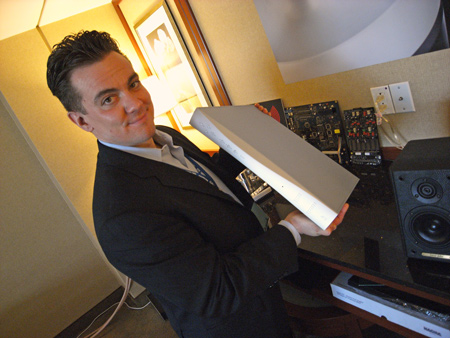
I was immensely impressed by the dCS Puccini SACD player and U-Clock when I reviewed the British combination <A HREF="http://www.stereophile.com/hirezplayers/dcs_puccini_sacd_playback_syste… December</A>. But as the physical discs becomes a legacy source of music, there was obviously a need for a related D/A product. SSI saw the public debut of the dCS Debussy ($10,999 with remote), shown off here by Tempo Marketing's John Quick. The Debussy basically combines the D/A, DSP, and analog board from the Puccini with the true asynchronous USB input topology from the U-Clock in a slim, attractive package. There are two AES/EBU and two S/PDIF inputs, as well as USB, and there is also a word-clock input to allow the Debussy to be controlled by an external master clock unit. Two digital filters are included, one a conventional symmetrical type, the other a variant of the increasingly popular minimum-phase "apodizing" type.

Continue Reading »
Advertisement
Advertisement
Advertisement