YBA 2 preamplifier
<I>A truly great preamplifier lets everything through, both music and distortion, but with such generosity that neither...is cramped and narrow.</I>—<B>Larry Archibald</B> (footnote 1)


<I>A truly great preamplifier lets everything through, both music and distortion, but with such generosity that neither...is cramped and narrow.</I>—<B>Larry Archibald</B> (footnote 1)
<I>A truly great preamplifier lets everything through, both music and distortion, but with such generosity that neither...is cramped and narrow.</I>—<B>Larry Archibald</B>(footnote 1)

I must admit, right from the outset, that I find reviewing electronic components harder than reviewing loudspeakers; the faults are less immediately obvious. No preamplifier, for example, suffers from the frequency-response problems endemic to even good loudspeakers. And power amplifiers? If you were to believe the older generation of engineers—which includes some quite young people!—then we reached a plateau of perfection in amplifier design some time after the Scopes Monkey Trial but well before embarking on the rich and exciting lifestyles afforded us by Reaganomics. (In the UK, it is generally felt by these people that the date coincided with the introduction of Quad's first current-dumping amplifier, the 405, in 1976.)
Following my reports on 13 mainly inexpensive loudspeakers that have appeared in the last four issues of <I>Stereophile</I>, I thought I would give myself a treat this month by reviewing the latest incarnations of a model that has stood the test of time: the two-way Celestion SL600Si...This is a carefully tuned infinite-baffle design, sacrificing ultimate extension for upper-bass and lower-midrange quality. Its crossover is conventionally British in that it puts flatness of on-axis amplitude response ahead of time coherence, while everything about it, from drive-units to the cabinet itself, is flagrantly "high-tech."
When some unknown copywriter coined that immortal phrase to promote the worldwide launch of Compact Disc in late 1982, little did he or she foresee how quickly it would become a term of ridicule. Yes, early CDs and players offered low background noise, a flat spectral balance, and freedom from wow and flutter. But all too often, the music encoded in the "perfect-sounding" pits seemed to have taken a vacation, leading the renowned recording engineer John Eargle to offer, in the medium's defense, that if you were to hear just one CD that sounded good, digital technology would be proved to be okay.
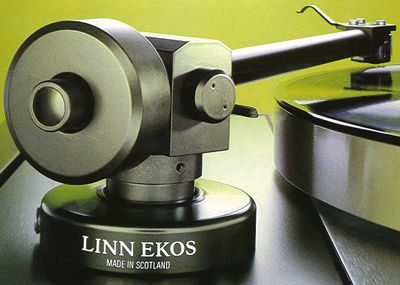
"Tonearm?" muttered John Crabbe, my erstwhile editor at <I>Hi-Fi News & Record Review</I>, as he bent over my shoulder some 12 years ago to see what I was writing about. "A <I>tone</I>arm belongs on an acoustic gramophone—you should use the term 'pickup arm,' which doesn't suggest that the arm has a sound of its own."

Back in the spring of 1990, <I>Stereophile</I> introduced its first <A HREF="http://www.stereophile.com//reference/176/">Test CD</A>, featuring a mixture of test signals and musical tracks recorded by the magazine's editors and writers. Even as we were working on that first disc, however, we had plans to produce a second disc which would expand on the usefulness of the first and feature a more varied selection of music. The result was our <A HREF="http://www.stereophile.com//features/338/">Test CD 2</A>, released in May 1992.