John Atkinson

Major Changes for YG Acoustics
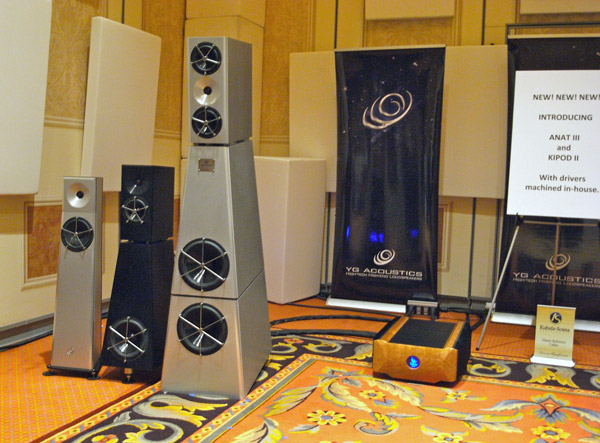
If you look closely at the easel to the right of the photo of the YG room at the Sands/Venetian Convention Center, you can see the text "with drivers machined in-house." Usually, this means that the manufacturer has machined the baskets and polepieces, but in the case of YG, they are also talking about the cones!

Called "BilletCore" by the Colorado company, the aluminum cone for the midrange and low-frequency drive-units used in the top-of-the-line Anat III Reference ($111,000/system) and the smaller three-way Kipod is milled from a solid block of aluminum. In the case of the Anat subwoofer, the starting point is a billet of aluminum 2.5" thick weighing 16 lbs, compared with the finished cone after a day of work, which is 0.008" thick and weighs less than 1 ounce. Stiffening ribs are left on the rear of the cone and the final step is to black-anodize the aluminum. The benefit of machining the cone is said to be improved unit-unit consistency and rigidity compared with a conventional spun, cast, or pressed metal diaphragm, which pushes break-up modes even farther out-of-band.

Though YG was in the same room as in previous CESes, they had taken heroic measures this year to tame its acoustics, as can be seen from the photo. The result was worth the effort. In a system that included dCS Scarlatti digital front-end, a Veloce battery-powered preamp, Tenor 350M monoblocks, and Kubala-Sosna Master Reference cables, the Anat II Reference produced a warm, detailed, full-range sound. Particularly impressive was a version of Sting's "Roxanne" from Italian singer Petra Magoni of Musica Nuda. Both the voice and the solo double bass accompaniment had a palpable presence but without sounding forced or exaggerated.

Continue Reading »

Trenner & Friedl Duke

"$175,000/pair?" I gulped. I know my beat at the 2011 CES was expensive loudspeakers, but the price of the Trenner & Friedl Duke took my breath away. Yes, the sound in the large room the new Austrian company shared with Cardas, Profundo, and the Jeff Rowland Design Group was superb, but that's a lot of change, even if the manufacturer will fly anywhere in the world to set the speakers up in the customer's home. (The rest of the system comprised a dCS Puccini used as a transport to feed JRDG's new Aeris DAC (the Colorado company's first digital product), $9800; a JRDG Criterion line stage, $18,500; and two JRDG 625 stereo power amplifiers, $13,500; with Cardas Clear cabling.

Each 12" woofer uses a fiber-glass–reinforced paper cone and is loaded by what is referred to as "a hybrid form of horn-resonator and bass reflex design." The mid/HF module is coupled to the woofer modules with spheres of varying hardness, to drain vibrations optimally, and can be adjusted to bring the drivers into proper time alignment at the listening position. The midrange unit features a papyrus cone with an elmwood phase plug and an alnico magnet, while the enclosure is filled with wool from "locally raised sheep" to reduce internal reflections being retransmitted through the drive-unit cone. The tweeter uses a titanium nitride dome loaded with a Tractrix-flare horn, while the supertweeter is a diamond-diaphragm type. The upper-range crossover is passive; the woofers are fed via a line-level crossover, and internal wiring is all Cardas Clear.

Continue Reading »

Ray Kimber Keynotes for Perfect Eight

I first encountered the glass-enclosured Force dipole loudspeaker from Perfect Eight, which combines a full-length ribbon with 8 cone midrange units and a subwoofer handling the load below 60Hz, at the 2008 CES. Their 2011 dem, with the speakers driven by Ypsilon amplification, was noteworthy for having invited Ray Kimber to talk about and play some of his IsoMike recordings. (Ray is seen here on the left in my admittedly rather grainy photo—it was dark—with Perfect Eight's Jons Rantila.) I listened first to soloists from the Academy of St. Martin-in-the Fields performing a movement from the Mendelssohn Octet, then to a Mozart piano sonata movement by Robert Silverman (the latter one of my "Records to Die For" in the February 2011 issue). Despite my skepticism about glass as an enclosure material, the sound was natural and uncolored.
Continue Reading »

TAD Speakers Sing

TAD didn't appear to be demonstrating anything new in their large penthouse suite at the Venetian, but designer Andrew Jones was getting such an enormously involving sound from the Compact Reference CR-1 stand-mounts ($37,500/pair plus $1800/pair for stands) that I had to stop to take an extended listen. Jones had some of HDTracks' new 24/192 files that he was playing with Amarra and one track, featuring Hammond organ, double bass and drums, had the audience stumped. (The fellow in front of me even held up his iPhone and ran a song ID app, only for the screen to flash "No Match.") Then I twigged: it was a jazz arrangement of Pink Floyd's "Money," with sound to die for. DAC, preamp, and power amps were also from TAD.
Continue Reading »

Estelon Speakers from Estonia

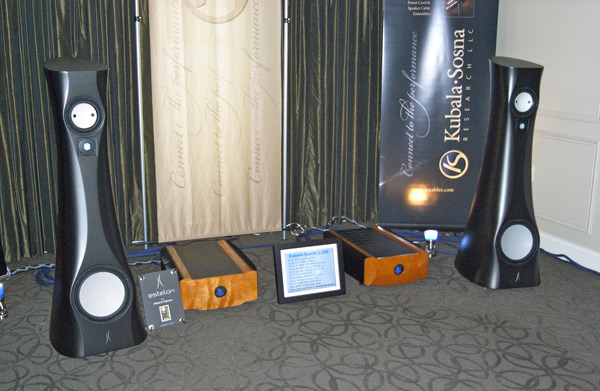
The Estelon speakers from Alfred & Partners ($43,900/pair) were one of the hits of last year's RMAF, so I made a point of taking a listen to them at CES. The ceramic-diaphragm floor-standers were being used in more than one room—Conrad-Johnson was also using them, in their first "live" Show dem in two decades—but I was drawn into the Kubala-Sosna room by the sound of Jimi Hendrix playing "Born Under a Bad Sign." Source was a Korg DSDx2 recorder, which Joe Kubala had used to record the track from LP, and the sound, with Audio Research Reference 5 preamp, Tenor 350M monoblocks, and Kubala-Sosna Excitation cables, was rich, full-range, and clean. The speakers are internally wired with K-S cable.
Continue Reading »

Vienna Acoustics The Kiss

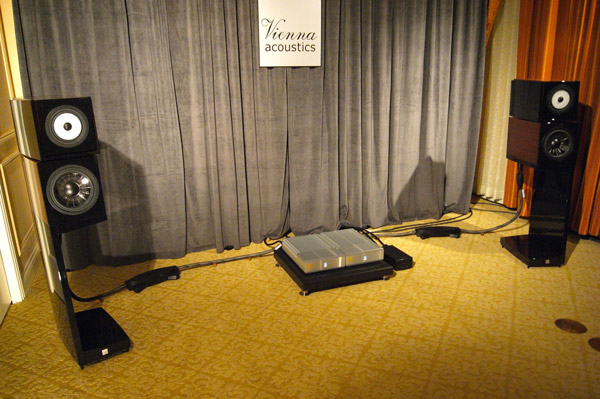
Austrian Vienna Acoustics set up its own distribution company in the US in 2010 and when I popped my head in the door of their suite at the Venetian, I saw they were demming the Kiss speaker ($16,000/pair) reviewed a year back by Wes Phillips. (The rest of the system comprised Ayre KX-R preamp, MX-R monoblocks, and DX-5 "universal audio engine, with Transparent cabling.)

The Kiss looks like a stand-mount but it is really a floorstander with an integral stand. The sound in this room really flattered piano, whether it was a 24/96 file of a jazz trio featuring a Fazioli instrument, or Glenn Gould's 1981 reading of the Bach Goldberg Variations, remastered from the analog backup tapes.

Continue Reading »

Rosso Fiorentino Siena

Pride of place in the Avatar Acoustics room at the Venetian went to the four-way Siena speakers ($24,995/pair) from Italian manufacturer Rosso Fiorentino. The designer teaches electroacoustics in Florence, but is a graduate from the University of Salford in the UK. A pair of aluminum-cone 8" woofers in a separate sealed enclosure are combined with a 6.5" paper-cone midrange unit (a ScanSpeak Revelator), a 1" silk-dome tweeter, and what appeared to be a Murata "ultrasonic generator," to give a specified response of 35Hz–100kHz, –3dB.

The Siennas were demmed in a system comprising Dr. Feikert turntable and tonearm, Abbingdon Music Research CD player, phono preamp, and integrated amplifier, with Acoustic System racks and cables, but I will hand over to Jason Serinus for some additional thoughts:

Continue Reading »

Volent Paragon VL-2

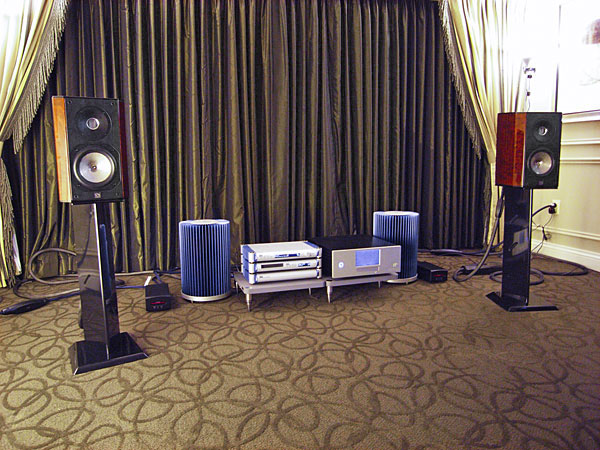
The Paragon VL-2 Signature ($8600/pair) from Hong Kong-based Volent Corp. combines a unique dual-ribbon tweeter with a titanium/graphite-sandwich–coned woofer in an attractively curved enclosure filled with wool. Frequency range is specified as 30Hz–60kHz, impedance as 4 ohms, and sensitivity as 88dB/2.83V/m. Driven by MSB's M202 tower amplifiers and MSB digital source, the sound was much larger than I was expecting from these stand-mounts.
Continue Reading »

Zu Goes Its Own Way

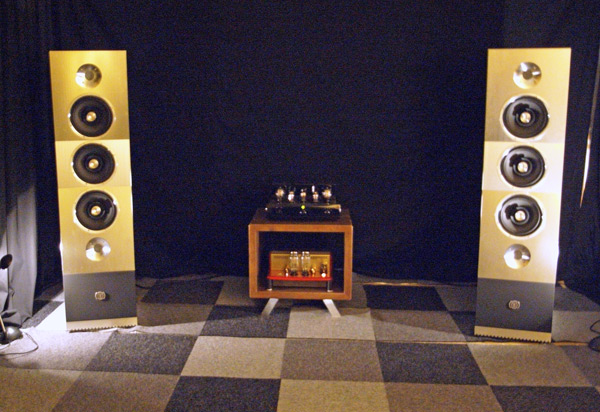
Utah-based Zu Audio does indeed goes its own way, with retro, almost-full-range pulp-cone drive-units used in high-sensitivity designs. (See Art Dudley's review of the $4000/pair Essence in the October 2009 Stereophile. All of Zu's speakers have been moderately priced, so I was not expecting to see and hear a design costing $40,000/pair when I went into the Zu room at T.H.E. Show.

The Dominance uses three 10" paper-cone drivers, each with a whizzer cone, to cover the range from 27Hz to 12kHz. Each is in its own sub-enclosure featuring Zu's proprietary ZuRG loading (See AD's review) with the outer two tuned identically and the central drive-unit adjusted to give a bit more upper-midrange energy. There is also a downward-firing 15" subwoofer, covering the octave below 27Hz, and completing the line-up are two horn-loaded ring-radiator tweeters operating above 12kHz. Unusually, these are placed at the top and bottom of the Dominance.

For the dem, the subwoofer was powered by a Pass Labs XA30.5 but the main drive-units were driven by a 1.5Wpc Yamamoto SET amp. Yup, just 1.5W, but the Dominances still managed to fill the room with sound. Lows were tight and extended; imaging was tangible; jump factor was startling; but I couldn't get away from a touch of character in the mid-treble imparted by those whizzer cones.

Continue Reading »
Advertisement
Advertisement
Advertisement