John Atkinson

When Things Go Wrong...

Michael Fremer's review of the AudioPhysic Caldera III loudspeaker in this issue (p.81) reminded me of a subject I have written about many times in the past: what happens when a manufacturer submits a faulty sample for review. I formalized Stereophile's policy on this matter in late 1988, following both an unfortunate series of reviews in which the samples either arrived broken or broke during the auditioning, and my learning about how much went on behind closed doors at other audio magazines, where reviewers and editors too often appeared to collude with manufacturers.1 I wrote back then that:
Continue Reading »

Under Pressure: Loudspeakers at Altitude

"The large peak at 16kHz reported by <I>Stereophile</I>...was nowhere in evidence...The most probable explanation of this discrepancy is that the [Waveform supertweeter's] very light ribbon depends on the air load for damping, and that load is much smaller in the thin air up there at 7000' in Santa Fe than at altitudes where less lightheaded and scientifically more accountable reviewers dwell." Thus spake Peter Aczel (footnote 1), erstwhile loudspeaker designer and Editor/Publisher of the reincarnated <I>The Audio Critic</I>, a publication that advertises itself as having "unusual credibility among the top professionals in audio."

Continue Reading »

2006 Stereophile Buyer's Guide

The 2006 edition of the <I>Stereophile Buyer's Guide</I> is out now. Listing the specifications of more than 5000 audio components within its 212 large-format pages, the <I>Buyer's Guide</I> is exclusively concerned with products for <I>music</I> reproduction, as opposed to the bangs, bonks, and battle noises typical of movie soundtracks.

Continue Reading »

Boston Acoustics Lynnfield 300L Series II loudspeaker

Loudspeaker manufacturer Boston Acoustics made its name&mdash;and its fortune&mdash;building high-performance but low-cost speakers. Indeed, I recently set up a modest system for my mother-in-law that was based on Boston's classic A-40&mdash;a two-way design that sold for just $160/pair back in 1986&mdash;and was very pleasantly surprised at the quality these little speakers offered. Back in the early '90s, however, the Massachusetts-based company announced that they were taking a step into the High End with a new loudspeaker line, the Lynnfields (see Thomas J. Norton's interview with Boston's Andy Kotsatos elsewhere in this issue). These were designed by expatriate British engineer Phil Jones, previously responsible for the impressive Acoustic Energy speakers.

Continue Reading »

Shahinian Diapason loudspeaker system

Richard Shahinian has been offering loudspeakers to music lovers for more than 15 years. I use the word "offering" here in its strictest sense, because Dick has never "sold" his products&mdash;by pushing them. Indeed, he is probably one of the worst self-promoters in the business. If we think of "soft sell" in the usual context of laid-back and low-pressure, then Shahinian's approach would have to be called "mushy sell."

Continue Reading »

Tony Federici

Back in the spring of 1986, I was visiting a hi-fi show in Lucerne, Switzerland. In the KEF/McIntosh/Perreaux room, I was engaged by a voluble American, who wanted to talk about the changes I was making with the English magazine <I>Hi-Fi News</I>. The conversation shifted to the hotel bar, then to a restaurant. The American was one Tony Federici, who at that time was distributing Perreaux gear in the US. With an education in the philosophy of science, Tony's comments were insightful and challenging. He was never at a loss for an opinion! After I moved to the US to take the <A HREF="http://www.stereophile.com/asweseeit/352">editorial reins at <I>Stereophile</I></A>, Tony stayed in touch, and many were the conversations we had about audio magazines, the audio business, and music.

Continue Reading »

DVD-A vs SACD

"This is offensive!" muttered usually mild-mannered Malcolm Hawksford, who was sitting next to me. "I'm leaving." The good professor was right. One thousand or so attendees at the 103rd Audio Engineering Society Convention, held at the end of September in New York, were being subjected to truly terrible sound. The irony was that the sound was that of 2- and 5-channel recordings made with 24-bit resolution and a 96kHz sampling rate, being played over a colored PA system to demonstrate the future of audio, in the form of DVD-Audio.

Continue Reading »

RadioShack Optimus Pro LX5 loudspeaker

It was a classic American tale: hearing that the head honcho of RadioShack was in town, the principals of Oregon-based high-end loudspeaker manufacturer Linaeum found out where he was staying and called him to see if RadioShack would be interested in marketing their speakers. They were rewarded for their daring by being given an introduction to the right RadioShack department head, and before you could say time-coherent, a deal was struck for RadioShack to manufacture a new line of three "audiophile" loudspeakers featuring a version of the unique Linaeum tweeter. The less-expensive Optimus Pro X77 and LX4 models use a baffle-mounted tweeter that radiates just to the front; the top-of-the-line Optimus Pro LX5 reviewed here mounts a bi-directional tweeter on the top of a diecast aluminum enclosure.

Continue Reading »

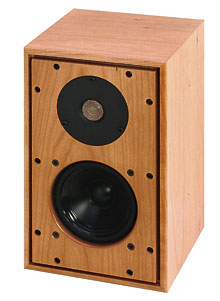
Harbeth HL-P3 loudspeaker

Back in the early 1970s, the BBC needed a physically unobtrusive, nearfield monitor loudspeaker for use in outside-broadcast trucks. Accordingly, they instructed their design department, which at that time featured such luminaries as Dudley Harwood (the "father" of the polypropylene cone, who went on to found Harbeth) and the late Spencer Hughes (the "father" of the Bextrene cone, who went on to found Spendor), to produce such a model. Thus, not only was what was then probably the finest collection of British speaker-design talent involved in its development, there were no commercial constraints placed on the design. The only limitations were intended to be those arising from the necessarily small enclosure and the absence of the need for a wide dynamic range under close monitoring conditions.

Continue Reading »
Advertisement
Advertisement
Advertisement