John Atkinson

High-end audio-industry veterans have new jobs

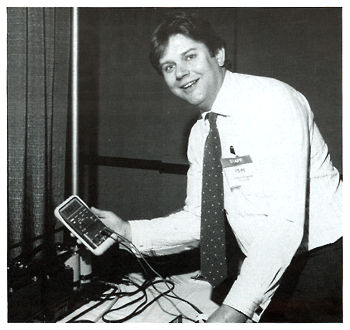
As of October, Meridian America's new VP/Sales, replacing the late Ross Keim, was industry veteran Andy Regan, who started his high-end career at Manhattan retailer Sound by Singer. Most recently, Regan was VP/Sales at cable manufacturer AudioQuest. Not uncoincidentally, Joe Abrams has moved from cable manufacturer MIT to AudioQuest.

Continue Reading »

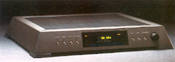
Mark Levinson No.380S preamplifier

"Comping," they call it at Madrigal. Once a circuit and its board layout have been finalized, passive components are substituted one by one in an exhaustive series of listening tests to determine the places where use of a premium part, or one of closer tolerances, results in an audible benefit. This fine-tuning process cannot be open-ended, however, as products do have to shipped. So what happens when new parts become available, or new manufacturing processes allow a better-sounding part to be used without financial penalty?

Continue Reading »

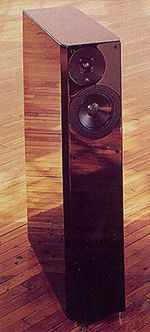
Paradigm Reference Active/20 loudspeaker

There are many benefits accruing to a loudspeaker when its designer goes the active or powered route. The usual losses and distortions associated with passive crossovers can be circumvented, while the fact that the amplifiers and drive-units can be designed as a package enables the designer to squeeze more performance from each than would otherwise be the case. And the savings gained from the absence of a separate amplifier chassis can be passed on to the consumer.

Continue Reading »

Paul Barton: It Doesn't Get Much Better Than That

Canadian loudspeaker company <A HREF="http://www.psbspeakers.com">PSB International</A> celebrated both its 25th anniversary in July and the 10th anniversary of the introduction of its Stratus series. (I review the latest version of the flagship Stratus speaker, the Gold <I>i</I>, elsewhere in this issue.) Started by Paul Barton and two friends in the summer of 1972, PSB Speakers was named after Paul and his high-school sweetheart Sue (now his wife). Paul & Sue Barton Speakers is now part of Lenbrook Industries, which distributes NAD, Marantz, and Bang & Olufsen in Canada, and which in turn is part of the Canadian conglomerate Lenbrook Inc.

Continue Reading »

dCS Elgar D/A processor

Things are changing rapidly in the world of professional digital audio. After a decade of stability, with slow but steady improvement in the quality of 16-bit, 44.1kHz audio, the cry among audio engineers is now "24/96!"&mdash;meaning 24-bit data sampled at 96kHz. Not coincidentally, DVD offers audiophiles a medium with the potential for playing back music encoded at this new mastering standard.

Continue Reading »

Blind Listening

<B>John Atkinson sets the stage</B><BR> Nothing seems to polarize people as much as the vexed question concerning the importance of audible differences between amplifiers. If you think there <I>are</I> subjective differences, you're an audiophile; if you don't, you're not. And as any glance at an appropriate issue of <I>Consumer Reports</I>&mdash;<I>the</I> publication for non-audiophiles&mdash;will confirm, the established wisdom is that once the price of an amplifier or receiver crosses a certain threshold, any further improvement in sound quality becomes irrelevant, in that it puts the price up for no apparent gain. In other words, when it comes to amplification, there is such a thing as being "too" good. Yet, as a reader of this magazine, I would expect that not only have you been exposed to real subjective quality differences between amplifiers that <I>Consumer Reports</I> would regard as sounding identical, you have made purchasing decisions made on the basis of hearing such differences.

Continue Reading »

Wired!!!

Compuserve's CEAUDIO forum has been buzzing in recent weeks about audio cables. The subject even spilled over into an April meeting of the New York chapter of the Audio Engineering Society (see Wes Phillips's report in this month's "Industry Update"). Nearly two decades after Polk, Fulton, and Monster Cable raised our collective consciousness about the differences cable choice can make in an audio system, the debate still rages between audiophiles and some members of the engineering community. "High-priced tone controls" is how some engineers dismiss the subject of cables, while admitting that they <I>can</I> sound different. Other engineers adopt the "Hard Objectivist" line that if there are differences to be heard between cables, differences in the lumped electrical parameters of resistance (R), inductance (L), and capacitance (C) are all that are required to explain such differences.

Continue Reading »
Advertisement
Advertisement
Advertisement