John Atkinson

Parasound Halo JC 2 line preamplifier
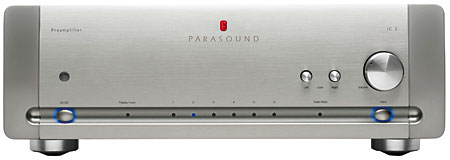
My very first review of a preamplifier, for British magazine <I>Hi-Fi News & Record Review</I> in May 1984, was of the Audio Research SP-10. In my opening to that review, I wrote that, "more than any other component," a preamplifier "should approximate to the late <A HREF="http://www.stereophile.com/news/121503walker">Peter Walker</A>'s 'Straight Wire with Gain.'" By this I meant that a preamplifier should not be in the business of effecting dramatic changes, and in any case, dramatic changes are not the kind that prove to be of lasting value. However, I also wrote back then that what I became increasingly aware of while using the SP-10 "was the fact that 'neutrality' is a positive virtue rather than just an absence of aberration."

Continue Reading »

Music Served

I'm writing these words on the flight home from the 2008 Consumer Electronics Show, held January 7–10 in Las Vegas. I wasn't sure what to expect at this year's CES. Though the official stats show that the US economy has grown for the fourth straight year, audio retailers I spoke with before the Show feel that that economic growth has not resulted in any increase in consumers' disposable incomes. In fact, with the drying up of credit, retailers are concerned that 2008 may well be a step back from 2007 in overall sales, and that high-end audio—a niche category within a niche category—will be adversely affected by the relative impoverishment of the middle class.
Continue Reading »

Celestion 100 loudspeaker

I believe <A HREF="http://www.stereophile.com/interviews/232">Ken Kantor</A> said it first: a couple of years ago, in his September 1990 interview with Robert Harley (Vol.13 No.9), he remarked that "there's no reason why a two-way 6" loudspeaker can't be the equal of almost the best speaker out there from a certain frequency point upward, with the possible exception of dynamic range." When I read those words, they rang true. If you put to one side the need to reproduce low bass frequencies and can accept less-than-live playback levels, a small speaker can be as good as the best, and allow its owner to enjoy the benefits of its size&mdash;visual appeal, ease of placement in the room, and the often excellent imaging afforded by the use of a small front baffle.

Continue Reading »

Cambridge SoundWorks Ambiance loudspeaker

According to the conventional wisdom, companies selling consumer products fall into two categories: those whose sales are "marketing-led" and those whose sales are "product-led." Marketing-led companies tend to sell mature products into a mature market where there are no real differences between competing products&mdash;soap powder, mass-market beer, or cigarettes, for example&mdash;whereas product-led companies tend to sell new technologies, such as personal computers and high-end hi-fi components. In the audio separates market, conventional wisdom would have a hard time categorizing any individual company: no matter which you choose, it would be simplistic to say that it is either product- or marketing-led. No matter how good the product, without good marketing the manufacturer stands little chance of success; a poor product superbly marketed may make a company successful overnight, but that success will have hit the end stops by the following night.

Continue Reading »

Is Ambisonics the Future of Sound Reproduction?

<B>Scene the First.</B> You are sitting in a concert hall, dead center, row M; the cellist walks on to the stage, sits down and starts to play the prelude to the first of <A HREF="http://www.stereophile.com/musicrecordings/1192yoyoma">Bach's solo cello suites</A>, that intricate unfolding of a rhapsodic melodic line within the tight framework of an implied chordal structure. Melody, harmony, rhythm&mdash;none exist at any one point of time in this most exquisite of Bach's solo instrumental writing, yet the skill of the composer, coupled with the artistry of the musician, allow you to perceive the abstract as reality.

Continue Reading »

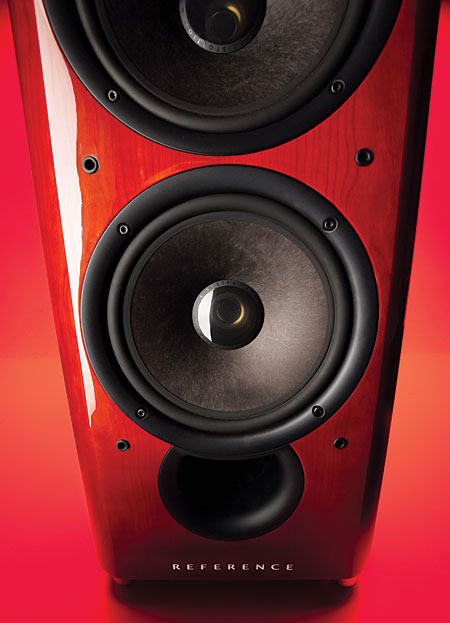
KEF Reference 207/2 loudspeaker

After reviewing a long series of minimonitors, I am now working on what may well be an equally varied selection of large floorstanding loudspeakers. This trend began with <A HREF="http://www.stereophile.com/floorloudspeakers/1207sonus">my review</A> of the Sonus Faber Cremona Elipsa in the December 2007 issue, and continues this month with the Series 2 version of the KEF Reference 207, until recently the flagship model from this English manufacturer (footnote 1). I <A HREF="http://www.stereophile.com/floorloudspeakers/775">reviewed</A&gt; the original Reference 207 in February 2003, and was very impressed by what I heard.

Continue Reading »

Is It Real? Or Is It...

Enid Lumley accosted me in the corridors of Santa Monica's BayView Plaza Hotel in March: "That doesn't sound like a real piano!" I was taken aback. The sound to which the redoubtable Ms. Lumley was referring emanated from a 7' Steinway we had hired for <A HREF="http://www.performancerecordings.com/">James Boyk</A> to play at the <I>Stereophile</I> show. Jim was conducting a series of tutorials on how the sound of a real piano is constituted, so Enid's criticism, on the face of things, seemed absurd. As my face obviously showed this conclusion, she hastily explained that, of course it <I>was</I> a real piano, but the fact that it overloaded the 40-seat room in which it was being played caused it to sound different from the sound of a real piano played in a concert hall. To lead visitors to the show to expect piano records to sound similar to what Jim was producing was dishonest.

Continue Reading »

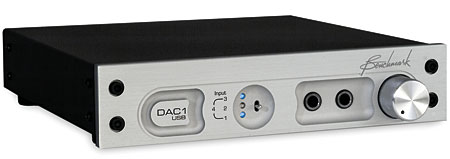
Benchmark DAC1 USB D/A processor & headphone amplifier

In his July 2003 "The Fifth Element" column, John Marks enthusiastically wrote about the Benchmark Media Systems DAC1 D/A processor and headphone amplifier. Comparing its sound playing CDs with that of a three-times-more-expensive Marantz SA-14 SACD player, he concluded that the DAC 1's "Red Book" performance was at least as good as that of the Marantz, being "slightly more articulate in the musical line, and slightly more detailed in spatial nuances, particularly the localization of individual images in space, and in soundstage depth."
Continue Reading »
Advertisement
Advertisement
Advertisement