John Atkinson
Live at Otto's: a New Stereophile Jazz CD
Released in July, <I>Live at Otto's Shrunken Head</I> (STPH020-2) is the latest Stereophile CD from reviewer Bob Reina's jazz quartet, Attention Screen. Unlike the group's first CD, <A HREF="http://www.stereophile.com/musicrecordings/907att"><I>Live at Merkin Hall</I></A> (STPH018-2, released in 2007), which was recorded with multiple microphones, I captured the eight improvisations on <I>Live at Otto's</I> using a single pair of mikes.
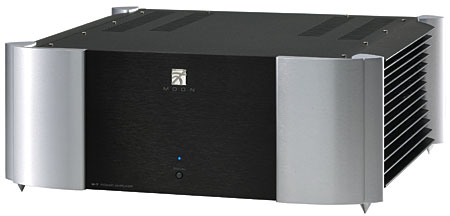
Simaudio Moon Evolution W-7 power amplifier
When I <A HREF="http://www.stereophile.com/solidpreamps/simaudio_moon_evolution_p-7_lin…; the Moon Evolution P-7 preamplifier ($6900) from Canadian manufacturer Simaudio in March 2009, I was impressed by the qualities of both the audio engineering and the sound. It was a no-brainer, therefore, to follow that report with a review of the matching power amplifier, the Moon Evolution W-7. In March 2006 Kalman Rubinson <A HREF="http://www.stereophile.com/solidpoweramps/306sim">reviewed</A> Simaudio's Moon Evolution W-8, which offered at least 250Wpc into 8 ohms (I measured 310Wpc at clipping). The W-7 looks identical to the W-8, but is 10 lbs lighter, offers 150Wpc into 8 ohms, and retails for $8900 compared with the W-8's $13,500.
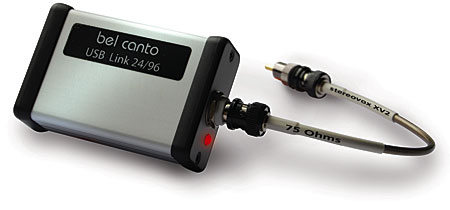
Bel Canto USB Link 24/96 USB-S/PDIF converter
What Did He Have?
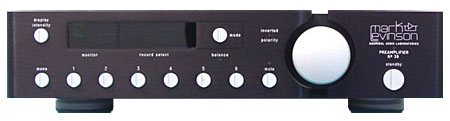
Mark Levinson No.38S preamplifier
Even as Robert Harley was writing his <I>Stereophile</I> <A HREF="http://www.stereophile.com/solidpreamps/mark_levinson_no38_preamplifier…; of the $3995 Mark Levinson No.38 remote-controlled line preamplifier (it appeared in August '94, Vol.17 No.8, p.98), Madrigal Audio Laboratories announced an upgraded, cost-no-object version, the No.38S (footnote 1). At $6495, the 'S is significantly more expensive than the junior version; although it uses the same chassis, power supply, and circuit topology, it's in all other ways a different preamplifier.
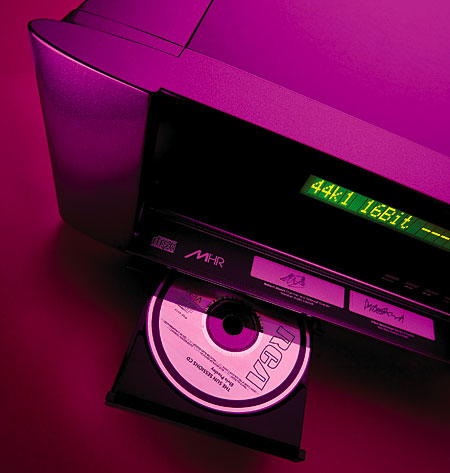
Meridian 808.2/808i.2 Signature Reference CD player/preamplifier
It's been a while since I auditioned a Meridian CD player in my system. I had enthusiastically reviewed the English company's groundbreaking <A HREF="http://www.stereophile.com/cdplayers/285meridian">Pro-MCD player</A> in early 1986, and over the years had kept up with the progress they were making in digital playback, either through my own reviews or by performing the measurements to accompany reviews by other <I>Stereophile</I> writers. The 508-24 player, <A HREF="http://www.stereophile.com/cdplayers/590">reviewed by Wes Phillips</A> in May 1998, was one of the finest digital products of the 1990s, I thought. But when Meridian began promoting surround sound and DVD-Audio at the turn of the century, their goals became somewhat incompatible with my own. Yes, I can appreciate what surround playback can do, but my own musical life is still solidly rooted in Two-Channel Land.
Anniversaries, Auditions, Advertisers
A couple months back, a question from a dealer set me back in my chair: "Are you guys <I>really</I> going to put out <I>Stereophile</I> on a monthly basis?" I was surprised—when he put the question, we were just starting production work on the issue you hold in your hands, the twelfth to hit the stands since we started publishing monthly. Beginning with Vol.10 No.5 in August 1987, a <I>Stereophile</I> has gone in the mail every month, pretty much on time despite having gone through the trauma of changing printers last December on one issue's notice.
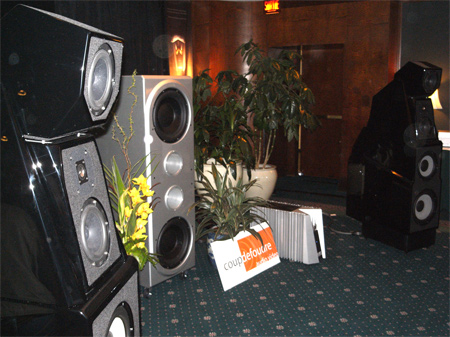
Wilsons to the MAXX
Okay, so the system in the big room from Montreal dealer Coup de Foudre was <I>very</I> expensive, and the room's acoustics I knew from the 2008 Show were excellent, but the sound was both my best at show and the best I heard in that room. Not only did Peter McGrath's high-resolution recordings, played back from his Sound Devices recorder feeding the very promising Playback Designs' D/A processor, reproduce with extraordinary dynamics and a superbly transparent window into the soundstage, my own recordings sounded the best I have experienced, with the audiophile attributes supporting/reinforcing rather than getting in the way of the music. And that was from CD!
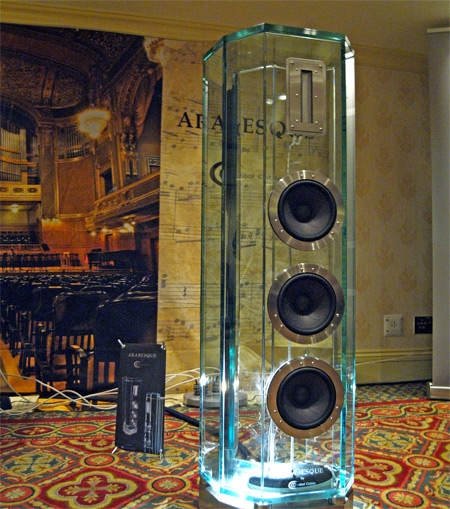
Crystal Clear
I first heard the prototypes of the almost-all-glass Arabesque from Dutch wire manufacturer Crystal Cable at the <A HREF="http://blog.stereophile.com/ces2009/see-through_transparency/">2009 CES</A>, where they produced sound in the Audio Basics room that belied my negative expectations. Demmed at SSI with Simaudio 5.3 series CD player and amplification, the Arabesques, now in full production, again produced a promising sound. With my my recording of "The Mooche," from <I>Editor's Choice</I>, the Arabesques put me squarely in the church acoustic of Chad Kassem's Blue Heaven Studio in Kansas, where the recording was made.