The High End, Mid-Fi, & Pretend High End
If there's a phrase that increasingly gets my dander up, it's "mid-fi." I'm even starting to lose patience with the term "High End."
Continue Reading »


<I>"Writing about music is like dancing about architecture."</I>—Laurie Anderson
The most important change made to the system was one that held up the writing of my review of the <A HREF="http://www.stereophile.com/solidpoweramps/991ml23">Mark Levinson No.23.5</A> power amplifier for several months, such was its anticipated impact. Though my listening room is well-equipped with wall sockets, there are actually only two 15A circuits serving these outlets. Ever since I had converted what had hitherto been our house's master bedroom into my listening room, I had intended to run new circuits to it.
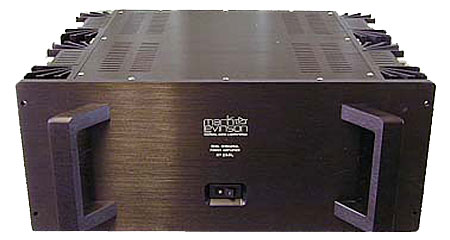
<I>"A high-quality amplifier must be capable of passing rigid laboratory measurements, meet all listening requirements, and be simple and straightforward in design in the interest of minimizing performance degradation..."</I>—Cdr. Charles W. Harrison Jr., <I>Audio</I>, January 1956 (footnote 1)
<B>John Atkinson: Making It Live</B>
<BR>
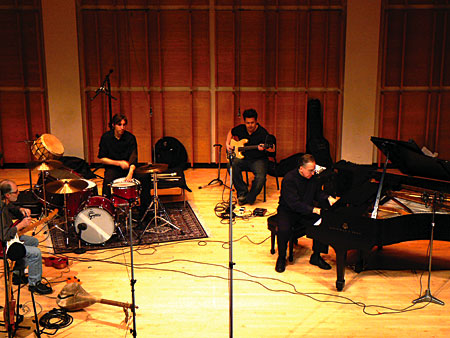
The e-mail from <I>Stereophile</I> reviewer Bob Reina was straightforward: "I want to make a demo of my new jazz group. I plan to record the session in my living room by getting my old four-channel Teac 3440 out of mothballs and sticking one or two mikes on each instrument. I'd like your view on which mikes would be most appropriate for the four instruments . . . "
<I>Stereophile</I> started publishing its "<A HREF="http://www.stereophile.com/recordingofthemonth/">Recording of the Month</A>" feature in its December 1992 issue, with the late Igor Kipnis's <A HREF="http://www.stereophile.com/recordingofthemonth/1292rotm/">rave review</A> of Keith Jarrett performing Shostakovich's 24 Preludes and Fugues.
Thirty-five years ago this month, the first issue of a <A HREF="http://www.stereophile.com/features/708">new audio magazine</A>—cover price 50 cents—cautiously made its way out of a Philadelphia suburb. Its black'n'white cover featured a chessboard adorned with tubes and XLR plugs. Its 20 advertising-free pages included a feature on <A HREF="http://www.stereophile.com/historical/108">how to write an ad</A> for an audio product, which had been penned by one Lucius Wordburger, a footnote helpfully pointing out that this was the <I>nom de plume</I> for one <A HREF="http://www.stereophile.com/historical/712">J. Gordon Holt</A>, "who wishes to remain anonymous."
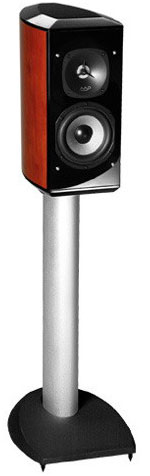
<I>Bookshelf loudspeaker</I>. The phrase may be common usage, but I really dislike describing small speakers as "bookshelf" models. Place a pair of high-performance minis on a bookshelf against the wall and you destroy much of the sound quality for which you've paid. Yet place the same speakers on good stands well away from room boundaries, and while it could be argued that their footprint is no smaller than a conventional tower speaker, with the best designs you'll get true high-end sound, particularly regarding the accuracy of midrange reproduction and the stability of stereo imaging.
"What the heck is <I>that</I> icon trying to tell me?" I had switched on Denon's new DVD-3000 player—a cute "Welcome to DVD World" message scrolled across its display—and put a disc in its drawer. The icon, which looked at best like a Japanese character and at worst like a child's drawing of a house (complete with windows), was lit up in light blue on the display. But the game was given away by the magic words "96kHz 24 bit" illuminated in red below the mysterious icon. For this was no DVD movie, but a test pressing of <A HREF="http://www.chesky.com">Chesky</A>'s new Super Audio Disc, <I>The Super Audio Collection & Professional Test Disc</I>, which makes use of the DVD-Video specification's provision for including a two-channel, linear-PCM signal encoded with a 96kHz sampling rate and a word depth of up to 24 bits. (Contrary to what you may have read in the popular press, using DVD-Video to carry high-definition sound quality does not introduce a new and incompatible standard.)