Mozart, Editing, & HI-FI '99
"Damned Mozart!"


"Damned Mozart!"
"Jonathan Scull told me there'd be trouble when I decided to put the <A HREF="http://www.stereophile.com/integratedamps/1200denon/">Denon AVR-4800</A> surround receiver on our December cover."
They say that time flies on faster wings once you pass 40, something that I have found to be more true than I care to think about. Yet even considering the unfortunately subjective nature of time, it hardly seems possible that it was 10 years ago, in those golden days of the first Conrad-Johnson preamplifier, <A HREF="http://www.stereophile.com/floorloudspeakers/579infinity">Infinity RS4.5</A> and Hill Plasmatronic loudspeakers, Infinity class-A and Audio Research D110B power amplifiers, that a small San Francisco company, led by a drummer and mechanical engineer who had previously worked on laser-fusion target design at Lawrence Livermore Laboratory, virtually invented the high-end cable industry. I say "virtually," because Jean Hiraga in France, Robert Fulton in the US, and Saboru Egawa in Japan had laid down considerable experimental work in the mid-'70s showing that interconnects and speaker cables were hardly the passive devices conventional engineering considered them, and the highly capacitative Cobra Cable, distributed in the US by Polk and in the UK by Monitor Audio, was already destroying marginally stable power amplifiers in 1977.
When Fred Kaplan made his <I>Stereophile</I> debut with his review of the <A HREF="http://www.stereophile.com/tubepoweramps/307rogue">Rogue Audio Atlas power amplifier</A> last March, our scheme was also to publish his writings on the music that fuels his soul, jazz. Starting this past weekend, you can find Fred's thoughts on recordings, concerts, musicians, and the music at <A HREF="http://blog.stereophile.com/fredkaplan/">http://blog.stereophile.com/fr…;.
Stuck out here in the <A HREF="http://www.stereophile.com/asweseeit/498awsi">desert depths of the Southwest</A>, we look forward to visits from out-of-towners. So when <A HREF="http://www.stereophile.com/interviews/478">David Wilson</A>, one-time audio reviewer but now full-time high-end manufacturer, called to say he was going to be in Santa Fe, there was a flurry of activity. David had agreed to an <A HREF="http://www.stereophile.com/interviews/690wil">interview</A>, so I started going through back issues of <I>The Absolute Sound</I> and <I>Stereophile</I> for background. Vol.6 No.2 of <I>Stereophile</I> from 1983, with its front-cover photograph of David and Sheryl Lee Wilson with their WAMM speaker system, seemed a good place to start—except that nothing inside the magazine corresponded to the cover picture. It was the <I>next</I> issue that had featured Larry Archibald's write-up on the WAMM, and once I opened its pages, I got trapped into reading the entire issue.
You would have thought the hardware companies who trumpeted at the January 2006 Consumer Electronics Show that their <A HREF="http://www.stereophile.com/asweseeit/1295awsi">video DVD players</A> would be in US retailers' showrooms by September 1996 would have learned an important lesson from the bungled DAT launch almost 10 years ago: Without first getting complete agreement of the software industry on substantive issues, it's foolish to announce a firm launch date for a new medium. September came and went without DVD discs or players being available in US stores. In fact, all that happened was that the bottom fell out of sales of 12" laserdiscs and laserdisc players.
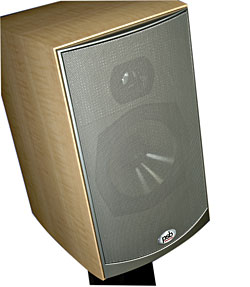
When audiophiles speak of the "Golden Age" of audio components, they almost always are talking about amplifiers and preamplifiers, not loudspeakers. While a very few speaker models have stood the test of time—among them the <A HREF="http://www.stereophile.com/standloudspeakers/361">BBC LS3/5a</A>, the <A HREF="http://www.stereophile.com/floorloudspeakers/914">Vandersteen 2</A>, the <A HREF="http://www.stereophile.com/artdudleylistening/706listening">original Quad electrostatic</A> and the <A HREF="http://www.stereophile.com/floorloudspeakers/416">Quad ESL-63</A>, some of the Magnepans, and the Klipschorn—almost no one would disagree that, taken en masse, the speakers of today outperform not just those of the 1960s and 1970s but even those of the 1980s and 1990s. The advent of low-cost, computerized test equipment, high-quality, inexpensive measuring microphones, and persuasive research into what measured parameters matter most to listeners who are listening for a neutral-sounding, uncolored loudspeaker (footnote 1), has led to an almost across-the-board improvement in speaker sound quality (footnote 2).
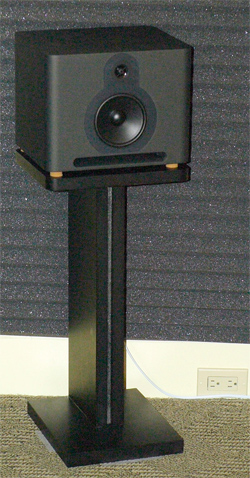
Other <I>Stereophile</I> writers, like <A HREF="http://blog.stereophile.com/he2007/051307Sjfon/">Wes Phillips</A> and <A HREF="http://blog.stereophile.com/he2007/051407sweden/">Stephen Mejias</A>, had mentioned how impressed they had been with the sound in the Sjöfn room, but what I had not appreciated until I visited the Swedish manufacturer's room towards the end of the Show was: a) how small these speakers were; b) how good the stereo imaging was despite the speakers being right up against the wall behind them; and c) how much thunderous bass was being produced by just two reflex-loaded 4" woofers! Of course, the Guru speaker ($1800/pair), photographed here by Larry Greenhill, is designed to take advantage of the low-frequency boundary reinforcement afforded by the close-to-the-corner positioning, but even so, I was surprised by the result. The speakers also sung on soprano vocals; Sjöfn is a company to watch out for, especially as the fact that the speakers must not be used out in the room makes them <I>very</I> spouse-friendly.