Jim Austin

What We Lose With Streaming

Photo by Alex Carvalho

In the August issue's As We See It, Tom Fine and I encouraged readers to hold on to their physical media—those black and silver discs—even if they're stashed away in a closet or attic, replaced by hi-rez streaming. An important reason we gave is that with physical media (in contrast to streaming), you know exactly what you're listening to—or at least you can know, with a little work.

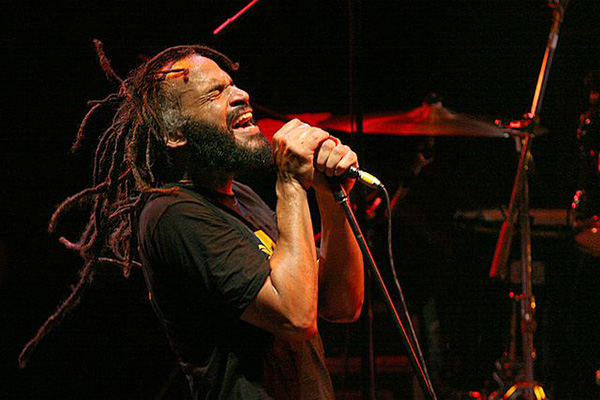
Also if you want to, you can do a lot of work, since there is much to know and to learn, especially about vinyl records (and shellacs), and learning about them—about the labels and those arcane codes in the runout groove area—is a big part of the music-collecting hobby. Serious record collectors are likely to have several pressings of favorite albums and to know the provenance of each one. With streaming, you're limited to whichever version they end up with, and usually they don't bother to tell you which version it is. An example is Rock for Light by Bad Brains, which is considered by Robert Baird in this month's Aural Robert.

Continue Reading »

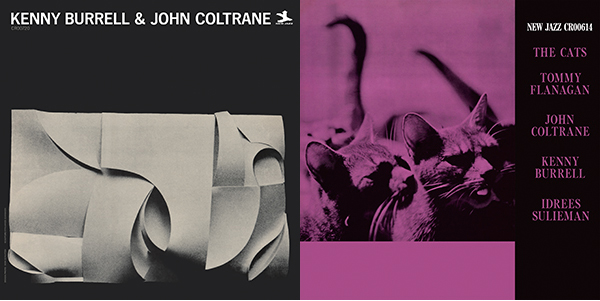
Revinylization #57: Trane meets the Motor City, 2 Reissues from OJC and Craft Recordings

Detroit became a destination for migrating African Americans early, starting with the Underground Railroad; the city's proximity to Canada was convenient for those seeking to escape Southern slavery. The mass human movement accelerated with the Great Migration, which started about 1910, when millions of African Americans left the Jim Crow South for northern cities. The same human movement that brought the blues to Chicago and jazz to New York City took both to Detroit.

In all those cities, the 1920s was a time of ballrooms and big music halls. In Detroit, "society bands" black and white played through-composed, jazz-inflected music, according to a narrative put together by Cliff Coleman and Jim Ruffner for the local jazz museum. The proliferation of orchestra chairs meant that skilled musicians familiar with a range of musical styles could find work, especially if they read music. It also meant that Detroit was ready when, in 1927, Don Redman, who had been the chief arranger for Fletcher Henderson's band, moved to the city to lead William McKinney's Cotton Pickers, the resident Black jazz orchestra at Detroit's Graystone Ballroom. The Pickers soon became an important touring band, with a national reputation. Big-name orchestras like Duke Ellington's and Fletcher Henderson's started to visit the city; on Monday nights, the national bands would "battle" local bands.

Continue Reading »

Pass Labs XP-27 phono preamplifier

One of the pleasures of reviewing—and also using—products from Pass Laboratories is an encounter with Nelson Pass's writing, which can usually be found in the owner's manual and is always competent, insightful, and sometimes funny. How often do you get real pleasure and insight from reading an owner's manual?

Pass Labs has a lot of owner's manuals online. Reading through one, I encountered the following passage; you'll find the same or similar language in other manuals and on the Pass Labs website. I present it not only because I admire it and agree with the philosophy it expresses but also because it captures the spirit of the product under review—the XP-27 phono preamplifier ($12,075 in silver)—at least as I've experienced it during an extended review period. Here it is, quoted at length with some slight adjustments to make it consistent with Stereophile's editorial style...

Continue Reading »

To Appeal to Young Audiophiles, Tell a Story

Yesterday, I had a brief conversation, by text message, with my 26-year-old son. He had just walked by the Devialet shop at the Shoppes at Columbus Circle here in Manhattan. Knowing my interest in such things, he sent me a photo. The Devialet boutique seems more a design exhibit than a shop, in a high-ceilinged open area.

The shops at the Shoppes at Columbus Circle include Hugo Boss, Eileen Fisher, and Floga, which sells furs, among less-exclusive brands, though even the less-exclusive stores look fancy. Upstairs from the Shoppes is the Mandarin Oriental New York Hotel, where rooms cost about $1k/night and up, and some notable restaurants, among them Thomas Keller's Per Se, and Masa, a three-star Michelin restaurant where dinner costs as much as a room at the Mandarin Oriental, per person.

Devialet is the only trace of the hi-fi industry not only in that mall but in that part of town. Innovative Audio, which carries Wilson, Focal, and D'Agostino, among other brands, is about a mile east, a 25-minute walk.

Continue Reading »

It Isn't Just the Music

Physical media market shares, from 1973–2024. From riaa.com/u-s-sales-database.

When the CD is gone, and it will be soon, we'll miss it. New CD releases are winding down (footnote 1). In the classical world, the era of big, bargain-priced boxes of CDs—a somewhat recent development—is ending because, after a long, slow descent, retail sales have fallen off a cliff in the past year or so. In pop and rock, if you discover a new band you like, you may or may not be able to buy a CD. Perhaps they'll self-publish a few to sell at concerts; there's a better chance they'll have LPs, assuming they can get time at a vinyl-mastering studio and a pressing plant, both of which are booked to the max. CDs, though, are an afterthought if they're even that.

Vinyl records will likely stay around indefinitely as a collector's artifact, but new CDs are fading fast. This is momentous. CD will be remembered as the last mainstream physical music format. Its passing marks the death of physical music media.

Continue Reading »

AXPONA 2024 in the Rear View

Photo: John Atkinson

If buying a hi-fi product from an internet retailer is like an arranged marriage, a hi-fi show is like speed dating. Not everyone, I realize, approaches hi-fi shows (or speed dating, for that matter) the same way, and anyway, the analogy between hi-fi and dating is far from perfect. Speed dating is how this year's AXPONA, America's biggest hi-fi show, held at the Renaissance Schaumburg Hotel & Convention Center (above) near Chicago in April, often felt to me as I moved from room to room. Every new system I heard had the potential to become a long-term relationship. Could I live with this one forever?

Continue Reading »

Audiovector R 3 Arreté loudspeaker

My first encounter with an Audiovector loudspeaker was at the 2019 Toronto Audiofest. Driven by colorful (both sonically and visually) Alluxity electronics, the R 3s sounded pure and very fine. As I sat listening to the R 3 Arretés, the R 8 Arreté, their big brother, sat quietly in the corner, seemingly pleased with the performance of its smaller sibling.

I ended up reviewing the R 8 instead of the R 3, which in retrospect hardly seems fair:It was the R3 I heard that day, the R 3 that attracted my attention and got me interested in the brand.

Continue Reading »

Beyoncé, Tracy Chapman, and Country Music

One of my coolest radio-related experiences happened just a few months ago, when, churning through FM stations in my car, I encountered a country-inflected male voice singing "Fast Car," the Tracy Chapman song. Rolling Stone dubbed "Fast Car" the 168th best song of all time. It has audiophile cred because its simple sonics (predominantly voice and acoustic guitar) and good engineering made it an important test track, used, eg, by Harman for listening tests and by others for assessing compression artifacts in MP3s.
Continue Reading »
Advertisement
Advertisement
Advertisement