As We See It

Sort By: Post DateTitle Publish Date

A Babel, a Babble . . .

Twice a year, Stereophile brings some of its writers out to Santa Fe, New Mexico, to discuss the compilation of the magazine's "Recommended Components" listing, the most recent of which appeared in the October issue. Following a comment from Will Hammond, John Atkinson's collaborator on the recent">http://www.stereophile.com//features/113/">recent amplifier blind listening tests, that the magazine's readers would love to eavesdrop on the conversations that take place on these occasions, it seemed a good idea to tape (footnote 1) some of the discussions and publish the transcript as this month's "As We See It" (footnote 2). Accordingly, Lewis Lipnick, Gary A. Galo, Robert Harley, Thomas J. Norton, Guy Lemcoe, Richard Lehnert, Dick Olsher, Peter Mitchell, Robert Deutsch, J. Gordon Holt, Larry Greenhill, John Atkinson, and Arnis Balgalvis all gathered in LA's palatial listening room one August Saturday. JA set the ball rolling by asking the assembled writers where they thought Stereophile had been, where it was, and where they thought it should be going, particularly in view of Robert Harley joining the magazine as Technical Editor.


Buy Cheap Speakers—Have Fun!

"Be like my friend Frank. He imagines that he's purchased certain products—right now he's imagining that he bought a pair of hard-to-get English speakers which he has read a review of but hasn't heard. This is ideal, since the speakers can sound better and better as Frank imagines more and more. When he tires of these speakers and gets excited about something else, he doesn't have to trade them in. He only needs to start imagining the next product." That was Sam Tellig's friend Frank, back in March of this year. No one could have said it better, but I have a followup.


A Matter of Measurements

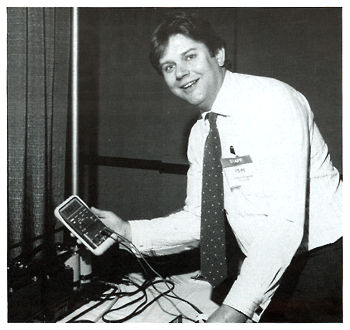
Beginning with this issue, Stereophile readers will notice that more of the subjective equipment reviews are augmented with technical reports describing certain aspects of the component's measured performance. Although test data have lately been increasingly included in reviews, Stereophile has recently made a major commitment to providing readers with relevant measurements of products under review. We have just finished building an audio test laboratory featuring the Audio Precision System One, a sophisticated, computer-based audio test measurement system.


Must We Test? Yes, We Must!

"Test We Must," cried High Fidelity's erstwhile editor, Michael Riggs, in a January 1989 leader article condemning the growth of subjective testing. (See the sidebar for Peter Mitchell's obituary of HF magazine, now effectively merged with Stereo Review.) With the exception of loudspeakers, where it is still necessary to listen, he wrote, "laboratory testing (properly done) can tell us pretty much everything we need to know about the performance of a typical piece of electronics...We know what the important characteristics are, how to measure them, and how to interpret the results."


Blind Listening

John Atkinson sets the stage
Nothing seems to polarize people as much as the vexed question concerning the importance of audible differences between amplifiers. If you think there are subjective differences, you're an audiophile; if you don't, you're not. And as any glance at an appropriate issue of Consumer Reportsthe publication for non-audiophiles—will confirm, the established wisdom is that once the price of an amplifier or receiver crosses a certain threshold, any further improvement in sound quality becomes irrelevant, in that it puts the price up for no apparent gain. In other words, when it comes to amplification, there is such a thing as being "too" good. Yet, as a reader of this magazine, I would expect that not only have you been exposed to real subjective quality differences between amplifiers that Consumer Reports would regard as sounding identical, you have made purchasing decisions made on the basis of hearing such differences.


A Matter of Dimensions

I have been reading a lot of late. Whether it is due to the reduced appeal of recorded music owing to the ever-decreasing shelves of LPs in our local specialty record store (the owner explains that he still wants to sell LPs; it's the record companies that make it increasingly harder for him to do so with punitive returns policies and deaf ears to back orders), or the fact that it's Spring, I don't know. But the fact remains that I have recently found myself devouring a shelf-full of titles sometimes only vaguely related—horrors!—to high fidelity. Stuart Chase's The Tyranny of Words, for example, first published in 1938 and a finer examination of what came to be called semantics you wouldn't want to find, should be essential reading for anyone involved in writing articles that are still intended to communicate some meaning.

The Last Word on Fidelity

Last October, in Vol.11 No.10, Stereophile's Founder and Chief Tester J">http://www.stereophile.com/interviews/66">J. Gordon Holt stated, in his acerbic editorial "The">http://www.stereophile.com/asweseeit/111">The Acoustical Standard," that, in his opinion, only recordings for which there is an original acoustic reference—ie, typically those of classical music—should be used to evaluate hi-fi components. And that in the absence of a consensus over such a policy, high-end component manufacturers were losing their way over what does and does not represent good sound quality.


A Trojan Horse in Washington

"Tax proposed to fund Public TV, radio," read the newspaper headline. The Working Group for Public Broadcasting, described as a "private study group," was proposing to free public broadcasting "from improper political and commercial influences" by replacing its $228 million in congressional appropriations and $70 million or so in corporate funding with $600 million to be raised from a new sales tax on electronic equipment. The article went on to say that the proposal was being sent to the congressional panels concerned with communications (ie, the commerce committees), where it could become the basis for a new Public Broadcasting Act.


The Chicken and the Egg

It is inarguable that the quality of magnetically recorded sound has improved immeasurably in the last 101 years. 101 years? Yes, according to a fascinating account in the May 1988 issue of the Journal of the Audio Engineering Society, it was in 1888 that the Cincinnatti-based engineer Oberlin Smith experimented with recording information on steel wire by drawing it across the corner of an electromagnet around which a coil had been wound. Smith only carried out experiments without producing a practical recording system, and it wasn't until 1898 that the Dane, Valdemar Poulsen, was granted a German patent for a "Method for the reception of news, signals, and the like."


Advertisement
Advertisement
Advertisement