Interviews

Sort By: Post DateTitle Publish Date

Bob Stuart: The Prime Meridian
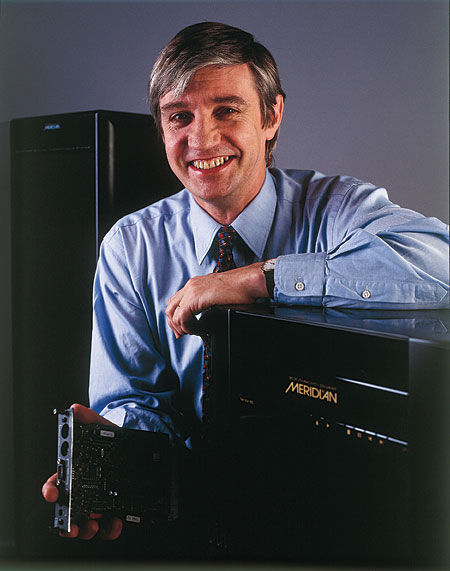
There are many colorful characters, many high-profile movers and shakers, in high-end audio, but there are only a few whose influence extends far beyond the promotion of their own brands. One of this exalted and mighty handful is Robert Stuart, chairman and technical director of the UK's Meridian Audio.

Willie Nile: Places He Has Never Been

Before I even turn on the recorder, Willie Nile is telling me his theory of how the granite under Manhattan Island conducts electricity, which accounts for the perceptible charge that many people feel makes New York City so special. It's also what draws artists like flies, none more passionate than singer-songwriter Nile, who's personally contributed a few volts during his years in NYC.


The Fifth Element #31

Firms that specialize in architectural acoustics usually concentrate on the big jobs—churches, schools, and auditoriums. Rives">http://www.rivesaudio.com">Rives Audio is unusual in that they specialize in "small-room" acoustics, for residential listening rooms and home theaters. Rives is unusual in another way: they consult on a nationwide and even international basis.


Audio Beginnings

My e-mailbox fills up with press releases announcing new products and new companies, and that always makes me wonder: Where does all this stuff come from?


I mean, I have lots of ideas—I feel like Butch Cassidy: "I have vision, and the rest of the world wears bifocals." But there's a huge gap between having a good idea and starting a company that successfully gets that idea out in front of the public. And, I suspect, there's an even greater gulf between getting a product out there and actually making a living at it.

Walter Sear's Analog Rules

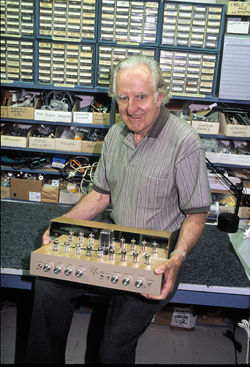
The first thing you notice about Walter Sear's legendary">http://www.searsound.com">legendary Manhattan studio is that it feels so darn comfortable. Sear Sound doesn't have a wall of gold records, gleaming million-dollar consoles, or the latest high-resolution digital workstations, but a quick stroll around the three studios reveals a treasure trove of tube and analog professional gear: a pair of Sgt. Pepper–era Studer recorders plucked from EMI's Abbey Road studios; an early Modular Moog synthesizer Sear built with Bob Moog; and a collection of 250 new and classic microphones.


A Glorious Time: AR's Edgar Villchur and Roy Allison

Editor's Note: In 1954, a New York writer and teacher reinvented the world of audio with the modest-looking Acoustic Research AR-1 loudspeaker. A small fraction of the size of the behemoths that were then de rigeur for the reproduction of bass frequencies, Edgar Villchur's loudspeaker went as low with less distortion. Perhaps more importantly, the AR-1 pioneered both the science of speaker design and the idea that a low-frequency drive-unit could not be successfully engineered without the properties of the enclosure being taken into account.


Jim Fosgate: Of (Surround) Sound Mind

Jim Fosgate fits the category of Classic American Inventor to a T. This softspoken, quietly intense man has earned 18 patents and founded three successful electronics companies. In the late 1970s, he pulled out of the car audio business to follow his quadraphonic bliss, and designed the Fosgate Tate 101, arguably the finest quad decoder of the era. He also created the best-selling matrix surround processor of all time, Dolby's Pro Logic II, and in 2003 won an Emmy for the Development of Surround Sound for Television. He now serves as a senior executive consultant for Fosgate Audionics, a division of the Rockford Corporation.


Tom Jung of DMP: Making Musical Sense

Tom Jung's career has been dotted with numbers. In 1969, he and a partner founded Sound 80, a Minneapolis recording studio named by an advertising wizard who had previously conjured up the appellation Cure 81 for a Hormel ham, supposedly while sipping Vat 69 scotch. Some years later, engineers from another Midwestern company with a numeral in its name, 3M, stopped by with an experimental tape recorder that also employed digits. Those zeros and ones proved critical to the recordings Jung went on to engineer and produce at his next company, Digital Music Products, better known as DMP.


Listening #16

Consider the fate of Giordano Bruno, a 16th-century astronomer who challenged Ptolemy's notion of Earth being the center of a finite universe—and in doing so went head to head with the church of Rome. Bruno's scholarly diligence and fearlessness were rewarded not with fame, riches, or accolades from his colleagues, but with a hot-lead enema, after which he was burned at the stake. Next heretic in line, step right up, please.


Advertisement
Advertisement
Advertisement