Stand Loudspeaker Reviews

Sort By: Post DateTitle Publish Date

B&W Nautilus 805 loudspeaker
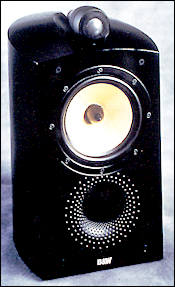
Unless you've recently returned from a five-year tour of Tibetan monasteries, the odds are pretty good you've heard about the Nautilus revision of B&W's classic three-way floorstanding monitor, the 801. Having sold 30,000 of the earlier 801, the Matrix, B&W recently revised this classic to incorporate some design features of its $40,000, four-way concept speaker, the Nautilus. Wes Phillips reviewed the new Nautilus 801 in the January 1999 Stereophile (p.107) and found it "incredibly dynamic, images and soundstages like crazy, and has that special magic that marks it as one of the great loudspeakers."
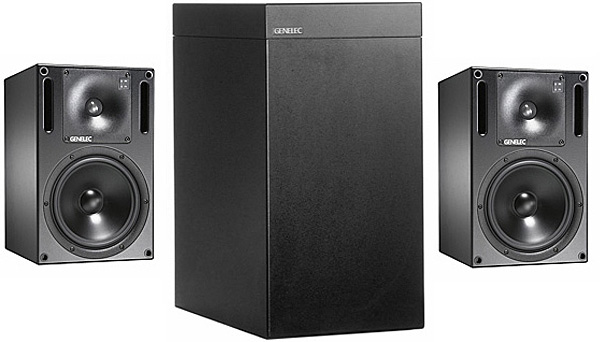
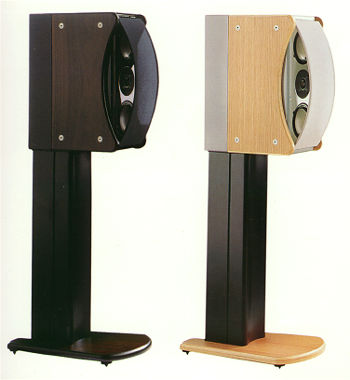
Genelec Studio Monitor 1031A loudspeaker & Studio Monitor 1092A powered subwoofer

Which loudspeakers do audio professionals listen to? And why should we care? After all, it's not as if recording engineers are the kind of refined, sensitive, music-loving types who read Stereophile. As much as they may love music, many audio pros appear only to view the original sounds of musical instruments as raw materials to be creatively reshaped and manipulated. (Okay, there are exceptions. But recordists who care about the sounds of real instruments usually record them in real acoustic spaces rather than in studios, and use as little signal processing as they can get away with.)

Revel Ultima Gem loudspeaker & Ultima Sub-15 subwoofer

A dream I have had since I discovered the pleasures of music is to possess a time machine. Not a fancy one, just a small device that would allow me to escape modern music-making and drop in to hear what must have been some of the greatest musical experiences of all time. Classical music presents no problems: Off to 18th-century Leipzig on Sunday, of course, to hear J.S. Bach play the organ in church, after an early 19th-century Saturday evening spent in Vienna listening to Beethoven improvising at the pianoforte. During the week it would still be Vienna, but forward 80 years or so to hear Brahms premiere one of his chamber works after afternoon cocktails at the Wittgensteins', with perhaps a trip to England's Three Choirs Festival just before the Great War to hear the first performance of Elgar's Dream of Gerontius. And the time machine would have to have transatlantic range—I couldn't miss Mahler conducting the New York Philharmonic around the same time. But with jazz and rock—music that is reborn every time in performance to a greater extent than in classical—there is a bewildering choice of live events from which to choose.


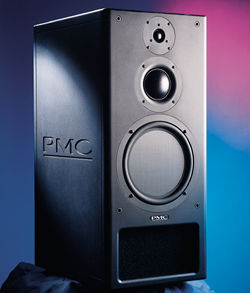
PMC IB-1S loudspeaker

I have a soft spot in my heart (some say my head) for transmission-line designs. I remember being entranced by the authoritative but effortless bass of John Wright's IMF and TDL Monitors, and I have been inspired to experiment by building my own lines in various sizes. Then, as demonstrated by Bryston's Jim Tanner at the 1997 WCES and at HI-FI '97, PMC's IB-1S loudspeakers threw an enormously deep soundstage. (I have a soft spot for that as well.)


Wilson Audio Specialties CUB loudspeaker

Scratch an audiophile and, chances are, you'll find a closet Wilson Audio fan. The Wilson">http://www.stereophile.com/loudspeakerreviews/477">Wilson WATT/Puppy would probably make almost anyone's list of the most significant high-end loudspeaker designs. David Wilson first built his reputation with the custom-built WAMM loudspeaker—a monumental piece invariably included with products like the Infinity IRS, Genesis I, and Apogee Grand when the world's most awesome loudspeakers are discussed. But it was the WATT, followed by the WATT/Puppy—the latter now several">http://www.stereophile.com/loudspeakerreviews/920">several generations improved over the original design—that really put the company on the high-end audio map.


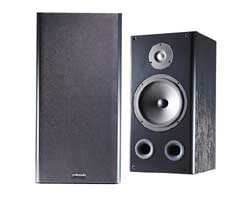
Polk Audio RT5 loudspeaker

Yeah, yeah, I know what you're thinking: "Polk? You're reviewing a $300 speaker from Polk? Get ready for the flames!"
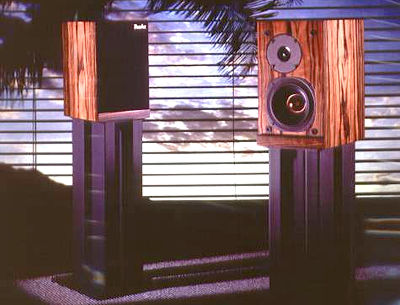

The genesis of this review lies in a casual comment Larry Archibald made last summer. Larry travels a lot, and everywhere he goes, like the archetypical (archibaldical?) audiophile he is, he listens voraciously. After a trip to the east coast, he dropped by my office and laid a bomb on me.


"I heard a pair of inexpensive bookshelf speakers from Polk that really impressed me."


"Um-hum," I replied dubiously, waiting for the punchline.


KEF RDM Two loudspeaker

Stereophile is, in one sense, like a family—us younguns have to make do sometimes because the house is straining at the seams. When I first arrived in Santa Fe, for instance, I was told not to come to the office for a few days—the good news, John Atkinson informed me, was that I had a desk; the bad news was that nobody had a clue where to put it. The dilemma was solved in Solomon-like fashion by shoehorning my desk into the "listening room," which was already serving double-duty as audition space and speaker-measurement lab. If manufacturers visited, we'd sweep up all the acoustic damping from the floor and stash it in JA's office; and if JA needed to take measurements, I would be asked to work at home. It was a manifestly fair solution: inconvenient for everyone involved.


Chario Academy One loudspeaker

I first auditioned a pair of Chario Academy One minimonitors five years ago, but the review was aborted when the Italian Chario company lost its US distribution. When I reheard the Chario Academy Ones at the 1997 WCES, I found their elegant cabinetwork appealing and their sound listenable and involving. I therefore requested a pair for review from the new US importers.


Advertisement
Advertisement
Advertisement