Floor Loudspeaker Reviews

Sort By: Post DateTitle Publish Date

Acoustic Research MGC-1 loudspeaker
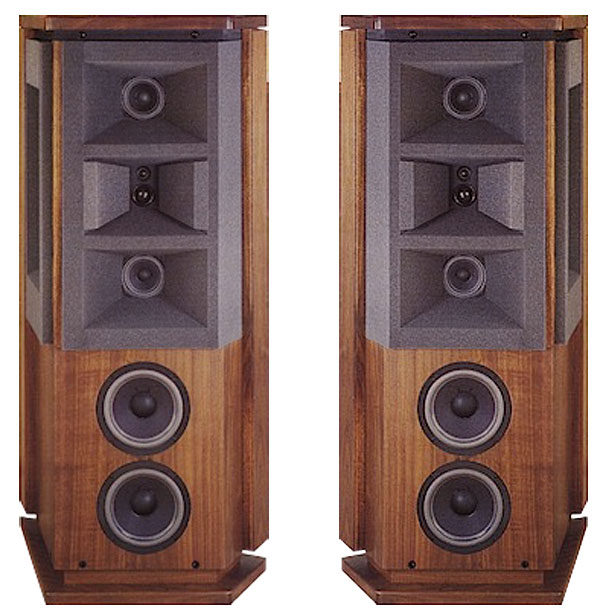
There's virtue in being in the right place at the right time. The right place in this story was the headquarters of Acoustic Research in Boston, MA, and the right time was just a couple of weeks or so before the subject of this piece was to be shown (but not heard) at a press conference in New York. Even within that short two weeks, the rot started to set in. What I saw (and heard) in Boston on that occasion was a loudspeaker that stakes a reasonable claim on being revolutionary. A rare event that. The project name was The Magic Box and I was hoping that is what it might have been called when it went on sale. The Magic Box does, after all, conjure up an image of something a little special, and it's also easy to remember.
MartinLogan Monolith loudspeaker

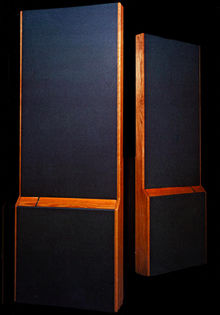
Most Stereophile readers are aware by now of why the full-range electrostatic should, in theory, be the ideal transducer. (If you aren't aware, see the accompanying sidebar.) Acoustat was the first manufacturer to design a full-range electrostatic that was so indestructible it came with a lifetime warranty. (MartinLogan is now offering a three-year warranty on their speakers, and is considering going to a lifetime warranty). But Acoustat was never able to solve another problem that has plagued all flat-panel speakers: treble beaming.

Acoustat 2+2 loudspeaker

While I refuse to admit publicly how long I have been sitting on these loudspeakers before doing the report on them, I must say that it is probably a good thing I wasn't in all that of a hurry to get around to it. They did not sound very good in the room where I had initially installed them, and had I written the report on that basis, it would have been lukewarm, to say the least.
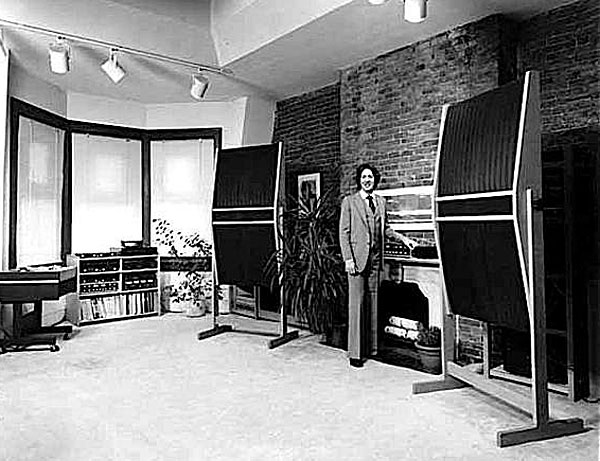
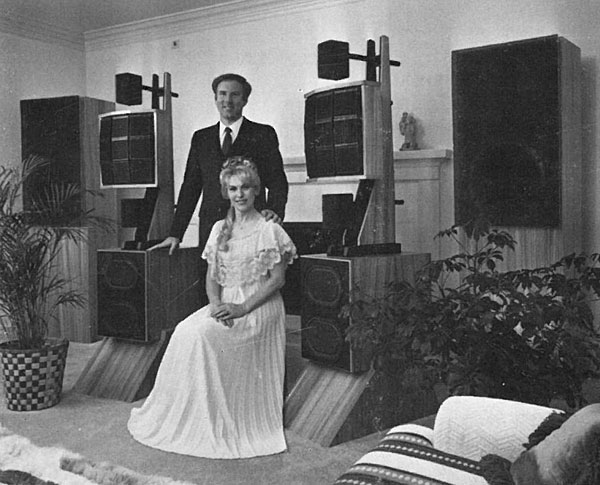
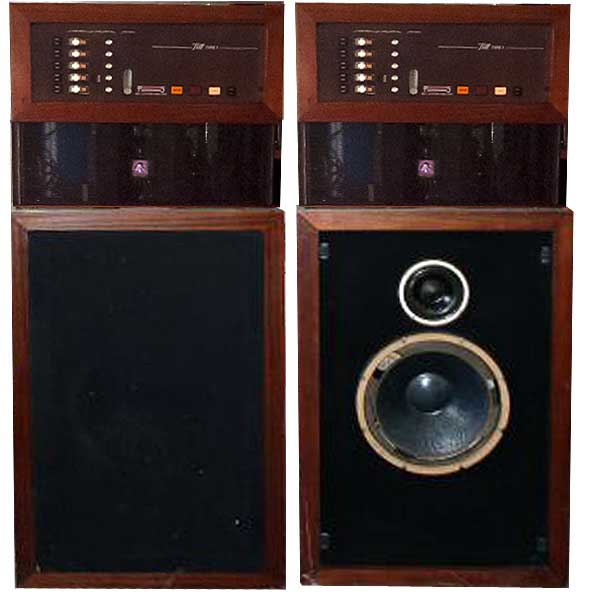
I have now had the opportunity to live with the Acoustat 2+2s in my usual listening room, which is more like a typical listening environment (19' by 24' by 9' and moderately padded), and I am more than a little impressed. This is an extremely good speaker, particularly at its price of $2100/pair.


The 2+2 resembles the Model Four in that it contains four of Acoustat's full-range electrostatic panels per side, but differs from it in that two of the panels (per side) are stacked on top of the first pair to produce a radiating surface twice as high and half as wide as that of the Four. The result, particularly in the case of the black-grilled version we tested, bears a startling resemblance to the mysterious obelisk in 2001, A Space Odyssey. The 2+2 system towers almost to the ceiling (and at just under 8' may be too high for some ceilings), and although it is more graceful in appearance than a pair of Fours, it tends to dominate a listening room at least as much.

Mark Levinson HQD loudspeaker system

We wrote a long, rather unkind report on the HQD, pointing out that, if that was typical of the way it was supposed to sound (And why not, after Mr. Levinson had installed and tweaked it?), then it had to be the most expensive bomb ever to be made available for civilian use. Mr. Levinson responded with a phone call during which he:


1) Told us we had not heard it at its best, but refused to address himself to our specific criticisms;


2) Claimed that many practicing professional musicians felt the HQD to be "extremely realistic";


3) Informed us that, since he sold very few HQD systems and would soon be discontinuing them anyway because Quad had ceased making those speakers, the "sensible" thing to do would be to kill the report; and


4) Mentioned, just in passing of course, that he was currently writing a feature article for Time on the subject of "underground" audio magazines.

Watkins WE-1 loudspeaker

First I should clear up what may be an ambiguity in the driver-lineup spec for these speakers. In each system, three 8" cone units serve as woofers. Two of these crossover from the midrange drivers at 100Hz. Crossover to the third 8-incher, the subwoofer, is at 40Hz. Thus, two woofers are active from 100Hz down to 40Hz, and all three are active below 40. In other words, the third woofer does not come into play until the frequency drops to the point where the radiating area of two 8-inchers starts to become inadequate for moving air, at which point the additional area of the third speaker is thrown in. Below 40Hz, all three are working together.


Quad ESL-63 loudspeaker

Warning to Purists: Despite certain qualities about the ESL-63 speakers which you will probably like, Quad equipment is not designed primarily for audiophiles, but for serious-music (call that "classical") listeners who play records more for musical enjoyment than for the sound. Quad's loudspeakers do not reproduce very deep bass and will not play at aurally traumatizing volume levels, and Quad's preamplifier is compromised through the addition of tone controls and filters, all for the purpose of making old, mediocre, and/or worn recordings sound as listenable as possible.

Thiel Model 04 loudspeaker

These speakers inadvertently managed to put me in a good mood even before I listened to them, because of a dumb little gaffe committed by Thiel's packing department. Each speaker came with an Owner's Information sheet, which is nice. Each sheet included Unpacking (and Repacking) Instructions, which is nicer. But each sheet came packed inside the carton, underneath the speaker, where it was not accessible until after the speaker was dumped out of the box, which is pretty silly!


Wilson Audio Modular Monitor (WAMM) loudpeaker system

No, we made no typos in the specifications sidebar. The weight of the Wilson Audio Modular Monitor (WAMM) speaker system is enough to make you consult a structural engineer before dropping it on your living room floor—fragile, 300-year old New England frame houses are probably out. And the recent price increase from $32,000 to $35,000 is enough by itself to buy a pair of Quad ESL-63s—which is not a bad speaker system. The WAMM represents an all-out assault on both the state of the art in speaker systems and on the limits to which wealthy audiophiles will go in order to have the best.

Hill Plasmatronics Type 1 loudspeaker

Dr. Alan Hill, president of Plasmatronics Inc., was previously employed by the US Government in laser research. His assignment: To increase the efficiency of lasers so that they could do something more impressive than produce holograms, mend leaky retinal blood vessels, and punch pinholes in steel blocks. Dr. Hill earned his keep, thus advancing laser technology a giant step closer to Star Wars, and then retired from government service to design. . . a loudspeaker?!!!?
Advertisement
Advertisement
Advertisement