

Industry Update: Immedia Distributes Lehmann; Audio-Technica Introduces Ripping Turntable
Lehmann Audio: Immediahttp://www.immediasound.com/">Immedia;, the Berkeley, CA–based distributor of Lyra cartridges, Finite Element stands, Sonics by Joachim Gerhard loudspeakers, and Spiral Groove turntables, has become Lehmann Audio's US distributor.
Industry Update: Is It CEDIA Yet?
XM/Sirius: Did we just hear the other shoe drop on the XM Satellite Radio/Sirius Satellite Radio merger? On July 25, XM founder and CEO Hugh Panero announced he would leave the company in August. The company named COO Nate Davis president and interim CEO.
Infiniti's New "Studio On Wheels"
Some days I feel like Stereophile's designated audio antichrist. After all, I wrote an automotive audio column for the magazine about 10 years back—a feature that prompted more than one reader to send the pages carrying my column back to Santa Fe as "not what I subscribed for"—and I reviewed the http://stereophile.com/mediaservers/934/ ">iPod. So, not really being a glutton for punishment, I wasn't wildly enthusiastic when Edelman account executive Stefani Gudis tendered an invitation to hear the Infiniti/Bose "Studio On Wheels" model G35 sedan. It wasn't that I didn't think that car audio could be a valid musical experience, I simply had been disappointed too many times by car manufacturers touting "audiophile" sound packages, which, upon examination, were probably more about preventing aftermarket add-ons by car audio installers. BTDT, as the kids text-message.
Injunction Issued Against Rio
In a story">http://www.stereophile.com/news/10283/">story last week, we covered the efforts of the Recording">http://www.riaa.com">Recording Industry Association of America (RIAA) to prevent portable MP3 players from entering the market without copy-protection measures in place. On August 16, a federal court entered a temporary restraining order (TRO) to enjoin the distribution and sale of Diamond">http://www.diamondmm.com/">Diamond Multimedia's Rio PMP300 portable MP3 recording device.
InnerFidelity Launched With Tyll Hertsens As Editor-in-Chief
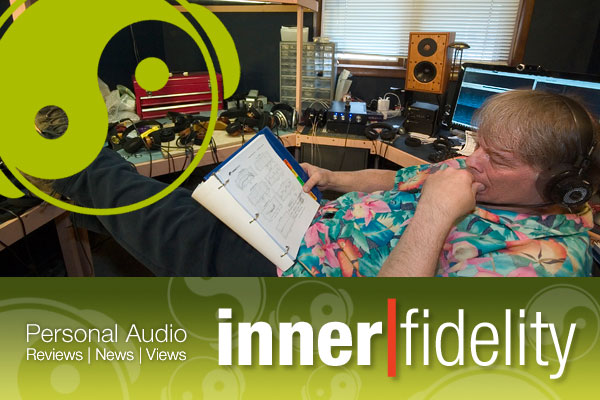
Keith Pray, Publisher of Source Interlink Media web sites, is thrilled to announce the April preview launch of InnerFidelity, a new website dedicated to playing well with personal audio.
Innovative Innovative Audio

Innovative's Elliot Fishkin (center) flanked by Wilson Audio Specialties' Peter McGrath (left) and VTL's Luke Manley (right).
As we reported below, Manhattan retailers Lyric and Stereo Exchange decided not to participate in the New York Audio & AV Show, instead holding standalone events at their stores. There are valid reasons for this decision, not the least of which is that the manufacturers are spared the crapshoot of setting up their systems in rooms with unknowable acoustics. By contrast, every dem room at a retailer is, or should be, an optimized machine for making audio components sound at their best, which surely is the point. However, if every retailer decided to do this, there would be insufficient support for the main show to take place. There would thus be no shows at all, an example of what has been called the "Tragedy of the Commons."
Props, therefore, to Innovative Audio, who both participated in the NY Audio & AV Show with passive and active rooms, but who also invited Showgoers to their premises after the Show closed Friday and Saturday evenings to take a listen under more controlled conditions.Insert At Your Own Risk
The escalating "anti-piracy" technology battle being fought by record labels has caught the attention and provoked the ire of consumers, who are finding their fair use rights quickly eroding away. But computer manufacturers are also feeling the effects of recent music-company attempts to restrict the activities of music fans, since many computers fail to play the altered discs.
Inside Your Brain
Want to improve your hearing? Have someone tickle your toes, or lightly stroke the palm of your hand. Sounds crazy, but it works, and things get even weirder.
Instant Audio Replay?
It's not uncommon for bootleggers to record live performances of favorite artists and then send copies of the tapes around the world. But in an interesting twist that could add a whole new dimension to concert merchandising, the Virgin Entertainment Group and Liquid Audio recently teamed up to record a live performance by the Joshua Redman Quartet at the Virgin Megastore in San Francisco. The recording was then immediately digitized and burned onto CD.
Instant Radio
Historically, radio stations have only partially cooperated with record label attempts to control when and where an important new record is first aired. It's not unusual for a new album or single to be "embargoed" until a specific date by the labels, with stations often competing with each other to find ways to get around this restriction and be first to air a hot new song.