

Everything You Ever Wanted to Know About AACS
On our last News Desk post of 2006, we reported that an anonymous hacker called Muslix64 had announced that he had crackedhttp://www.stereophile.com/news/010107hacked/">cracked; the Advanced Access Content System (AACS) digital rights management (DRM) scheme. Muslix64 said he'd release more details (and decryption software) on January 2. That software, called BackupHDDVD, is now available onlinehttp://rapidshare.com/files/8318838/BackupHDDVD.zip.html%22">online; and the Internets have been all atwitter about it, with charges ranging from "bogus!" to "hallelujah!"
eXamining a trio of systems at Xclusive High End Show Vienna 2026
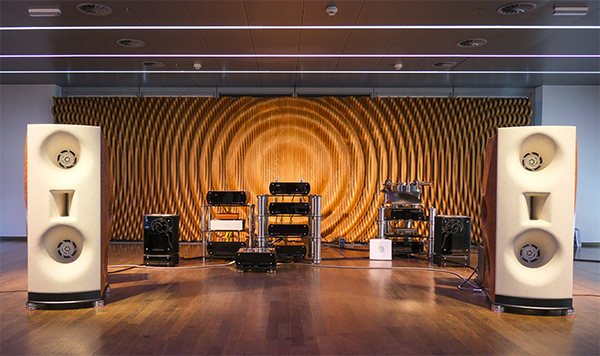
Ola Björling reports on what he saw and heard at the Xclusive High End Show Vienna 2026, one of High End Vienna 2026's satellite shows.
Execs Will Depart BMG In Wake of Napster Settlement; Rumor of EMI Deal
Two top executives at Bertelsmann">http://www.bmg.com/">Bertelsmann Music Group will depart in the wake of the company's recent settlementhttp://www.stereophile.com/news/10885/">settlement; of its lawsuit against Napster. Citing irreconcilable differences with parent company Bertelsmann AG over company strategy, BMG chief executive Strauss Zelnick and chairman Michael Dornemann announced their resignations Sunday November 5.
Experience Music Project Announces Grand Opening
Last week, the Experience">http://www.emplive.com">Experience Music Project, described as an "interactive museum devoted to creativity and innovation in American popular music," announced that it will open its doors to the public on Friday, June 23, 2000, in Seattle, Washington, with a multi-day celebration featuring events in and around the museum, and live performances by a wide variety of musicians. EMP said it expects more than a million visitors during the course of its first year.
Experimental Recording Technologies Spice Home Entertainment 2001
 Although Gary Shapiro emphasized digital television in his keynote address at Home Entertainment 2001, the Consumer">http://www.ce.org">Consumer Electronics Association president didn't ignore the importance of audio advancements. "SACD is a fantastic sensory experience," he told reporters at the May 11 press luncheon.
Exploring Audio's "Last Frontier"
Two elements that keep the audio business interesting are the new companies and technologies arriving almost every week (see also BW's storyhttp://www.stereophile.com/news/10382/">story;). Some stick around for years, while others fade away between hi-fi shows. But amid the incessant change are a handful of characters who stay with it, continually evolving with the industry and reinventing themselves with each twist and turn.
Exploring Bayreuth's Fabled Acoustic
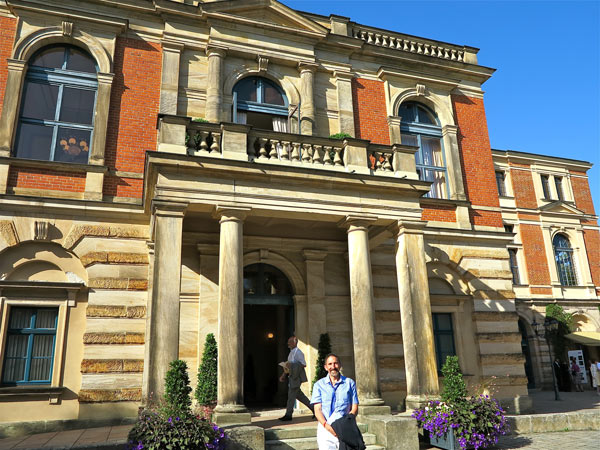
Photo of the author in Bayreuth: Paul Hyde
For audiophiles, the acoustic of the Bayreuth Festspielhause in Germany, home of the annual festival of Richard Wagner's operas, vies with Amsterdam's Concertgebouw and Vienna's Musikverein as one of the most fabled for recording as well as listening. As a participant in the Music Critics of North America 2012 institute at the Festival, I had the opportunity to not only explore the venue from a near-ideal seat in Row 25 Center, but to also visit the fabled "covered pit" from which many of the greatest Wagner conductors of the last 136 years have led exalted performances.F. Alton Everest: 1909–2005
We were saddened to learn just this week that F. Alton Everest died earlier in the month. Like many audiophiles, much of what we know about acoustics was gleaned from Everest's authoritative books on the subject, including several editions of his Master Handbook of Acoustics, Critical Listening and Auditory Perception, and Acoustical Techniques for Home and Studio. Everest packed a lot of living into 95 years, earning a BSc in EE from Oregon State and an EE from Stanford. He taught at Oregon State and Hong Kong Baptist Universities, worked in film production for 25 years, and was an acoustic consultant for 15. During WWII, he spent four years in undersea acoustic research. He was an Emeritus Member of the Acoustical Society, Life Member of the IEEE, Life Fellow of the Society of Motion Picture and Television Engineers, Member of the Audio Engineering Society, and cofounder and past president of American Scientific Affiliation.
Fair Use At Risk?
One of the provisions of the Digital Millennium Copyright Act (DMCA) is that the US Copyright Office hold hearings every three years to ensure that the DMCA is operating properly. For one month prior to those hearings any interested party can submit comments calling for exceptions or revisions. The latest comment period began on January 4, 2006 and has resulted in some fascinating comments.
Fair Use Support
As tighter restrictions on the use of both audio and video digital content loom">http://www.stereophile.com/news/11393/">loom in the legislature, the Home">http://www.hrrc.org">Home Recording Rights Coalition (HRRC) and the Consumer Electronics Association (CEA) have teamed up to counter the ever-increasing demands from copyright holders. The HRRC, founded in 1981, is a leading advocacy group for consumers' rights to use home electronics products for private, non-commercial purposes.