<I>Stereophile</I> is devoted to getting the best sound from a home audio system. But as I have <A HREF="http://www.stereophile.com/asweseeit/533">written before</A>, audiophiles don't have access to an <I>absolute</I> sound, only to what has been captured in the pits or grooves of their discs, which is itself the result of a creative process. The playing back and the making of recordings are therefore two sides of the same coin. This is why I get actively involved in recording projects and why I publish articles about those projects, the most recent of which appears on p.50. "<A HREF="http://www.stereophile.com/musicrecordings/804k622">Project K622</A>" describes the making of a new recording of Mozart's Clarinet Concerto (work number 622 in the Köchel catalog of Mozart's compositions, hence the article's title), which is being released both on hybrid SACD and on 180gm vinyl. (You can buy both from our secure "<A HREF="https://secure.stereophile.com/stereophile/recordings.shtml">Recordings…; page.)
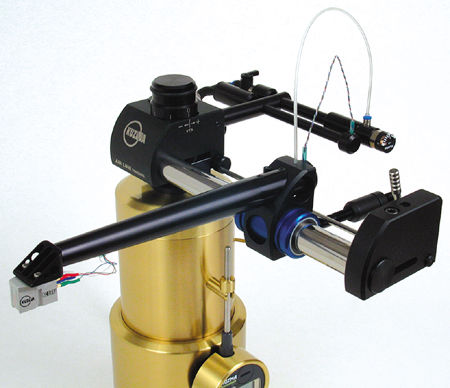
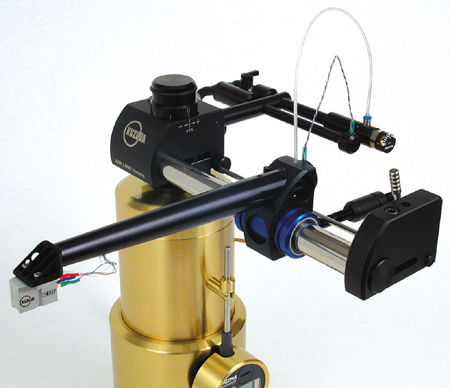
The lacquers from which LPs are pressed are cut in a straight line, and that's how the LP groove should be traced. Even when set up perfectly, a pivoted arm describes an arc across the disc surface, maintaining tangency to the groove at only two points on that arc. Yet despite numerous attempts at building and selling linear-tracking tonearms, few remain on the market, and most are fraught with technical problems. Linear-tracking arms can be anything <I>but</I> linear, committing more sins of geometry as they meander across the record surface than do their pivoted brethren.
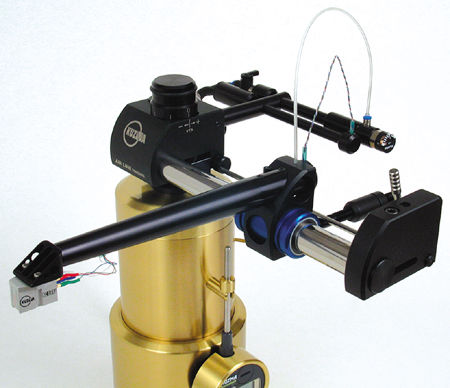
The lacquers from which LPs are pressed are cut in a straight line, and that's how the LP groove should be traced. Even when set up perfectly, a pivoted arm describes an arc across the disc surface, maintaining tangency to the groove at only two points on that arc. Yet despite numerous attempts at building and selling linear-tracking tonearms, few remain on the market, and most are fraught with technical problems. Linear-tracking arms can be anything <I>but</I> linear, committing more sins of geometry as they meander across the record surface than do their pivoted brethren.
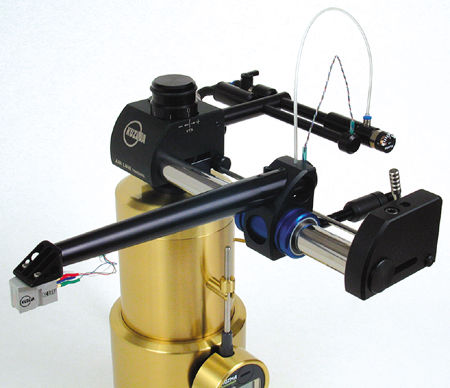
The lacquers from which LPs are pressed are cut in a straight line, and that's how the LP groove should be traced. Even when set up perfectly, a pivoted arm describes an arc across the disc surface, maintaining tangency to the groove at only two points on that arc. Yet despite numerous attempts at building and selling linear-tracking tonearms, few remain on the market, and most are fraught with technical problems. Linear-tracking arms can be anything <I>but</I> linear, committing more sins of geometry as they meander across the record surface than do their pivoted brethren.
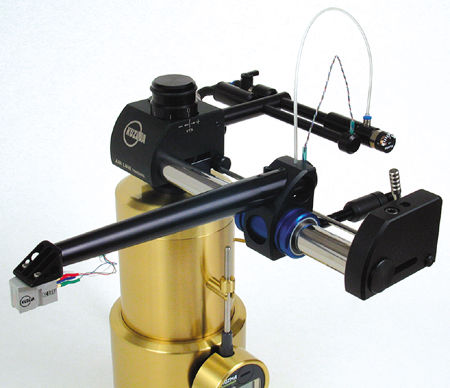
The lacquers from which LPs are pressed are cut in a straight line, and that's how the LP groove should be traced. Even when set up perfectly, a pivoted arm describes an arc across the disc surface, maintaining tangency to the groove at only two points on that arc. Yet despite numerous attempts at building and selling linear-tracking tonearms, few remain on the market, and most are fraught with technical problems. Linear-tracking arms can be anything <I>but</I> linear, committing more sins of geometry as they meander across the record surface than do their pivoted brethren.
The lacquers from which LPs are pressed are cut in a straight line, and that's how the LP groove should be traced. Even when set up perfectly, a pivoted arm describes an arc across the disc surface, maintaining tangency to the groove at only two points on that arc. Yet despite numerous attempts at building and selling linear-tracking tonearms, few remain on the market, and most are fraught with technical problems. Linear-tracking arms can be anything <I>but</I> linear, committing more sins of geometry as they meander across the record surface than do their pivoted brethren.
McIntosh MC501 monoblock power amplifier Measurements
It's true—you never forget your first love. And no, I'm not talking about little Jackie Lynn Neeck in my second-grade class when I was seven years old. I still remember her, almost as vividly as I remember my first encounter with a fantastic stereo system, and therein hangs a tale.
McIntosh MC501 monoblock power amplifier Associated Equipment
It's true—you never forget your first love. And no, I'm not talking about little Jackie Lynn Neeck in my second-grade class when I was seven years old. I still remember her, almost as vividly as I remember my first encounter with a fantastic stereo system, and therein hangs a tale.
McIntosh MC501 monoblock power amplifier Specifications
It's true—you never forget your first love. And no, I'm not talking about little Jackie Lynn Neeck in my second-grade class when I was seven years old. I still remember her, almost as vividly as I remember my first encounter with a fantastic stereo system, and therein hangs a tale.
It's true—you never forget your first love. And no, I'm not talking about little Jackie Lynn Neeck in my second-grade class when I was seven years old. I still remember her, almost as vividly as I remember my first encounter with a fantastic stereo system, and therein hangs a tale.