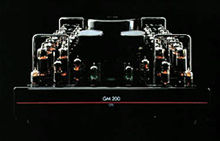
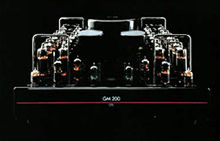
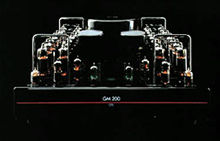
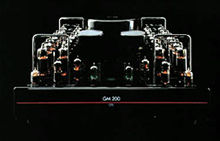
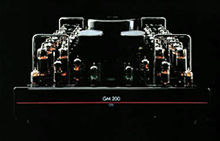
I'm always eager to fulfill my prime <I>Stereophile</I> directive: "To go where no audiophile has gone before," as JA often quips. As it happens, I've long suffered an itch to audition OTL (output-transformer–less) amplifiers, wondering how eliminating the output transformer might affect the sound. Enter the Graaf GM 200, with nothing but wire between its power tubes and the crossover.
Graaf GM 200 OTL power amplifier Associated Equipment
I'm always eager to fulfill my prime <I>Stereophile</I> directive: "To go where no audiophile has gone before," as JA often quips. As it happens, I've long suffered an itch to audition OTL (output-transformer–less) amplifiers, wondering how eliminating the output transformer might affect the sound. Enter the Graaf GM 200, with nothing but wire between its power tubes and the crossover.
I'm always eager to fulfill my prime <I>Stereophile</I> directive: "To go where no audiophile has gone before," as JA often quips. As it happens, I've long suffered an itch to audition OTL (output-transformer–less) amplifiers, wondering how eliminating the output transformer might affect the sound. Enter the Graaf GM 200, with nothing but wire between its power tubes and the crossover.
I'm always eager to fulfill my prime <I>Stereophile</I> directive: "To go where no audiophile has gone before," as JA often quips. As it happens, I've long suffered an itch to audition OTL (output-transformer–less) amplifiers, wondering how eliminating the output transformer might affect the sound. Enter the Graaf GM 200, with nothing but wire between its power tubes and the crossover.
I'm always eager to fulfill my prime <I>Stereophile</I> directive: "To go where no audiophile has gone before," as JA often quips. As it happens, I've long suffered an itch to audition OTL (output-transformer–less) amplifiers, wondering how eliminating the output transformer might affect the sound. Enter the Graaf GM 200, with nothing but wire between its power tubes and the crossover.
An acquaintance in the world of CD distribution recently gave me an astonishing statistic: that the average classical title sells fewer than 2000 copies worldwide in its first year of release; which in turn means that many titles sell only about 500 copies! Given that the cost of producing a classical orchestral album can include up to $100,000 in union-mandated musician fees, such minimal sales guarantee financial disaster.
An acquaintance in the world of CD distribution recently gave me an astonishing statistic: that the average classical title sells fewer than 2000 copies worldwide in its first year of release; which in turn means that many titles sell only about 500 copies! Given that the cost of producing a classical orchestral album can include up to $100,000 in union-mandated musician fees, such minimal sales guarantee financial disaster.
Please let me explain. Because I've never been especially adept at making lifelong commitments and irrevocable decisions, when it came to naming this new column, Managing Editor Debbie Starr and I decided that we would gather the passionate (and supremely efficient) minds of the Stereophile production staff, add a near–life-threatening amount of margaritas, and put the question to them.
Magnolia Audio, the upscale west-coast subsidiary of Best Buy, has signed an agreement with ReadyTo Play, a Palo Alto, CA–based digital music company, to offer in-store and point-of-sale promotion of RTP's CD ripping service to Magnolia's customers.