As much as I'm tempted by the impressive sweep and scale with which some of the large, full-range loudspeakers endow music, for some reason I find myself more at home with more compact examples of the breed. This is not through lack of familiarity with large speakers, a pair of <A HREF="http://www.stereophile.com/floorloudspeakers/506">B&W Matrix 801</A>s occupying pride of place in our living room (which also serves as my wife's listening room). Yet I find myself hankering after that ultimate soundstage precision that only minimonitors seem capable of producing: the loudspeakers totally disappearing, vocal and instrumental images hanging in space, truly solid—the prefix "stereo-" is derived from the Greek word <I>stereos</I>, which means solid—so that a rectangular, totally transparent window into the concert hall opens at the rear of your room. In addition, the necessarily limited low-frequency extension offered by small speakers makes it much easier to get the optimum integration with the room acoustics below 100Hz.
Even to a nontechnical observer, someone without a deep grasp of the germane technical issues, the Amazing Loudspeaker should indeed prove a source of amazement. First of all, there's no box. Don't mistake the back grille for an enclosure—if you pass your hand along the Amazing's behind, you'll realize that the grille is merely a cosmetic cover; you can actually stroke the woofer magnets if you're so inclined. Yet without an enclosure or electronic trickery, this speaker boasts excellent dynamic headroom and true flat bass extension almost to 20Hz. Just think of the woodworking costs inherent in trying to coax such low-end performance from a conventional box speaker. The savings in carpentry have been put toward one heavy-duty ribbon design. The Amazing begins to sound like an incredible bargain at its modest (by high-end standards) asking price. What's the catch? Fundamentally, the answer lies in superior engineering. And, as Bob Carver will readily admit, good engineering isn't inherently any more costly than bad engineering.
Even to a nontechnical observer, someone without a deep grasp of the germane technical issues, the Amazing Loudspeaker should indeed prove a source of amazement. First of all, there's no box. Don't mistake the back grille for an enclosure—if you pass your hand along the Amazing's behind, you'll realize that the grille is merely a cosmetic cover; you can actually stroke the woofer magnets if you're so inclined. Yet without an enclosure or electronic trickery, this speaker boasts excellent dynamic headroom and true flat bass extension almost to 20Hz. Just think of the woodworking costs inherent in trying to coax such low-end performance from a conventional box speaker. The savings in carpentry have been put toward one heavy-duty ribbon design. The Amazing begins to sound like an incredible bargain at its modest (by high-end standards) asking price. What's the catch? Fundamentally, the answer lies in superior engineering. And, as Bob Carver will readily admit, good engineering isn't inherently any more costly than bad engineering.
Even to a nontechnical observer, someone without a deep grasp of the germane technical issues, the Amazing Loudspeaker should indeed prove a source of amazement. First of all, there's no box. Don't mistake the back grille for an enclosure—if you pass your hand along the Amazing's behind, you'll realize that the grille is merely a cosmetic cover; you can actually stroke the woofer magnets if you're so inclined. Yet without an enclosure or electronic trickery, this speaker boasts excellent dynamic headroom and true flat bass extension almost to 20Hz. Just think of the woodworking costs inherent in trying to coax such low-end performance from a conventional box speaker. The savings in carpentry have been put toward one heavy-duty ribbon design. The Amazing begins to sound like an incredible bargain at its modest (by high-end standards) asking price. What's the catch? Fundamentally, the answer lies in superior engineering. And, as Bob Carver will readily admit, good engineering isn't inherently any more costly than bad engineering.
Even to a nontechnical observer, someone without a deep grasp of the germane technical issues, the Amazing Loudspeaker should indeed prove a source of amazement. First of all, there's no box. Don't mistake the back grille for an enclosure—if you pass your hand along the Amazing's behind, you'll realize that the grille is merely a cosmetic cover; you can actually stroke the woofer magnets if you're so inclined. Yet without an enclosure or electronic trickery, this speaker boasts excellent dynamic headroom and true flat bass extension almost to 20Hz. Just think of the woodworking costs inherent in trying to coax such low-end performance from a conventional box speaker. The savings in carpentry have been put toward one heavy-duty ribbon design. The Amazing begins to sound like an incredible bargain at its modest (by high-end standards) asking price. What's the catch? Fundamentally, the answer lies in superior engineering. And, as Bob Carver will readily admit, good engineering isn't inherently any more costly than bad engineering.
Even to a nontechnical observer, someone without a deep grasp of the germane technical issues, the Amazing Loudspeaker should indeed prove a source of amazement. First of all, there's no box. Don't mistake the back grille for an enclosure—if you pass your hand along the Amazing's behind, you'll realize that the grille is merely a cosmetic cover; you can actually stroke the woofer magnets if you're so inclined. Yet without an enclosure or electronic trickery, this speaker boasts excellent dynamic headroom and true flat bass extension almost to 20Hz. Just think of the woodworking costs inherent in trying to coax such low-end performance from a conventional box speaker. The savings in carpentry have been put toward one heavy-duty ribbon design. The Amazing begins to sound like an incredible bargain at its modest (by high-end standards) asking price. What's the catch? Fundamentally, the answer lies in superior engineering. And, as Bob Carver will readily admit, good engineering isn't inherently any more costly than bad engineering.
Even to a nontechnical observer, someone without a deep grasp of the germane technical issues, the Amazing Loudspeaker should indeed prove a source of amazement. First of all, there's no box. Don't mistake the back grille for an enclosure—if you pass your hand along the Amazing's behind, you'll realize that the grille is merely a cosmetic cover; you can actually stroke the woofer magnets if you're so inclined. Yet without an enclosure or electronic trickery, this speaker boasts excellent dynamic headroom and true flat bass extension almost to 20Hz. Just think of the woodworking costs inherent in trying to coax such low-end performance from a conventional box speaker. The savings in carpentry have been put toward one heavy-duty ribbon design. The Amazing begins to sound like an incredible bargain at its modest (by high-end standards) asking price. What's the catch? Fundamentally, the answer lies in superior engineering. And, as Bob Carver will readily admit, good engineering isn't inherently any more costly than bad engineering.
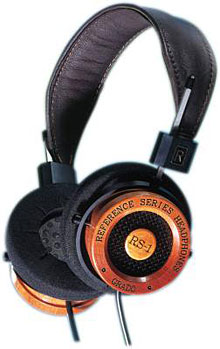
Grado Reference Series One Headphones Specifications
Years ago, I uncovered a piece of my father's secret soul. Hidden in the back of a closet was a treasure trove I'd give anything to possess today. It was my father's stash of mementos from his service in the Eighth Air Force during WWII: his A-2 leather and lamb's-wool flight jacket, a silk scarf with a detailed topographic map of his Theater of Operations imprinted on it, his "50 mission hat" (an Air Corps-lid with the shaping frame removed, carefully crumpled through the middle so that every mother's son would know he was no FNG), his ruptured duck, and, thrust in one pocket, his old headsets—a pair of Bakelite earpieces held together with a leather-covered steel strap. They were funky-looking cans, but to me, they spoke of all of the nobility and courage displayed by the boys who flew over Fortress Europe. I don't actually remember ever plugging them <I>into</I> anything, but I sure wore them for years in every fantasy situation, from plucky French underground guerrilla to Wes Phillips <I>Space Raaaangerrr!</I>


When I first heard Karol Szymanowski