What is the angular separation of your loudspeakers as viewed from your favorite chair? Whatever your answer, it's wrong. Of course I don't mean that it's a factually incorrect answer, just that any single value of subtended angle cannot be ideal for all recordings.
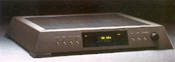
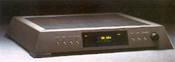
dCS Elgar D/A processor Followup by Jonathan Scull, January 2001
Things are changing rapidly in the world of professional digital audio. After a decade of stability, with slow but steady improvement in the quality of 16-bit, 44.1kHz audio, the cry among audio engineers is now "24/96!"—meaning 24-bit data sampled at 96kHz. Not coincidentally, DVD offers audiophiles a medium with the potential for playing back music encoded at this new mastering standard.
Things are changing rapidly in the world of professional digital audio. After a decade of stability, with slow but steady improvement in the quality of 16-bit, 44.1kHz audio, the cry among audio engineers is now "24/96!"—meaning 24-bit data sampled at 96kHz. Not coincidentally, DVD offers audiophiles a medium with the potential for playing back music encoded at this new mastering standard.
Things are changing rapidly in the world of professional digital audio. After a decade of stability, with slow but steady improvement in the quality of 16-bit, 44.1kHz audio, the cry among audio engineers is now "24/96!"—meaning 24-bit data sampled at 96kHz. Not coincidentally, DVD offers audiophiles a medium with the potential for playing back music encoded at this new mastering standard.
Things are changing rapidly in the world of professional digital audio. After a decade of stability, with slow but steady improvement in the quality of 16-bit, 44.1kHz audio, the cry among audio engineers is now "24/96!"—meaning 24-bit data sampled at 96kHz. Not coincidentally, DVD offers audiophiles a medium with the potential for playing back music encoded at this new mastering standard.
Things are changing rapidly in the world of professional digital audio. After a decade of stability, with slow but steady improvement in the quality of 16-bit, 44.1kHz audio, the cry among audio engineers is now "24/96!"—meaning 24-bit data sampled at 96kHz. Not coincidentally, DVD offers audiophiles a medium with the potential for playing back music encoded at this new mastering standard.
Things are changing rapidly in the world of professional digital audio. After a decade of stability, with slow but steady improvement in the quality of 16-bit, 44.1kHz audio, the cry among audio engineers is now "24/96!"—meaning 24-bit data sampled at 96kHz. Not coincidentally, DVD offers audiophiles a medium with the potential for playing back music encoded at this new mastering standard.
Things are changing rapidly in the world of professional digital audio. After a decade of stability, with slow but steady improvement in the quality of 16-bit, 44.1kHz audio, the cry among audio engineers is now "24/96!"—meaning 24-bit data sampled at 96kHz. Not coincidentally, DVD offers audiophiles a medium with the potential for playing back music encoded at this new mastering standard.
Things are changing rapidly in the world of professional digital audio. After a decade of stability, with slow but steady improvement in the quality of 16-bit, 44.1kHz audio, the cry among audio engineers is now "24/96!"—meaning 24-bit data sampled at 96kHz. Not coincidentally, DVD offers audiophiles a medium with the potential for playing back music encoded at this new mastering standard.
"Recommended Components"—the St. Hubbins' Syndrome! Page 3
Suppose you've put aside some cash for a new preamp. You survey the field and zero in on the Musical Ecstasy 1000 and the Sonic Nirvana Special. Both got good reviews in all the magazines, they look great, and each will set you back about the same number of mortgage payments. So you visit your dealer and camp out for a weekend or two. You listen, you think, you walk around the store, you listen some more, you recalculate your tax return. You listen some more. Finally, you have a winner. "I want that one," you tell your dealer; "the Sonic Nirvana."