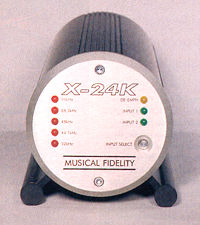
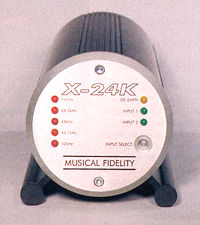
Musical Fidelity X-24K D/A processor Measurements part 2
The standalone digital/analog converter emerged as a product category in 1987 with the appearance of the Arcam Black Box and the Marantz CDA-94, closely followed by the PS Audio Link. The idea was that putting the sensitive D/A-conversion and analog stages in a separate enclosure with its own power supply would maximize the sound quality when compared with packing these circuits in the same box as the transport. However, it turned out that the routing of the digital data between transport and processor in the form of an S/PDIF- or AES/EBU-encoded bitstream could introduce word-clock jitterwhich undid much of the sonic advantages. (See "Bits is Bits" by Malcolm Hawksford and Chris Dunn, <I>Stereophile</I>, March 1996.)
The standalone digital/analog converter emerged as a product category in 1987 with the appearance of the Arcam Black Box and the Marantz CDA-94, closely followed by the PS Audio Link. The idea was that putting the sensitive D/A-conversion and analog stages in a separate enclosure with its own power supply would maximize the sound quality when compared with packing these circuits in the same box as the transport. However, it turned out that the routing of the digital data between transport and processor in the form of an S/PDIF- or AES/EBU-encoded bitstream could introduce word-clock jitterwhich undid much of the sonic advantages. (See "Bits is Bits" by Malcolm Hawksford and Chris Dunn, <I>Stereophile</I>, March 1996.)
The standalone digital/analog converter emerged as a product category in 1987 with the appearance of the Arcam Black Box and the Marantz CDA-94, closely followed by the PS Audio Link. The idea was that putting the sensitive D/A-conversion and analog stages in a separate enclosure with its own power supply would maximize the sound quality when compared with packing these circuits in the same box as the transport. However, it turned out that the routing of the digital data between transport and processor in the form of an S/PDIF- or AES/EBU-encoded bitstream could introduce word-clock jitterwhich undid much of the sonic advantages. (See "Bits is Bits" by Malcolm Hawksford and Chris Dunn, <I>Stereophile</I>, March 1996.)
The standalone digital/analog converter emerged as a product category in 1987 with the appearance of the Arcam Black Box and the Marantz CDA-94, closely followed by the PS Audio Link. The idea was that putting the sensitive D/A-conversion and analog stages in a separate enclosure with its own power supply would maximize the sound quality when compared with packing these circuits in the same box as the transport. However, it turned out that the routing of the digital data between transport and processor in the form of an S/PDIF- or AES/EBU-encoded bitstream could introduce word-clock jitterwhich undid much of the sonic advantages. (See "Bits is Bits" by Malcolm Hawksford and Chris Dunn, <I>Stereophile</I>, March 1996.)
The standalone digital/analog converter emerged as a product category in 1987 with the appearance of the Arcam Black Box and the Marantz CDA-94, closely followed by the PS Audio Link. The idea was that putting the sensitive D/A-conversion and analog stages in a separate enclosure with its own power supply would maximize the sound quality when compared with packing these circuits in the same box as the transport. However, it turned out that the routing of the digital data between transport and processor in the form of an S/PDIF- or AES/EBU-encoded bitstream could introduce word-clock jitterwhich undid much of the sonic advantages. (See "Bits is Bits" by Malcolm Hawksford and Chris Dunn, <I>Stereophile</I>, March 1996.)
The standalone digital/analog converter emerged as a product category in 1987 with the appearance of the Arcam Black Box and the Marantz CDA-94, closely followed by the PS Audio Link. The idea was that putting the sensitive D/A-conversion and analog stages in a separate enclosure with its own power supply would maximize the sound quality when compared with packing these circuits in the same box as the transport. However, it turned out that the routing of the digital data between transport and processor in the form of an S/PDIF- or AES/EBU-encoded bitstream could introduce word-clock jitterwhich undid much of the sonic advantages. (See "Bits is Bits" by Malcolm Hawksford and Chris Dunn, <I>Stereophile</I>, March 1996.)
The standalone digital/analog converter emerged as a product category in 1987 with the appearance of the Arcam Black Box and the Marantz CDA-94, closely followed by the PS Audio Link. The idea was that putting the sensitive D/A-conversion and analog stages in a separate enclosure with its own power supply would maximize the sound quality when compared with packing these circuits in the same box as the transport. However, it turned out that the routing of the digital data between transport and processor in the form of an S/PDIF- or AES/EBU-encoded bitstream could introduce word-clock jitterwhich undid much of the sonic advantages. (See "Bits is Bits" by Malcolm Hawksford and Chris Dunn, <I>Stereophile</I>, March 1996.)
The standalone digital/analog converter emerged as a product category in 1987 with the appearance of the Arcam Black Box and the Marantz CDA-94, closely followed by the PS Audio Link. The idea was that putting the sensitive D/A-conversion and analog stages in a separate enclosure with its own power supply would maximize the sound quality when compared with packing these circuits in the same box as the transport. However, it turned out that the routing of the digital data between transport and processor in the form of an S/PDIF- or AES/EBU-encoded bitstream could introduce word-clock jitterwhich undid much of the sonic advantages. (See "Bits is Bits" by Malcolm Hawksford and Chris Dunn, <I>Stereophile</I>, March 1996.)
Bill Gates would have you believe we live in a plug'n'play world. Apple has proselytized same since day one. But I'm here to tell you it just isn't so for high-end audio. The orientation of a component's AC plug—even the quality of the wall receptacle itself—affects the sound! Oh no, Mr. Bill, not something else to futz with! Will it never end?