It is a truism that audiophiles love music. What distinguishes us (footnote 1) from the vast majority of music lovers is the importance we ascribe to the high-quality reproduction of recorded music. But what, exactly, constitutes high-quality sound reproduction? To many audiophiles, the answer relates to accuracy. Useful indices of accuracy include many of the parameters that editor John Atkinson routinely measures: flat frequency response, time and phase accuracy, and low distortion, to name a few. On the other hand, many audiophiles apparently have little interest in these aspects and instead seek nothing more—or less—than a romantic and pleasant sound. Such individuals are unfazed by demonstrable inaccuracies in their systems; as long as it sounds good to their ears, they are happy. Are these two schools of thought both compatible with the notion of high-end audio? If so, is one "more correct" than the other? Are they mutually exclusive? What brought this issue to mind was, of all things, a digital transport. Actually, two transports.
It is a truism that audiophiles love music. What distinguishes us (footnote 1) from the vast majority of music lovers is the importance we ascribe to the high-quality reproduction of recorded music. But what, exactly, constitutes high-quality sound reproduction? To many audiophiles, the answer relates to accuracy. Useful indices of accuracy include many of the parameters that editor John Atkinson routinely measures: flat frequency response, time and phase accuracy, and low distortion, to name a few. On the other hand, many audiophiles apparently have little interest in these aspects and instead seek nothing more—or less—than a romantic and pleasant sound. Such individuals are unfazed by demonstrable inaccuracies in their systems; as long as it sounds good to their ears, they are happy. Are these two schools of thought both compatible with the notion of high-end audio? If so, is one "more correct" than the other? Are they mutually exclusive? What brought this issue to mind was, of all things, a digital transport. Actually, two transports.
I am writing this copy on a venerable Radio Shack TRS-100 portable computer while flying via TWA from St. Louis to Albuquerque, the very fact of doing so having reminded me of what I wanted to write about in this month's column: hardware reliability. J. Gordon Holt touched on this subject in last June's "As We See It," but I felt it worth readdressing in light of recent events.
Who out there is producing a pro or consumer, non-computer based, DVD recorder that accepts Digital Audio (opt or coax) inputs and High Definition Component Video (720p or 1081i) inputs?
When Dorothy Parker left her estate to MLK and the NAACP, she didn't expect one detail to have such long lasting consequences: Appointing Lillian Hellman as executor actually affected her literary reputation. Marion Meade unravels a tangled tale.
The premise is simple: Prepare a history of the world based on events referenced to (or shown) in movies. Man, I had no idea that Bouvet Island, Antarctica was such a happening place. (<I>Alien vs Predator</I>).
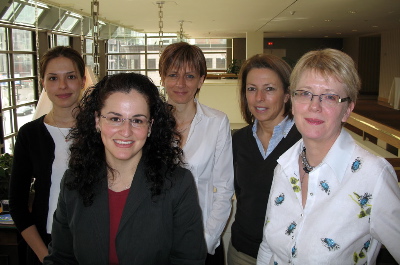
Aside from a few grumbles about the small size of some of the rooms, the 2006 FSI was a resounding success with exhibitors as well as attendees. Show organizer Marie-Christine Prin has managed to maintain the show's appeal to hard-core audiophiles while broadening the show's coverage to include products for the video/MP3/iPod generation. As always, Marie-Christine and her stalwart assistants, Céline Roy, and Diane Hébert, joined for this show by Sarah Bouhali and Elisa Fernandez, ran the show with grace and efficiency. Merci!
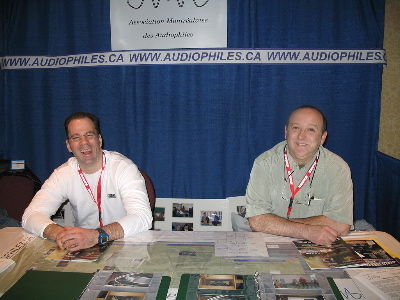
Manufacturers exhibiting at FSI for the first time have often told me that the Montreal-area audiophiles attending the show seem to be an unusually enthusiastic and knowledgeable group. This impression is confirmed by the existence of the Montreal Audiophile Association. The Association—which always has a booth at FSI—is a highly active one, with over 100 members. They meet twice a month (they rent space in a school for this purpose), one meeting devoted to equipment (<I>eg</I>, talks by audio designers) and the other to classical music (<I>eg</I>, comparison of recordings of piano concertos). Pictured: members Yves Lepage, who is also an occasional contributor to <I>Son & Image</I> magazine, and webmaster Serge Tremblay. A fun pair of guys—I quite enjoyed talking to them.




Who out there is producing a pro or consumer, non-computer based, DVD recorder that accepts Digital Audio (opt or coax) inputs and High Definition Component Video (720p or 1081i) inputs?