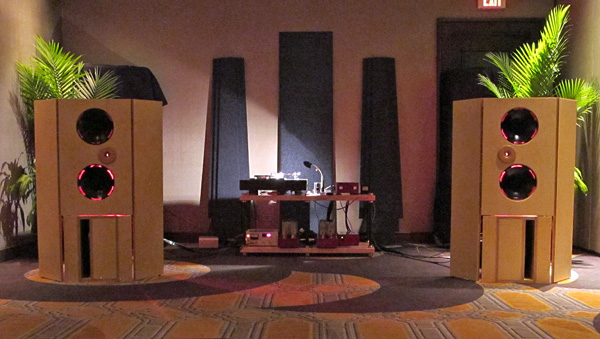
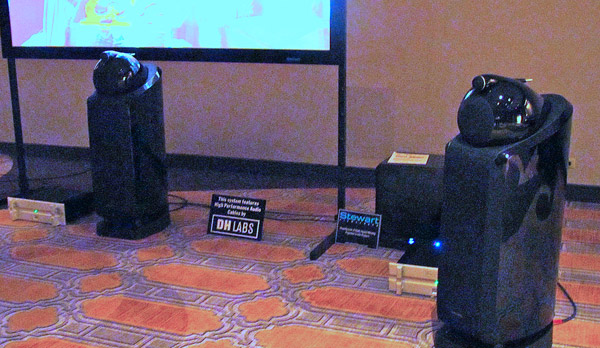
At Saturday night dinner with Channel D’s Rob Robinson, his wife Claudia, and Jeff Joseph of Joseph Audio, we spoke about the number of exhibitors at audio shows who either come ill-prepared to deal with the vagaries of hotel room sound, don't know what to do about room-invoked sonic anomalies, or think any attempt at amelioration is futile. This was certainly not the case with Jeremy Bryan, President CEO of MBL North America, Inc. Faced with an air-walled room replete with bass boom, and whose ceiling was sonically divided halfway back into the listening position (with the back half of the ceiling concealing a crawl space that did not extend forward), Jeremy took immediate action. He may have been up until the wee hours, but when we arrived in his fabulous-sounding space, I had no idea that behind the rear drapes were concealed double rows of mattresses, stacked on their ends, that were absorbing errant bass. Rob and Jeff were familiar with this fix, because they had done the same in their room.
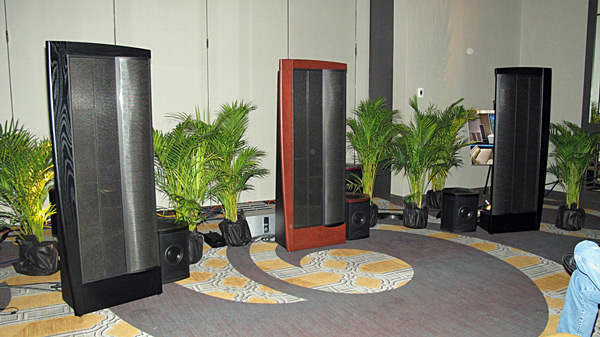
Audible Images of Melbourne, FL treated AXPONA visitors to a 5-channel MartinLogan set-up that managed to look big even in the huge Florida Salon B. Capable of playing five different formats, the system did full justice to a two-channel recording of Jimmy Smith from 1958, with sound very warm and laid back. Further treats were in store with a 3-channel Mercury Living Presence SACD of Rodrigo's famous Concierto d'Aranjuez, the system capturing both that label's in your face brightness as well as the beautiful delicacy of the guitar. In multichannel, Pink Floyd's Wish You Were Here sounded as though "here" had come to me, which was a good thing. My own disc of Mahler Symphony No.2 sounded convincingly big and bright, although for some reason the low bass lines were not as full as I'm accustomed to hearing.
All the way from East Greenbush, New York, Bill Demars of Beauty of Sound was showing the brand new Ikeda 9TT moving-coil cartridge ($3800) on The Emperor Turntable, whose total price ($17,400) includes both the cartridge and Ikeda IT-407CR1 tonearm ($6500). The cartridge's body parts are made of an aluminum alloy, and the cantilever is made of a double-layered hard aluminum alloy in order to reduce possible distortion from warped platters. Appropriate stylus downforce is 1.75gram2.25gram, and frequency range is 10Hz45kHz
At the same time that AIX Record's Mark Waldrep was in the Omni Ballroom B giving the first of two keynote seminars, "Realizing the Dream of Perfect Music Reproduction: Are we There Yet?", the large salon two doors down was presenting his new AIX Records Real HD-Audio sources Blu-ray discs using Dolby TrueHD Encoding. I confess that I find wearing 3D glasses awkward, and don't know if I'll ever become accustomed to the neck of a guitar beaming out at my gut like a foreign projectile while I'm listening to beautifully played classical music. Nonetheless, the quality of the picture could not be faulted, and the sound, especially when discomfort was erased with eyes closed, was very fine.
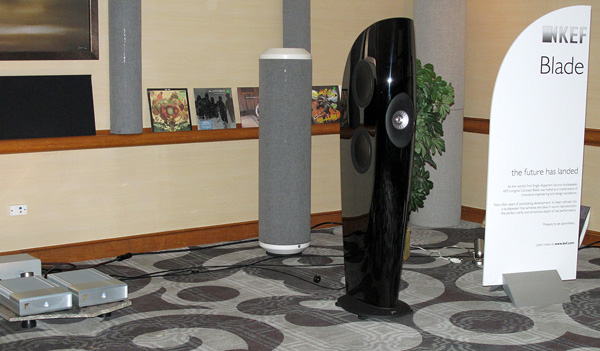
Jacksonville's very own House of Stereo, run by Bill Gibson, gave me my third opportunity to hear KEF's relatively new Blade loudspeaker ($30,000/pair). Coupled with Ayre electronicsAyre MX-R monoblocks ($19,000/pair), Ayre KX-R preamp ($19,000), Ayre DX5 universal player ($10,000), and Ayre phono preamp ($2500)an Oracle Mk.VI turntable with SME arm and Oracle cartridge ($13,000), and an assortment of Audience Au24 cabling and line conditioners, the system had a laid back and non-fatiguing presentation that just made you want to take off your shoes, lie back and chill. This was an exceptionally quiet and smooth system, especially on vinyl, and one that threw a huge and inviting soundstage.
It's always a good sign when the first room you enter at an audio show makes you happy that you're there. Better yet when the room is on the lobby level, and acts as a good feng shui portal to the 27 other rooms to follow.
Larry Diaz of Miami's High End Palace had put together a fine system whose sound was solid and a bit sweet.
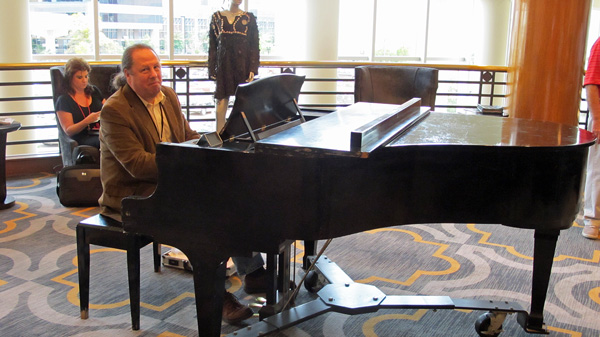
When I arrived on the second floor the first day of AXPONA, the large open landing that had served as a reception area for exhibitors the night before had been transformed into a mellow entryway to sonic heaven. Paving the way on the keys was John Yurick, who was playing John Lennon's "Imagine" as I snapped his picture. Facing him were May Audio's CD display on the left, and Transcendental Meditation on the right. Note that the TM folks do not simply chant themselves to bliss in mantra land, they are also very connected on a cellular level.
With the sound of Jacoby Symphony Hall virtually hyped to life by the glowing accolades on its website and the praises of AXPONA's Steve Davis, I had to hear it for myself. Besides, I'd never heard either An-Lun Huang's Saibei Dance or John Corigliano's Oboe Concerto. I do recall, however, hearing Beethoven Symphony No.7 in A major at least once in my increasingly lengthy lifetime. (I'm being facetious, folks).