It may seem strange to introduce a huge show reportactually my final blog, since, in time-honored biblical fashion, the last shall always be first in the blogisphere with a photo of a Bentley Mulsanne (over $400,000). But inside this gorgeously outfitted automobile, a machine that even closes its doors for you should you be too occupied trading stocks via iPhone to pull the handle, is a custom-enhanced sound system by Reus Systems of Orange. (It was part of the exotic car exhibition that was part of T.H.E. Show.)
"That sound real," I thought as I approached the room shared by Oracle, Burmester, and Genesis. "It sounds just like Canadian singer Anne Bisson," whom I had heard live at an SSI concert in Montreal a couple of years ago.
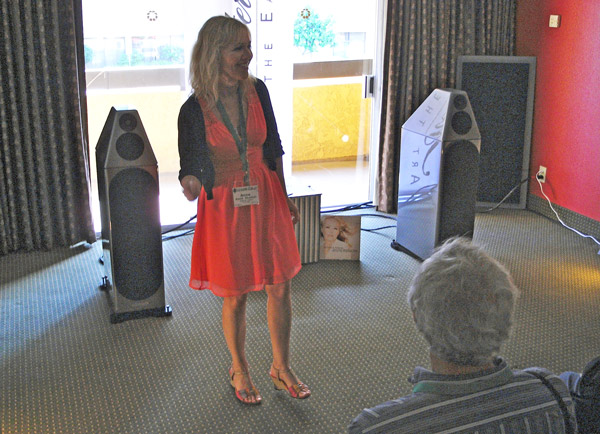
Stepping into the room, I was confronted by, yes, the real Anne Bisson, who was duetting with herself on one of the tracks from her Blue Mind LP on Fidelio.
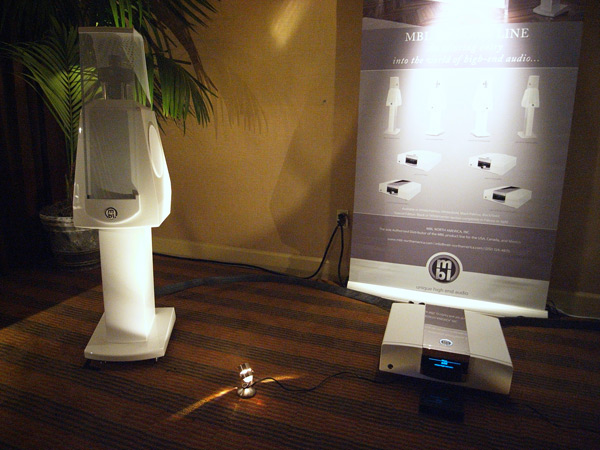
Oh, Santa. Santa Baby. Dear Santa Baby. Please make that a Reference Line Combination D ($259,700 total). I won't even ask you to sit on my lap, if only you and Rudolph bring me a pair of MBL 101E Mk.II Radialstrahler speakers, along with an MBL 1621 A CD transport, 1611 F D/A converter, 6010 D preamplifier, and 9011 power amplifier. In snow white, please, just as in the photo. This same Combo platter received my hands up and down "Best of Show" at AXPONA 2012 in Jacksonville. Here it sounded almost as good.
I still remember the chills that ran down my spine when I saw the band Rufus, with a young, slim Chaka Khan, performing "Tell Me Something Good" at a small English club more years ago than I care to recall. So when I went into the smaller MBL room at the Irvine Hilton and Jeremy Bryan started playing a live version of the same song, I got a similar thrill.
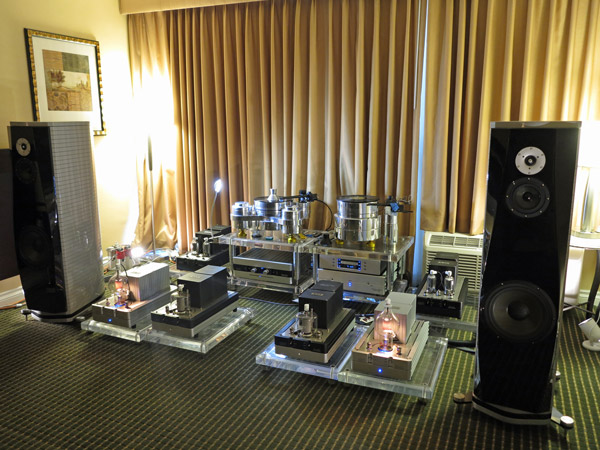
Scaena's imposing systems never fail to provide one of the highlights of the Show experience. Once the flashing light show on the VAC tube equipment was turned off, I was able to settle in and enjoy sensational sound through the Scaena Spiritus 3.6 System with Trifecta subwoofers ($130,000), VAC Statement 450 monoblock amplifiers ($78,000, presumably for the pair), VAC Signature MK2a preamp with phono option ($19,500), Audience Adept aR-12-TSS power conditioner ($10,000) and, for analog, the Kronos counter-rotating dual platter turntable ($28,000) with Graham Phantom Supreme 12" arm ($6000), Clearaudio Goldfinger Statement cartridge ($15,000), and Audio Research Ref phono 2 ($11,995).
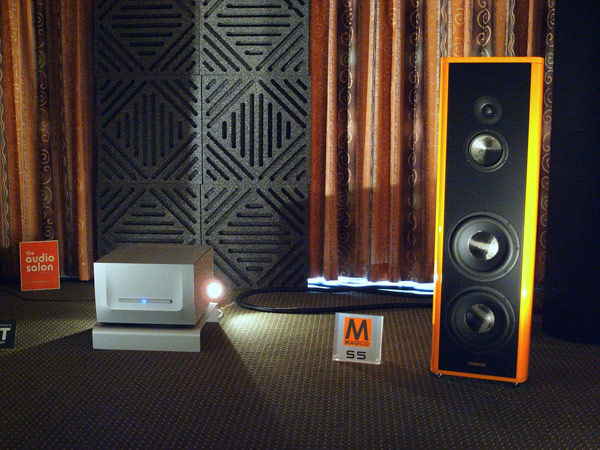
A surprise was in wait for me as I sat in front of Magico's new S5 speaker ($28,600/pair) in The Audio Salon room at the Atrium Hotel. With the speakers driven by Constellation's Centaur 250Wpc amplifierthe amp in the photo is a dummy; the real one was behind mewith MIT cables throughout, Constellation's Peter Madnick selected a file on his iPad and told me I'd recognize the music. Indeed I did: it was Cantus performing Curtis Mayfield's "It's Alright," which I had recorded live in concert at Minneapolis's Southern Theater in May 2008. It had been released on a limited edition CD but I had completely forgotten I had given Peter a file of the final mixdown. Wow, the band was hanging there in space between and behind the speakers. And when the audience started clapping along with the music, they sounded above and to the sides of the speakers, as I had intended.
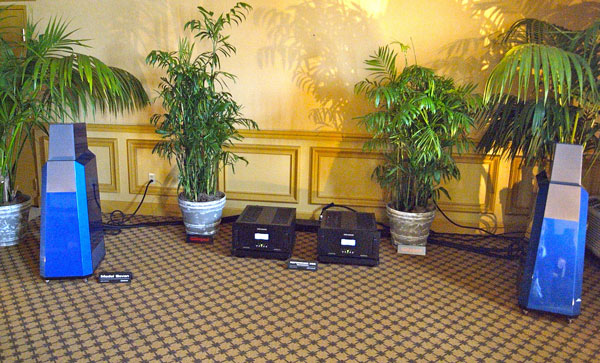
I don't have much to say about the sound in this room, produced by Vandersteen Model 7 speakers ($50.000/pair) driven by Audio Research Ref 250 tubed monoblocks ($20,000/pair) and an Audio Research Ref 5SE preamp, wired with AudioQuest cables, other than it was simply one of my best sounds at the Newport Beach Show (the others being the Magico S5 and the MBL 101E Mk.II, with the Wisdom LS4 and Luxman-driven YG Anat II Studio not far behind).
Source was a Basis Inspiration turntable and arm fitted with a Lyra Atlas cartridgethe complex mix at the end of Blood Sweat & Tears' "Spinning Wheel," played on an acetate cut by Bernie Grundman, where treble recorders contrast with the brass, was untangled in a most effective manner but without any spotlighting.
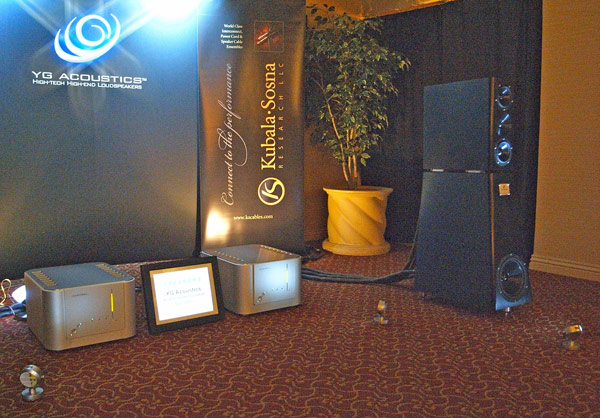
In their 10th floor suite, YG Acoustics was driving their Anat II Studio Signature speakers with Luxman B-1000 solid-state monoblock amps via Kubala-Sosna Elation cables. Total cost of the system was an eye-watering $275,000, but I don't think I have heard Talking Heads' live "Psychokiller," from Stop Making Sense, sound as viscerally real, yet without strain nor grain. (Trying to reproduce this track at similar levels with an all-Mission system a quarter century ago, I managed to melt the amplifiers' output stages.)
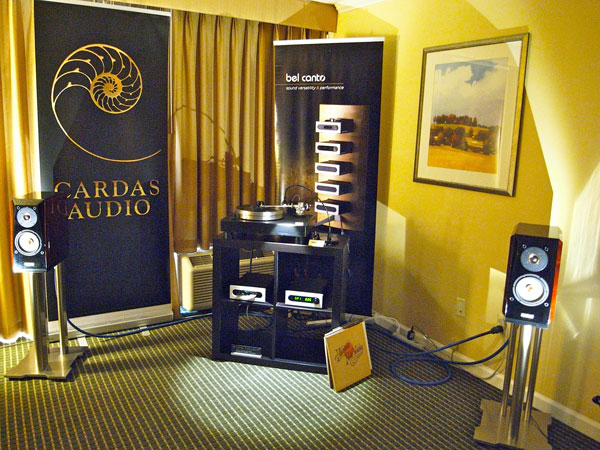
It is always a pleasure visiting the Joseph Audio room at Shows, not the least because Jeff Joseph knows how to set up a system to work with the room acoustics, not against them. In Newport beach Beach, as at some other shows, he had set-up the Pulsar stand-mounts ($7000/pair) along the room's diagonal. Source was Pure Music running on a MacBook Pro, feeding USB data to the Bel Canto. Powered by Bel Canto's new C7R integrated amp, which includes a phono preamp, D/A section, headphone output, and an FM tunerwait a moment, isn't that we used to call a "receiver?"and hooked up with Cardas cables, the Pulsar's produced an almost full-range sound. The double bass on the Bad Plus's arrangement of Nirvana's "Smells Like Teen Spirit" had body and good definition,a difficult trick to pull off for a stand-mounted two-way.
"Whoa!" said self to self upon entering the KT Audio Imports room. This display is so dazzling, how can I begin to take it all in?
Arrayed before me were the Triangle Art Referent turntable ($13,990); GamuT CD3 ($6500); NAT Audio Magma 160W amplifiers ($45,000/pair), Symmetrical dual balanced preamplifier ($8700), Signature battery phono stage ($7800); Eventus Audio Nebula loudspeakers ($65,000/pair), and Wireworld cabling. Not playing were the Triangle Art Signature turntable ($9990), NAT Single Integrated ($7800), and NAT Magnastotat battery preamplifier ($17,490). Some of this, as well as two other Eventus loudspeakers, was off to the side.