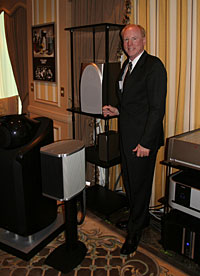
Whatever you say about David Wilson, you have to admit he gives great show. Wilson doesn't come to CES with just a new product, he constructs a narrative structure and puts on a show. This is a good thing, since Wilson thinks long and hard about the lesson he wants to teach. He plays fair, too.
Today's demo was designed not to show that Wilson's Duette ($11,000/pair) was
better than the competition—in this case B&W 800 Diamonds ($20,000/pair) or Krell LAT-2000s ($14,000/pair)—but rather to demonstrate how they might provide a solution for a common loudspeaker problem, namely where a normal person might
put the darn things.
Wilson hypothesized that normal people don't go to an audio store and ask for a big loudspeaker that had to be placed in the center of the room, tethered by hawsers. ("Actually," Wilson quipped, "we are fortunate that some customers
do want that, since that describes most of the speakers we sell.") Wilson set up a pair of his Duettes on a bookshelf against a wall, 42" above the floor, while having set up the Krells and B&Ws in their optimal positions, well into the room.
The Krells were driven by a Krell FPB200c power amp and the B&Ws were driven by a Classé CA-2200; the Wilsons were driven by Parasound A21. (The total system costs were therefore dissimilar.) All three systems were mated to Nagra PLP preamplifiers matched to within 0.3dB.
Wlson played tracks he deemed appropriate to a high-quality small monitor (LAT-2000)
and large floorstanders (the 800 Diamonds) and then played them back through the Duettes.
Were there differences? Yeah, but they were not so much qualitative as they were minor tonal variations. The Duettes acquitted themselves well—and even back against the wall way above our ear level, they had better off-axis fill and spread than either of the other speakers. They really
did blend into the décor on the shelves and they sounded
good.
Would this demo convince an audiophile to buy the Duettes rather than the B&Ws or the Krells? Possibly not, but even the most ardent audiophile would admit that they belonged in the comparison. For
non-audiophiles looking for domestic tranquility and high-fidelity sound (assuming there are such critters), the Duettes might offer strengths the more traditional designs just don't. I expect JA will offer more technical details on the Duettes when he weighs in, but David Wilson sure impressed the heck out of me.