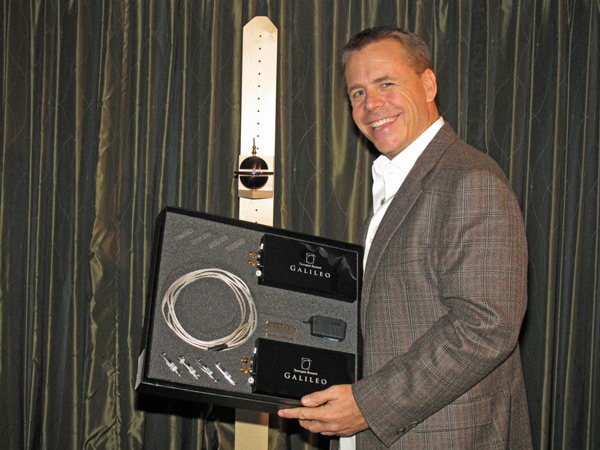
Synergistic Research’s Ted Denney was eager to show off the great midrange and bass transmitted by his Galileo System of hand-built cables. His choice of music: Michel Jonaz’ “Le Temps Passé,” a classic recording whose abundance of space and choice of contrasting, slightly gimmicky instrumental timbres makes for one of those ideal audiophile demo discs.
The Galileo System of cables includes speaker wire ($40,000/8ft pair) and interconnects ($25,000/1m pair), the PowerCell LE (limited edition—only 20 are being built for $10,000 each), and the Galileo Element series. All cables work universally, with switchable XLR and RCA terminations. If you switch gear from single-ended to balanced, you don’t have to buy an entirely new set of cables with different terminations. Very neat.
It takes Denney one month to build one set of speaker cables and two pair of interconnects. Each cable is externally wound with either gold or silver wires—you select which—in order to tune their sound to your system. Each cable includes over $3000 worth of Lemo connectors from Switzerland.
Denney claims that the Galileo Electromagnetic cells that come with his cables result in the lowest distortion and highest resolution that he has ever heard from any cables. He also believes that the Electromagnetic cells eliminate noise at extreme high frequencies and calm electronic behavior, resulting in extremely high levels of resolution without fatigue.
The most affordable trickle-down technology that has resulted from Denney’s research is Synergistic Research’s Galileo Universal Cell ($2500/pair). These boxes, described in detail on his website, can be used in conjunction with any cable from any designer to reduce noise and calm electrons. Among the benefits, which he claims are universally applicable, are much more resolution and a much bigger soundstage. Knowing my own choice of cabling, he noted, “It’s a match made in heaven for Nordost.”
In the works are a Galileo System Rack (projected cost, at least $10,000) and the MiG (Mechanical interface Grounding) footers ($150/set of three). The footers are said to retune the resonance of a component’s chassis to “get it more in step with the music it produces.” The footers can be set up in different configurations according to your desire for either pinpoint or ambient focus.
Denney continues to praises the benefits of the Synergistic Acoustic ART system that John Atkinson and I have written about on several occasions. As someone who uses the system to control the sound in my large room, I was excited to learn that Denney has done a lot more experimenting with how to tune large spaces with irregularly shaped openings and cavities. In the photo at the head of this item, you can see the Acoustic ART Vibratron behind Denney.