Johnny Hartman's album Once in Every Life (Bee Hive Records BH 7012) has become an audiophile chestnut, but I give credit to my friend Brian Futterman for bringing this lovely record into the audiophile realm. Nearly 40 years ago, Brian brought it along to a dealer I was working at to audition some new speakers, and it soon became a demonstration favorite. "I Could Write a Book" is my go-to track, with its bouncy bass line played by Victor Gaskin accompanying Hartman's deep, rich voice. Sibilance can rear its ugly head with this record if the playback isn't top notch, but, assisted by the Moonriver 505, the Benz really dug into Hartman's deep sonority while remaining smooth and sibilance free. Billy Taylor's solo piano also impressed, delivering the attack of each chord perfectly.
The Moonriver 505 is a Swiss Army knife of a phono stage. With four inputs and an impressive array of adjustments, it can handle just about any combination of arms and cartridges. It looks elegant, is built to last, and most importantly, sounds wonderful.
 DS Audio E3 Optical Phono Cartridge and Equalizer
With all their recent successes, you could forgive Tetsuaki Aoyagi and the folks at DS Audio if they decided to take a breather. Instead, DS Audio continues to upgrade their lineup at a dizzying pace (footnote 3). First we got the new Master Series models, with prices that wouldn't look out of place on a nice new car's window sticker. Following that, they brought out the somewhat more affordable but still rather spendy W3, which I reviewed in Spin Doctor #11. With the new E3, they're bringing optical cartridge technology to the masses, at less than one-fifth the cost of the W3.
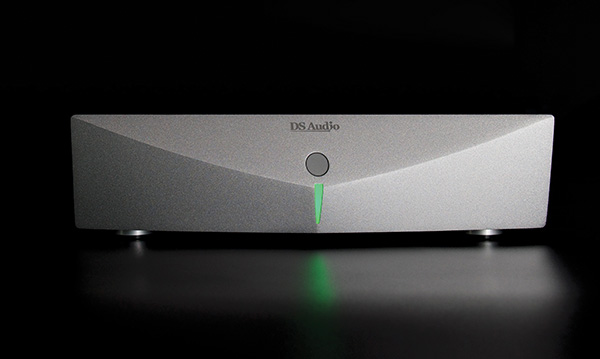
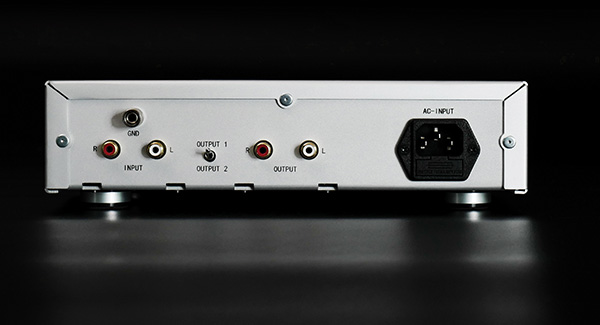
The E3 cartridge and equalizer sell for $1375 each, or $2750 for the combination, which is exactly the same price as the E1 models they replace. That's remarkable when you consider that the E3 cartridge incorporates the third-generation dual-LED optical engine first seen in the megabuck Master Series cartridges. The E3 equalizer is a reengineering of the E1; it now physically resembles the big-buck (and physically larger) Master and W3 equalizers, with their sculpted front panels. Unlike those bigger DS Audio equalizers, the E3 has just one single-ended output and less flexible bass-response tailoring than is available on those bigger models. On the rear panel is a switch cryptically labeled "Output 1" and "Output 2"—confusing considering that there is only one output. In fact, these are bass controls. Output 1 has a slight bass enhancement while Output 2 rolls off the bass: It's a rumble filter. In my system the flatter "Output 1" setting was clearly preferable.
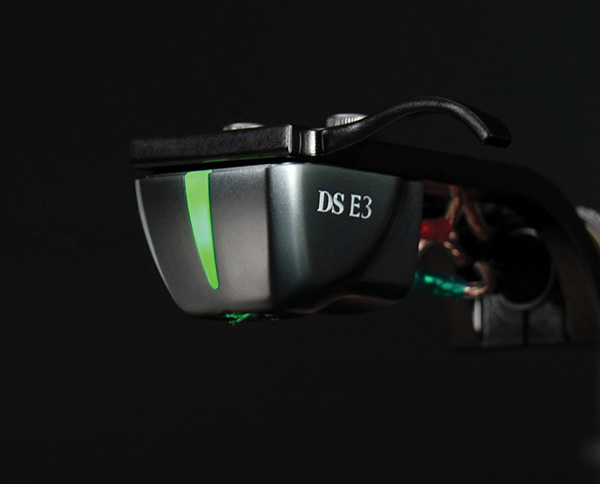
 I still encounter a lot of confusion when people ask me about optical cartridges, so here's a quick primer. DS Audio optical cartridges look pretty much like any conventional moving coil cartridge except for a colorful illuminated strip on the front of the cartridge body, which lets you know when they are powered on. The cartridges mount and align just like any regular cartridge, and they work in most standard tonearms. They trace the record groove using a conventional stylus and cantilever and connect to the tonearm wiring using the same four headshell wires as a standard magnetic cartridge.
The difference is in how the cantilever's deflection is read. DS Audio's "optical engine" uses two narrow-angle LEDs—one for each channel—that direct their light beam onto a pair of optical sensors. In between each LED and its sensor is an ultralightweight beryllium shading plate attached to the cantilever, which moves as the cantilever is deflected by the record groove, modulating the light beam hitting the sensor.
So instead of connecting your tonearm cable to a magnetic phono input, an optical cartridge needs to be used with a special equalizer/energizer, which provides the 5V DC the cartridge needs to operate, sending the power over the left and right channel ground connections. As the name suggests, the equalizer also handles the EQ correction an optical cartridge needs to conform to the RIAA curve.
I still encounter a lot of confusion when people ask me about optical cartridges, so here's a quick primer. DS Audio optical cartridges look pretty much like any conventional moving coil cartridge except for a colorful illuminated strip on the front of the cartridge body, which lets you know when they are powered on. The cartridges mount and align just like any regular cartridge, and they work in most standard tonearms. They trace the record groove using a conventional stylus and cantilever and connect to the tonearm wiring using the same four headshell wires as a standard magnetic cartridge.
The difference is in how the cantilever's deflection is read. DS Audio's "optical engine" uses two narrow-angle LEDs—one for each channel—that direct their light beam onto a pair of optical sensors. In between each LED and its sensor is an ultralightweight beryllium shading plate attached to the cantilever, which moves as the cantilever is deflected by the record groove, modulating the light beam hitting the sensor.
So instead of connecting your tonearm cable to a magnetic phono input, an optical cartridge needs to be used with a special equalizer/energizer, which provides the 5V DC the cartridge needs to operate, sending the power over the left and right channel ground connections. As the name suggests, the equalizer also handles the EQ correction an optical cartridge needs to conform to the RIAA curve.
 One great feature of the DS Audio cartridge system is that all the cartridges and equalizers are fully compatible with each other, making it possible to mix and match. I still had the W3 cartridge on hand from my earlier review; its matching W3 equalizer had already made a trip back to DS Audio's distributor. I also had the superb EMM Labs DS-EQ1 equalizer. Moving two cartridges and two equalizers in and out of the system helped me get a handle on the relative importance of the two main parts of an optical cartridge system.
The E3 uses the same third-generation light engine as the W3. The key differences are in the stylus type, the cantilever material, and the material used to make the cartridge body. The E3 has an aluminum cantilever with an elliptical stylus, which may sound ordinary compared to the ultra-exotic diamond cantilevers and MicroRidge styli employed further up the range, but I have heard plenty of cartridges that use such humble ingredients to make truly beautiful music.
One great feature of the DS Audio cartridge system is that all the cartridges and equalizers are fully compatible with each other, making it possible to mix and match. I still had the W3 cartridge on hand from my earlier review; its matching W3 equalizer had already made a trip back to DS Audio's distributor. I also had the superb EMM Labs DS-EQ1 equalizer. Moving two cartridges and two equalizers in and out of the system helped me get a handle on the relative importance of the two main parts of an optical cartridge system.
The E3 uses the same third-generation light engine as the W3. The key differences are in the stylus type, the cantilever material, and the material used to make the cartridge body. The E3 has an aluminum cantilever with an elliptical stylus, which may sound ordinary compared to the ultra-exotic diamond cantilevers and MicroRidge styli employed further up the range, but I have heard plenty of cartridges that use such humble ingredients to make truly beautiful music.
 The first thing that struck me as I played the E3 was how effortlessly it sorted out recordings that normally sound thick and dense, allowing me to hear each element of the sound—the same impression I had when I auditioned the W3. A good example is "Waves of Fear" from Lou Reed's The Blue Mask (RCA AFL1-4221). This is Lou rocking out at his loudest, but the E3 was able to perform its magic trick of putting all the elements in their own place. Tracking was superb, with never a hint that the stylus was about to become unstuck from the groove.
Substituting the four-times-as-expensive W3 cartridge resulted in a small but clear uptick in transparency and resolution, although the two cartridges displayed a similar and identifiable house sound. Going back to the E3, now pairing it with the EMM Labs DS-EQ1 equalizer resulted in changes similar to what I heard when I compared the DS-EQ1 to the W3 equalizer in my W3 review: The EMM has a slightly more upfront and lively presentation, drawing the lines of the sonic picture a little more sharply, similar to when you focus the lens on a fine camera. The much more expensive EMM was a clear step up over the E3 equalizer, but given a choice, I would go for the cartridge upgrade first.
Switching gears, I put on the "Sonata Concertata for Guitar and Violin" from the album Paganini Works with Guitar (Supraphon 1111 3647). A recording of an acoustic guitar and a violin sounds like it should be easy to play back, but these two instruments are rarely combined in live performance—for a good reason. A violin can be a lot louder and more dynamic than a classical guitar, which often struggles to be heard clearly. This Czech recording from 1985 handles the balance well, giving the guitar its own place. With the E3, the guitar combined a clearly delineated pluck from each string with warmth of tone from (mainly) the guitar's body.
The first thing that struck me as I played the E3 was how effortlessly it sorted out recordings that normally sound thick and dense, allowing me to hear each element of the sound—the same impression I had when I auditioned the W3. A good example is "Waves of Fear" from Lou Reed's The Blue Mask (RCA AFL1-4221). This is Lou rocking out at his loudest, but the E3 was able to perform its magic trick of putting all the elements in their own place. Tracking was superb, with never a hint that the stylus was about to become unstuck from the groove.
Substituting the four-times-as-expensive W3 cartridge resulted in a small but clear uptick in transparency and resolution, although the two cartridges displayed a similar and identifiable house sound. Going back to the E3, now pairing it with the EMM Labs DS-EQ1 equalizer resulted in changes similar to what I heard when I compared the DS-EQ1 to the W3 equalizer in my W3 review: The EMM has a slightly more upfront and lively presentation, drawing the lines of the sonic picture a little more sharply, similar to when you focus the lens on a fine camera. The much more expensive EMM was a clear step up over the E3 equalizer, but given a choice, I would go for the cartridge upgrade first.
Switching gears, I put on the "Sonata Concertata for Guitar and Violin" from the album Paganini Works with Guitar (Supraphon 1111 3647). A recording of an acoustic guitar and a violin sounds like it should be easy to play back, but these two instruments are rarely combined in live performance—for a good reason. A violin can be a lot louder and more dynamic than a classical guitar, which often struggles to be heard clearly. This Czech recording from 1985 handles the balance well, giving the guitar its own place. With the E3, the guitar combined a clearly delineated pluck from each string with warmth of tone from (mainly) the guitar's body.
 DS Audio's optical cartridges have always had a bit of a walled garden feeling in that they make your existing phono preamp obsolete and lock you in to a new way of doing things. DS Audio has worked hard to open up the garden, though, first by encouraging other manufacturers to make optical equalizers, and now by lowering the price of entry so that it's hard to say no. Yes, there was an E1 before the E3, but I don't recall being as impressed by that as I am by the E3, which gets you tantalizingly close to the performance of DS Audio's much more expensive offerings at a small fraction of the price. Highly recommended
Footnote 3: DS Audio/Digital Stream Corp., 4-50-40, Kamitsuruma-Honcho, Minami-ku, Sagamihara. Kanagawa 252-0318, Japan. Tel: +81-427-47-0900. Web: ds-audio-w.biz. US importer: Musical Surroundings, 5662 Shattuck Ave., Oakland, CA 94609. Tel: (510) 547-5006. Web: musicalsurroundings.com
DS Audio E3 Optical Phono Cartridge and EqualizerWith all their recent successes, you could forgive Tetsuaki Aoyagi and the folks at DS Audio if they decided to take a breather. Instead, DS Audio continues to upgrade their lineup at a dizzying pace (footnote 3). First we got the new Master Series models, with prices that wouldn't look out of place on a nice new car's window sticker. Following that, they brought out the somewhat more affordable but still rather spendy W3, which I reviewed in Spin Doctor #11. With the new E3, they're bringing optical cartridge technology to the masses, at less than one-fifth the cost of the W3.
I still encounter a lot of confusion when people ask me about optical cartridges, so here's a quick primer. DS Audio optical cartridges look pretty much like any conventional moving coil cartridge except for a colorful illuminated strip on the front of the cartridge body, which lets you know when they are powered on. The cartridges mount and align just like any regular cartridge, and they work in most standard tonearms. They trace the record groove using a conventional stylus and cantilever and connect to the tonearm wiring using the same four headshell wires as a standard magnetic cartridge.
The difference is in how the cantilever's deflection is read. DS Audio's "optical engine" uses two narrow-angle LEDs—one for each channel—that direct their light beam onto a pair of optical sensors. In between each LED and its sensor is an ultralightweight beryllium shading plate attached to the cantilever, which moves as the cantilever is deflected by the record groove, modulating the light beam hitting the sensor.
One great feature of the DS Audio cartridge system is that all the cartridges and equalizers are fully compatible with each other, making it possible to mix and match. I still had the W3 cartridge on hand from my earlier review; its matching W3 equalizer had already made a trip back to DS Audio's distributor. I also had the superb EMM Labs DS-EQ1 equalizer. Moving two cartridges and two equalizers in and out of the system helped me get a handle on the relative importance of the two main parts of an optical cartridge system.
The E3 uses the same third-generation light engine as the W3. The key differences are in the stylus type, the cantilever material, and the material used to make the cartridge body. The E3 has an aluminum cantilever with an elliptical stylus, which may sound ordinary compared to the ultra-exotic diamond cantilevers and MicroRidge styli employed further up the range, but I have heard plenty of cartridges that use such humble ingredients to make truly beautiful music.
The first thing that struck me as I played the E3 was how effortlessly it sorted out recordings that normally sound thick and dense, allowing me to hear each element of the sound—the same impression I had when I auditioned the W3. A good example is "Waves of Fear" from Lou Reed's The Blue Mask (RCA AFL1-4221). This is Lou rocking out at his loudest, but the E3 was able to perform its magic trick of putting all the elements in their own place. Tracking was superb, with never a hint that the stylus was about to become unstuck from the groove.
Substituting the four-times-as-expensive W3 cartridge resulted in a small but clear uptick in transparency and resolution, although the two cartridges displayed a similar and identifiable house sound. Going back to the E3, now pairing it with the EMM Labs DS-EQ1 equalizer resulted in changes similar to what I heard when I compared the DS-EQ1 to the W3 equalizer in my W3 review: The EMM has a slightly more upfront and lively presentation, drawing the lines of the sonic picture a little more sharply, similar to when you focus the lens on a fine camera. The much more expensive EMM was a clear step up over the E3 equalizer, but given a choice, I would go for the cartridge upgrade first.
Switching gears, I put on the "Sonata Concertata for Guitar and Violin" from the album Paganini Works with Guitar (Supraphon 1111 3647). A recording of an acoustic guitar and a violin sounds like it should be easy to play back, but these two instruments are rarely combined in live performance—for a good reason. A violin can be a lot louder and more dynamic than a classical guitar, which often struggles to be heard clearly. This Czech recording from 1985 handles the balance well, giving the guitar its own place. With the E3, the guitar combined a clearly delineated pluck from each string with warmth of tone from (mainly) the guitar's body.
DS Audio's optical cartridges have always had a bit of a walled garden feeling in that they make your existing phono preamp obsolete and lock you in to a new way of doing things. DS Audio has worked hard to open up the garden, though, first by encouraging other manufacturers to make optical equalizers, and now by lowering the price of entry so that it's hard to say no. Yes, there was an E1 before the E3, but I don't recall being as impressed by that as I am by the E3, which gets you tantalizingly close to the performance of DS Audio's much more expensive offerings at a small fraction of the price. Highly recommended
Footnote 3: DS Audio/Digital Stream Corp., 4-50-40, Kamitsuruma-Honcho, Minami-ku, Sagamihara. Kanagawa 252-0318, Japan. Tel: +81-427-47-0900. Web: ds-audio-w.biz. US importer: Musical Surroundings, 5662 Shattuck Ave., Oakland, CA 94609. Tel: (510) 547-5006. Web: musicalsurroundings.com