

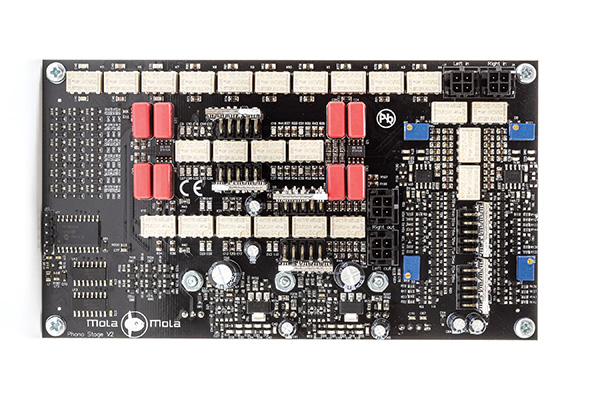
 Typically, moving magnet inputs are comparatively simple, with fixed gain, a fixed 47k ohm load, and perhaps, on the fancier ones, a capacitive loading option. Japanese manufacturers have traditionally taken moving magnet cartridges more seriously, offering a wider range of moving magnet input options. For example, the Luxman EQ-500, reviewed by Art Dudley in 2016, has just two settings for the moving coil input but a host of adjustments for moving magnet cartridges. The Lupe follows this lead, with five moving magnet resistance loads, from 18k ohms to 120k ohms, eight capacitive loads, from 0pF to 380pF, and two gain settings, at 45dB and 50dB. This final setting is the only place where I can foresee a cartridge compatibility issue, specifically with low-output induced-magnet cartridges like some of the better Grado and especially Soundsmith models. These cartridges require a load resistance close to 47k ohms, but their low output—as low as 0.4mV with some Soundsmith models—requires more than 50dB of gain. If you're thinking that you could simply use the higher gain moving coil input instead—well you could, but you'd run into a loading problem, with the 1k ohm maximum resistive load setting over on the moving coil side.
To explore this issue, I tried using the Lupe with my 1mV–output Grado Epoch cartridge through the moving magnet input, set to 50dB gain, and found that it was fine, with sufficient gain and very low noise. Still, I'm less confident that Soundsmith cartridges with even lower output would work as well. These are very isolated examples. With 99% of cartridges, the Lupe's adjustments will cover all bases.
Moving on: Additional controls on each preset include a mono switch, a subsonic filter, and the ability to invert the polarity of each channel. That last setting is useful when playing vertically cut records, such as Edison Diamond Discs or transcription records. Hopefully I can keep the Lupe around long enough to try this with some of the transcription records I have with Stan Maxwell's Gates turntable.
Typically, moving magnet inputs are comparatively simple, with fixed gain, a fixed 47k ohm load, and perhaps, on the fancier ones, a capacitive loading option. Japanese manufacturers have traditionally taken moving magnet cartridges more seriously, offering a wider range of moving magnet input options. For example, the Luxman EQ-500, reviewed by Art Dudley in 2016, has just two settings for the moving coil input but a host of adjustments for moving magnet cartridges. The Lupe follows this lead, with five moving magnet resistance loads, from 18k ohms to 120k ohms, eight capacitive loads, from 0pF to 380pF, and two gain settings, at 45dB and 50dB. This final setting is the only place where I can foresee a cartridge compatibility issue, specifically with low-output induced-magnet cartridges like some of the better Grado and especially Soundsmith models. These cartridges require a load resistance close to 47k ohms, but their low output—as low as 0.4mV with some Soundsmith models—requires more than 50dB of gain. If you're thinking that you could simply use the higher gain moving coil input instead—well you could, but you'd run into a loading problem, with the 1k ohm maximum resistive load setting over on the moving coil side.
To explore this issue, I tried using the Lupe with my 1mV–output Grado Epoch cartridge through the moving magnet input, set to 50dB gain, and found that it was fine, with sufficient gain and very low noise. Still, I'm less confident that Soundsmith cartridges with even lower output would work as well. These are very isolated examples. With 99% of cartridges, the Lupe's adjustments will cover all bases.
Moving on: Additional controls on each preset include a mono switch, a subsonic filter, and the ability to invert the polarity of each channel. That last setting is useful when playing vertically cut records, such as Edison Diamond Discs or transcription records. Hopefully I can keep the Lupe around long enough to try this with some of the transcription records I have with Stan Maxwell's Gates turntable.
 I was born a couple of years into the stereo LP era; I must confess that my record collection does not include an extensive selection of early mono pressings. I do have plenty of mono records, but most of them are from the late 1950s or reissues cut well after RIAA was established. I do however have a first pressing of RCA LM-1086, Brahms's 4th Symphony, with the venerable Boston Symphony Orchestra conducted by Charles Munch. This April 1950 recording was made with the legendary RCA recording team of producer Richard Mohr and recording engineer Lewis Layton, about five years before they started working in stereo to create many of the best regarded RCA Living Stereo releases. 1950 was also a couple of years before RCA was using the New Orthophonic curve, so the Lupe's app told me to use their early-RCA preset. Playing the record on the SME 30/2 with the Korf tonearm and Miyajima Kotetu mono cartridge, I was able to switch easily between the early RCA curve and RIAA, focusing in on the differences. But the first thing I noticed was just how clean this not-quite-three-quarters-of-a-century-old record sounded. The surfaces were smooth and quiet, and the tracking was superb, with no breakup or distortion.
Tonally, I heard two key differences between the RIAA and RCA curves. With the latter, the bottom end was leaner and tighter and the midrange opened up. With RIAA, the midrange sounded a bit more closed in and boxy and a bit thick at times.
I was born a couple of years into the stereo LP era; I must confess that my record collection does not include an extensive selection of early mono pressings. I do have plenty of mono records, but most of them are from the late 1950s or reissues cut well after RIAA was established. I do however have a first pressing of RCA LM-1086, Brahms's 4th Symphony, with the venerable Boston Symphony Orchestra conducted by Charles Munch. This April 1950 recording was made with the legendary RCA recording team of producer Richard Mohr and recording engineer Lewis Layton, about five years before they started working in stereo to create many of the best regarded RCA Living Stereo releases. 1950 was also a couple of years before RCA was using the New Orthophonic curve, so the Lupe's app told me to use their early-RCA preset. Playing the record on the SME 30/2 with the Korf tonearm and Miyajima Kotetu mono cartridge, I was able to switch easily between the early RCA curve and RIAA, focusing in on the differences. But the first thing I noticed was just how clean this not-quite-three-quarters-of-a-century-old record sounded. The surfaces were smooth and quiet, and the tracking was superb, with no breakup or distortion.
Tonally, I heard two key differences between the RIAA and RCA curves. With the latter, the bottom end was leaner and tighter and the midrange opened up. With RIAA, the midrange sounded a bit more closed in and boxy and a bit thick at times.
 The human voice was also well served by the Lupe. When I played "I Could Write a Book" from Johnny Hartman's album Once in Every Life (Bee Hive BH 7012), I was able to bask in the rich glow of Hartman's deep baritone. I have been using this record to evaluate equipment for over 35 years, and I can't recall any phono stage that extracted more music from it than the Lupe. In some systems, the sound of this record can edge toward brightness and sibilance, but with the Lupe, everything was impressively resolved and clean.
This is not a warm, fuzzy-sounding phono stage, but it is exceptional in its ability to take all the information a cartridge throws at it and sort it into a sound that's coherent and detailed, and it never sounds bright or hard. "Resolving" is the word that keeps popping into my head. When it comes to sorting out recordings, the Lupe can out-resolve just about anything I've heard.
The human voice was also well served by the Lupe. When I played "I Could Write a Book" from Johnny Hartman's album Once in Every Life (Bee Hive BH 7012), I was able to bask in the rich glow of Hartman's deep baritone. I have been using this record to evaluate equipment for over 35 years, and I can't recall any phono stage that extracted more music from it than the Lupe. In some systems, the sound of this record can edge toward brightness and sibilance, but with the Lupe, everything was impressively resolved and clean.
This is not a warm, fuzzy-sounding phono stage, but it is exceptional in its ability to take all the information a cartridge throws at it and sort it into a sound that's coherent and detailed, and it never sounds bright or hard. "Resolving" is the word that keeps popping into my head. When it comes to sorting out recordings, the Lupe can out-resolve just about anything I've heard.
Footnote 3: DG and Teldec were both major players in the EQ-curve game.















