The D7s gave me the kind of imaging and image specificity I associate with small stand-mounted monitors. You know how Brits like to place their speakers close to the front wall; the D7s seemed to want some distance—at least 3'. They worked for me in the relative nearfield, toed in slightly. I suspect that the D7 owner has considerable leeway in positioning them. If your room is long and narrow, you might get away with placing them about 4' from the front wall and very close to the sidewalls.
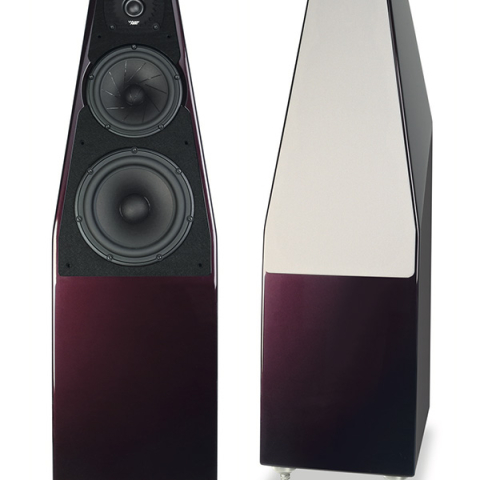
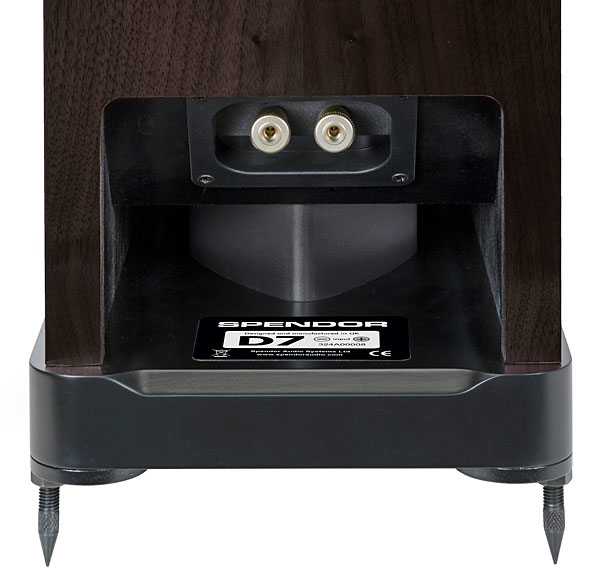
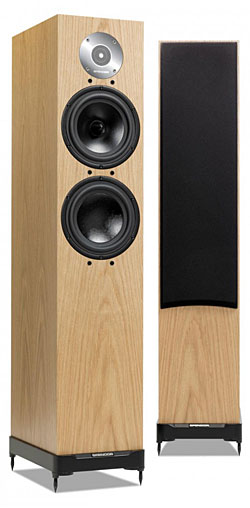
Over the years, all sorts of materials have been tried for woofer cones. Doped paper. Plastic recycled from old shampoo bottles. Hemp. Aluminum (ouch). The D7's 7" (180mm) mid/woofer has a cone of copolymer (plastic); the 7" woofer—or "LF drive unit," as Spendor calls it—has a Kevlar-composite cone. Kevlar is the stiff stuff used for everything from body armor to bicycle tires to hunting trousers. The 7/8" (22mm) tweeter sports a precision-woven polyamide dome, if that catches your fancy—it's fabric, not metal. I'm more interested in the way the tweeter is built into a damped acoustical chamber, with the dome behind a protective plate of stainless steel. A phase-correcting screen built into the plate is said to allow all parts of the dome to act in a similar, linear fashion, and guards against the prying digits of fool audiophiles.
Spendor describes the D7 as a "2.5-way" speaker. The bottom, bass-only driver has Kevlar-reinforced skins on a lightweight cone and runs up to 900Hz, the mid/woofer up to 3.2kHz, where the tweeter takes over. The D7's overall frequency response is 29Hz–25kHz.
That's the short of it. For more technical details, see Spendor's website, where you can mull such terms as linear pressure zone.
 Spendor sonics
In my listening room, where once resided my Spendor BC1s, I noticed especially fine treble dispersion and extension, as well as freedom from any harshness. The treble had a crystalline clarity that put the Spendor D7 among the finest speakers I have heard at any price. I noticed this particularly with piano recordings, such as Simone Dinnerstein's Something Almost Being Said, a collection of music by J.S. Bach and Schubert (CD, Sony Masterworks 798943). I've heard Dinnerstein live, and I must say that the D7s brought her sound and her presence into my listening room. Then there's the British pianist Christian Blackshaw. The other day, on BBC 3, I heard a live recital of him playing works by Mozart, Beethoven, and Schubert. I keep replaying it for this week that it remains available for streaming. Exquisite. I looked up his discography and found Vol.1 of his cycle of Mozart's piano sonatas (1, 2, 8, 9, 17), which I heartily recommend (2 CDs, Wigmore Hall Live 61). Few pianists perform so quietly, so sensitively, without regard to creating a sensation. Awe-inspiring. I can hardly wait for the late Schubert sonatas. Blackshaw is now 65. His playing is comparable to that of Sviatoslav Richter, which is to say that it's otherwise incomparable.
I turned to the Endellion String Quartet's recording of Schubert's quartets 13 ("Rosamunde") and 14 ("Death and the Maiden"), D.804 and D.810 (CD, Warner Classics 664232). Talk about a work to die for—Schubert was soon to do just that. I like stringed instruments to sound bright and lively, yet full, rich, and sweet at the same time. The D7s delivered, though some might welcome a slightly softer tone. It would be fascinating to compare the D7 with Spendor's Classic SP1/2R2.
 The cabinet is well braced but has little stuffing, which may account for the tight, controlled bass and the seamless sound. In no way did the bass lag behind. What I found especially rare about the D7, for a relatively small loudspeaker, was its authority, weight, and speed. You could spend far more for a speaker and not get such a fast, highly resolving sound, and such a sweet midrange. As sweet as the speakers in Spendor's Classic line? Comparing them would be a splendid way to spend an afternoon. I turned to more robust, more full-bodied classical fare.
Carlo Maria Giulini's cycle of the Brahms symphonies with the Vienna Philharmonic has long been a favorite. His Los Angeles Philharmonic cycle suffers from a mediocre acoustic and muddled recording. Both are on Deutsche Grammophon. The Vienna cycle was briefly available a few years ago as Newton Classics 8802063. See if you can pick up that 4-CD set for around $20. Check Berkshire Record Outlet, where it could be a "Featured Restock!" (footnote 1).
Listen to the opening bars of Symphony 1 and the way Giulini drives the music home. (I twice heard him conduct the work live.) Few loudspeakers can convey the power without the aid of a pesky subwoofer or two. Or without pooping out. The D7s could, given enough power.
But how little power?
I was listening mainly with my Quicksilver Silver 88 tubed monoblocks. There, on a nearby table, I spied my 3.5Wpc wonder, the Sun Audio SV-2A3, also tubed. Why not?
The sound was glorious: the life, the space, the resolution. If only there were more power to bring out the Spendor's splendid bass. The sound lacked large-scale dynamics, bottom-end weight and authority. Nice try.
Flea-watt amps aside, the D7s didn't seem overly fussy. The bass control was equally firm with the Quicksilvers, as it was with the solid-state Musical Fidelity M6PRX. Through these quite different power amps, the D7s' sound remained, overall, surprisingly consistent.
Conclusion
The cabinet is well braced but has little stuffing, which may account for the tight, controlled bass and the seamless sound. In no way did the bass lag behind. What I found especially rare about the D7, for a relatively small loudspeaker, was its authority, weight, and speed. You could spend far more for a speaker and not get such a fast, highly resolving sound, and such a sweet midrange. As sweet as the speakers in Spendor's Classic line? Comparing them would be a splendid way to spend an afternoon. I turned to more robust, more full-bodied classical fare.
Carlo Maria Giulini's cycle of the Brahms symphonies with the Vienna Philharmonic has long been a favorite. His Los Angeles Philharmonic cycle suffers from a mediocre acoustic and muddled recording. Both are on Deutsche Grammophon. The Vienna cycle was briefly available a few years ago as Newton Classics 8802063. See if you can pick up that 4-CD set for around $20. Check Berkshire Record Outlet, where it could be a "Featured Restock!" (footnote 1).
Listen to the opening bars of Symphony 1 and the way Giulini drives the music home. (I twice heard him conduct the work live.) Few loudspeakers can convey the power without the aid of a pesky subwoofer or two. Or without pooping out. The D7s could, given enough power.
But how little power?
I was listening mainly with my Quicksilver Silver 88 tubed monoblocks. There, on a nearby table, I spied my 3.5Wpc wonder, the Sun Audio SV-2A3, also tubed. Why not?
The sound was glorious: the life, the space, the resolution. If only there were more power to bring out the Spendor's splendid bass. The sound lacked large-scale dynamics, bottom-end weight and authority. Nice try.
Flea-watt amps aside, the D7s didn't seem overly fussy. The bass control was equally firm with the Quicksilvers, as it was with the solid-state Musical Fidelity M6PRX. Through these quite different power amps, the D7s' sound remained, overall, surprisingly consistent.
Conclusion
The D7 is a splendid Spendor. One might seriously question the need to spend any more than $6495 for a pair of speakers. Goodness knows, I'm no spendswift. Or spendorthrift.
Footnote 1: It is is still available at ArkivMusic, for $27.49, though it's listed as a "Backorder" item; also, all four of Giulini/VPO's Brahms symphony recordings are included in the 15-CD boxed set Giulini in Vienna (DG) for $80.49, also at Arkiv.— Ed.
Spendor sonicsIn my listening room, where once resided my Spendor BC1s, I noticed especially fine treble dispersion and extension, as well as freedom from any harshness. The treble had a crystalline clarity that put the Spendor D7 among the finest speakers I have heard at any price. I noticed this particularly with piano recordings, such as Simone Dinnerstein's Something Almost Being Said, a collection of music by J.S. Bach and Schubert (CD, Sony Masterworks 798943). I've heard Dinnerstein live, and I must say that the D7s brought her sound and her presence into my listening room. Then there's the British pianist Christian Blackshaw. The other day, on BBC 3, I heard a live recital of him playing works by Mozart, Beethoven, and Schubert. I keep replaying it for this week that it remains available for streaming. Exquisite. I looked up his discography and found Vol.1 of his cycle of Mozart's piano sonatas (1, 2, 8, 9, 17), which I heartily recommend (2 CDs, Wigmore Hall Live 61). Few pianists perform so quietly, so sensitively, without regard to creating a sensation. Awe-inspiring. I can hardly wait for the late Schubert sonatas. Blackshaw is now 65. His playing is comparable to that of Sviatoslav Richter, which is to say that it's otherwise incomparable.
The cabinet is well braced but has little stuffing, which may account for the tight, controlled bass and the seamless sound. In no way did the bass lag behind. What I found especially rare about the D7, for a relatively small loudspeaker, was its authority, weight, and speed. You could spend far more for a speaker and not get such a fast, highly resolving sound, and such a sweet midrange. As sweet as the speakers in Spendor's Classic line? Comparing them would be a splendid way to spend an afternoon. I turned to more robust, more full-bodied classical fare.
Carlo Maria Giulini's cycle of the Brahms symphonies with the Vienna Philharmonic has long been a favorite. His Los Angeles Philharmonic cycle suffers from a mediocre acoustic and muddled recording. Both are on Deutsche Grammophon. The Vienna cycle was briefly available a few years ago as Newton Classics 8802063. See if you can pick up that 4-CD set for around $20. Check Berkshire Record Outlet, where it could be a "Featured Restock!" (footnote 1).
Listen to the opening bars of Symphony 1 and the way Giulini drives the music home. (I twice heard him conduct the work live.) Few loudspeakers can convey the power without the aid of a pesky subwoofer or two. Or without pooping out. The D7s could, given enough power.
The D7 is a splendid Spendor. One might seriously question the need to spend any more than $6495 for a pair of speakers. Goodness knows, I'm no spendswift. Or spendorthrift.
Footnote 1: It is is still available at ArkivMusic, for $27.49, though it's listed as a "Backorder" item; also, all four of Giulini/VPO's Brahms symphony recordings are included in the 15-CD boxed set Giulini in Vienna (DG) for $80.49, also at Arkiv.— Ed.