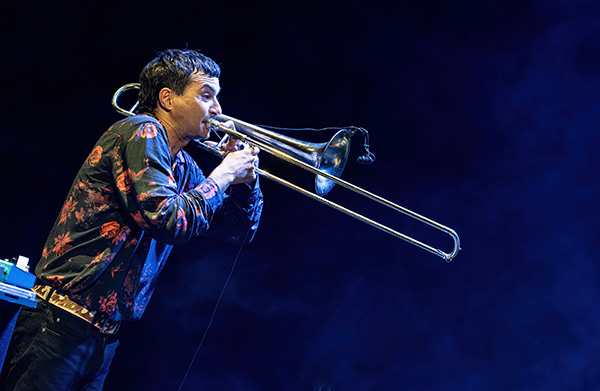
Gianluca Petrella, Teatro Morlacchi.
This year's festival provided further confirmation that the leading jazz scene outside the United States is Italy. Many of the best Italians were there: Enrico Rava. Paolo Fresu. Fabrizio Bosso. Gianluca Petrella. Flavio Boltro. Stefano di Battista. Enrico Morello. And that is before we get to the piano players. The greatest strength of the Italian jazz scene is pianists. The top four are Stefano Bollani, Enrico Pieranunzi, Danilo Rea, and Dado Moroni.
But one searches in vain for Italian names in the 71st DownBeat Critics Poll. The almost complete absence of Italians speaks volumes about the ethnocentrism of the American jazz community and its ignorance about jazz beyond its borders. In addition to its possible utility as a jazz travelogue, this article aspires to chip away at that ignorance.
Enrico Pieranunzi is the oldest (73) of the four greatest living Italian pianists, with the largest body of work. Like so many European jazz pianists, he started in classical music. He has recorded albums of improvisations on Scarlatti sonatas. But he chose jazz as his calling in his early 20s.
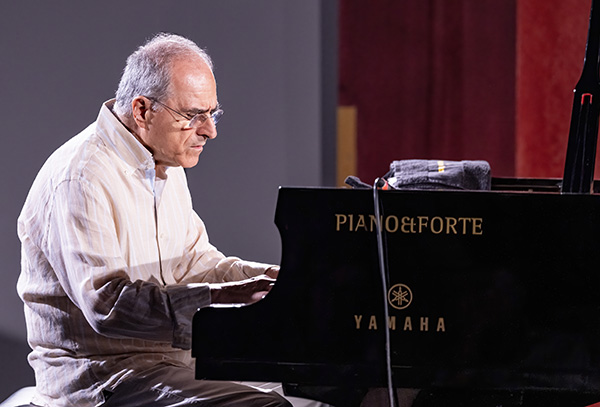
Enrico Pieranunzi, Sala Podiani.
Pieranunzi played a solo recital in Sala Podiani. With a capacity of 150, it was the most intimate of the festival's primary venues and was nearly always sold out. An accomplished composer, Pieranunzi played almost exclusively originals. They all sounded vaguely familiar, not because you had heard them before but because their inevitable melodies seemed to already exist somewhere in your musical subconscious. In an interview after his concert, Pieranunzi said, "When you play an original that you have played many times, but the people don't know, you have to make sure to tell a story. In jazz, interpretation is as important as composition. Maybe more. Chet Baker wrote very few tunes in his life, but anything he played became his own song. I think interpretation is an underrated aspect of jazz today. There aren't so many storytellers left."
When he played originals like "Flowering Stones" and "Molto Ancora," their stories were implicit in their plaintive melodies, which kept emerging in myriad permutations, through improvisation. And when he played standards like "Yesterdays" and "Everything I Love," he (like Chet Baker) made them his own, with new harmonies and personal interpretations of their enduring melodies.
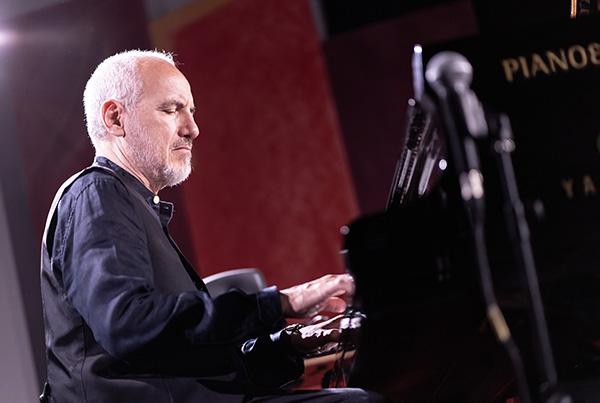
Danilo Rea, Sala Podiani.
Danilo Rea also performed solo in Sala Podiani. When Enzo Capua introduced him, he called Rea the "grandissimo melodista." A Rea solo recital is an unbroken, spontaneous, stream-of-consciousness outpouring. The first song he played was Sting's "Englishman in New York." In an interview later that day, he said that he had never played it before but had heard it on the radio that morning. To say that Rea "plays songs" is imprecise. In his extemporaneous creative process, in his flow of the moment, he comes upon them. Sometimes he barely brushes against a known melody; sometimes he lingers. Songs provoke other songs, in a suite that connects touchpoints of memory.
In two hour–long concerts, Rea never stopped to think and never repeated a song. For an American like me, the second show was best because it contained more tunes I knew. "Moon River" became "The Man I Love" became "As Time Goes By" became "When You Wish Upon a Star" became Carole King's "You've Got a Friend." Rea told me that his piano teacher at the Santa Cecilia conservatory in Rome, Liliana Vallazza, always demanded that he think about "il suono"—the sound. Rea is a rare jazz pianist who gets his own suono from a piano. He makes the instrument sing. Leonard Cohen's masterpiece "Hallelujah" has been covered by many singers. Its lyrics are epic. Rea sang it on the piano, without words. He fully rendered its inherent drama. He filled Sala Podiani with the suono of Leonard Cohen's song.
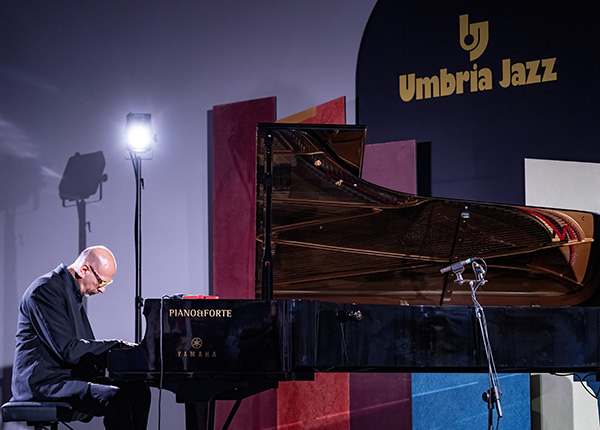
Dado Moroni, Sala Podiani.
Dado Moroni is a different Italian pianist. He did not start in classical music and is not conservatory-trained. He is self-taught and does not read music well. But his chops are electric. Few living piano players can knock you back in your chair like Moroni can. He is by far the "most American" of the four pianists under discussion. His primary influence is probably Alfred McCoy Tyner. In his solo performance in Sala Podiani, you could sometimes hear Tyner in Moroni's thundering left-hand chords and hurtling right-hand runs. One of the pieces he played was his own "Brother Alfred," which is dedicated to Tyner. Like Tyner's, Moroni's playing contains a spiritual power that makes many fine pianists sound somewhat prissy.
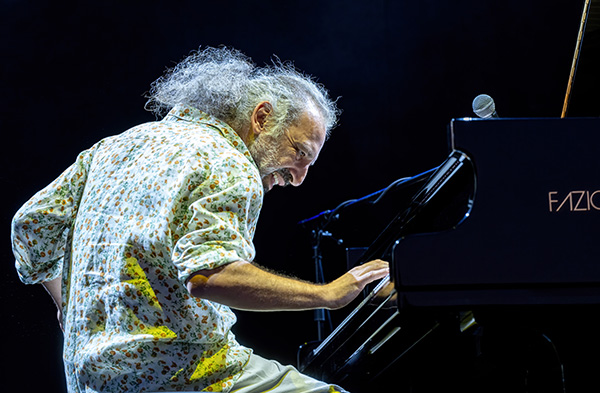
Stefano Bollani, Arena Santa Giuliana.
By broad consensus, Stefano Bollani is the greatest pianist in Italy. (He is one of the greatest anywhere, a fact that you would not glean from the DownBeat Critics Poll, which ignored him.) To find comparisons to Bollani's level of keyboard mastery, you have to go to Keith Jarrett and Brad Mehldau, or further back to Oscar Peterson. In Italy, he is a superstar. He did not appear in Sala Podiani, but in Arena Santa Giuliana. With just his piano, solo, he came close to filling it.
Perhaps the most jaw-dropping performance in Bollani's long concert was "All the Things You Are." Jerome Kern's song often stimulates jazz musicians to go for broke, perhaps because of its harmonic erudition and challenging modulations. Bollani incinerated it. He exploded it, at a velocity that rendered unnecessary all future attempts to display technical virtuosity based on "All the Things You Are."