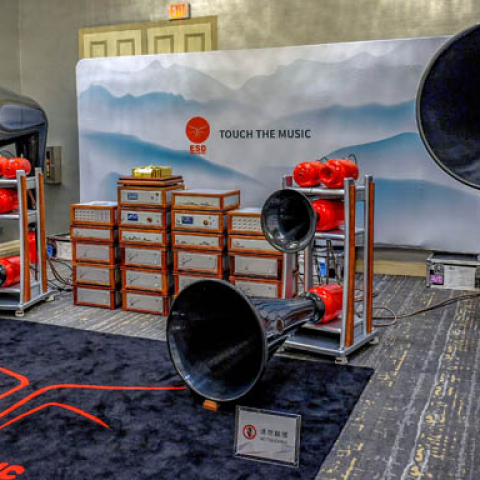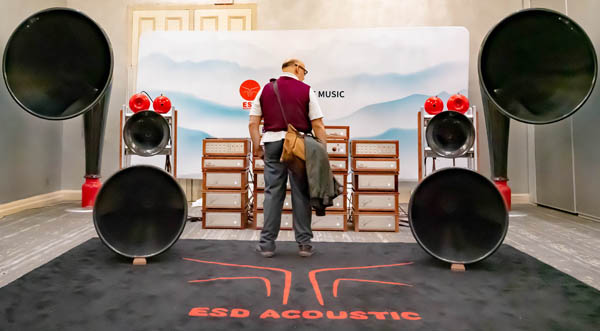
Late on Friday at the New York Audio Show, I found myself explaining to an audiophile friend, also in attendance, my reaction to the big room sponsored by ESD Acoustic, and to their huge, extravagant, ostentatious five-way horn system—the one my colleagues Sasha Matson and Ken Micallef described in detail, and about which my colleague Herb Reichert contrasted his favorable experience here in New York with his unfavorable experience at the 2018 Munich show. As configured, the system as displayed would cost some $800,000 here in the United States. I smugly explained to my friend that, in taking on such an ambitious project, the ESD folks had set for themselves—and subsequently met—a set of arbitrary, difficult, and ultimately unnecessary technical challenges. Why go to the trouble of putting together a system like this when simpler, cheaper systems could accomplish much the same thing? Look at all those boxes! Look at that price tag!
In part, my response was that of an audio critic. Musically, the ESD system was fine—better than just fine—but hardly life-altering. For such a massive system, with so many disparate parts, it blended well. It played without congestion, and the frequency response was good. Bass horns taller than me provided low bass, but they did not provide too much bass. So
well done! But did it sound significantly better than many much simpler and less extravagant systems? Not to me.
Still, my initial response was partly—or mainly—an instance of my innate conservatism, a characteristic I work hard to exorcise. Why do something unnecessary? Why not just do nothing instead?
Yet later, after a bit more self-examination, that preliminary, negative reaction was replaced by a more positive one: Why the hell not? If you love audio and have the resources, why not set out on a near-Quixotic quest? Got anything better to do with your life?
I decided to write this postscript because the question gets at something basic about our audio pursuit: Why do we do it? Some say it's all about the music—but that assertion has always, to me, seemed unsatisfying and incomplete. I love music, sure, but I also love sound, and I also love beautiful machines. Some say it's a high-end consumerist hobby for rich people—true enough, but also incomplete. I love the challenge of optimizing a system and the giddy anticipation I feel—still, after a decade and a half of reviewing—whenever I plug in a new component.
I could of course put the money I spend on audio into feeding the poor instead, or addressing climate change, or put my time into helping the good guys win some important election. If, some day, I find myself in a position to make a real difference in that world, I'll surely pursue that Quixotic quest. Meanwhile, I'll keep experimenting with and writing about audio. Why? Because it's important, I feel, to pursue our enthusiasms. God—or whoever, or whatever—gave each of us particular, idiosyncratic natures; surely we are meant to pursue them. My wife and I even inserted something about that—promising to help each other fulfill our natures—in our wedding vows.
The longer I live, the more I feel there's something Quixotic about mere daily existence. Everyday routine can dull enthusiasm and make us forget what an absurd quest we're all on—the quest to find satisfaction and meaning or just stay alive—but that doesn't change the reality. "Just as on a stormy sea," Schopenhauer wrote, "that, unbounded in all directions, raises and drops mountainous waves, howling, a sailor sits in a boat and trusts his frail bark; so in the midst of a world of torments, the individual man sits quietly, supported by and trusting [the principle of individuation]." (I encountered Schopenhauer filtered through Nietzsche's The Birth of Tragedy, so my interpretation likely shares Nietzsche's faults while adding some of my own.)
If tossing waves and a fragile, sinking ship is the basic truth of existence, then why do we not live our lives in a panic? One can argue that we should have a more intense and frequent awareness of this plight—that the comforts we surround ourselves with numb us too much to these fundamental truths of existence. But that, too, is our nature—to seek comfort—and anyway, cohabitating with panic and anxiety is a crappy way to live.
So we turn instead to art—in Nietzsche's formulation, to "Apollonian" images: beautiful, solid, shining things. "Thus, the sculptor would shape the marble in order that one beholding it might come to see those forms—for instance the gods—that already hovered before his own phantastic vision," writes John Sallis in his essay "Shining Apollo." "The epic poet would do much the same thing, though more indirectly, by leading the listener to engage himself in a certain artistic composing by which he would come to see the very figure or image that hovered before the poet." For music, substitute "composer" or "musician" for "epic poet."
"Thus is the goal attained," Nietzsche wrote. "'I understand the image because I have myself produced it.'"
Do I need to explain the relevance of all this to arbitrary and seemingly Quixotic quests? What else are we gonna do with the time we have available? What quests of value are not ultimately Quixotic—and also arbitrary? Examined from the perspective of everyday, routine life, what's the value in painting pictures (art), or in making up fake stories (literature)? The obvious answer is, what else are we going to do with our time? Also: What could be better?
Is it silly to invoke Nietzsche and Schopenhauer and high art in discussing high-end audio? Not to me. True, audio is full of paradox and contradiction. It is, in fact—among other things—an expensive consumerist hobby, an adrenaline rush we get by spending money. And some pursuits and creations, of course, are worthier than others: Huckleberry Finn, The Starry Night, The Brothers Karamazov are surely more valuable than an audio system wrought from carbon fiber. But that doesn't mean that lesser works lack value.
If there's something else you ought to be doing—something more important—go do it. Meanwhile, dive in.