The audibility of any distortion depends on its order. Low-order harmonics are preferable because they're musically consonant—see my essay on this subject in the Stereophile Test CD 2 booklet—and more easily masked by musical fundamentals. Figs. 9 and 10 reveal that the RM-200's distortion is predominantly third-harmonic. Fig.9 was taken with a 1kHz sinewave at a low level (1W into 8 ohms from the 8 ohm tap), with just 0.011% THD. Fig.10 was taken about 3dB below clipping into 4 ohms from the 4 ohm tap, with a low-frequency tone. The third harmonic lies at -50dB (0.3%), with the second, fourth, and fifth harmonics all below -70dB (0.03%). The picture was similar with a 1kHz tone at 40W into 4 ohms (not shown), but halving the power to 20W dropped the higher harmonics to very low levels (fig.11). 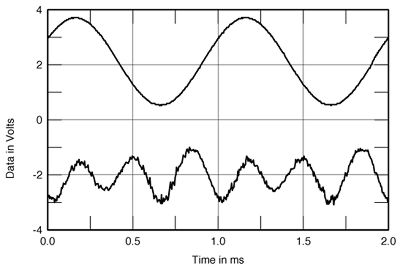 Fig.9 Music Reference RM-200, 8 ohm tap, 1kHz waveform at 1W into 8 ohms (top), distortion and noise waveform with fundamental notched out (bottom, not to scale).
 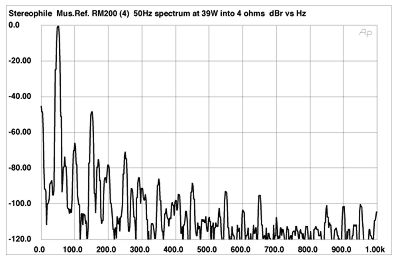 Fig.10 Music Reference RM-200, 4 ohm tap, spectrum of 50Hz sinewave, DC-1kHz, at 39W into 4 ohms (linear frequency scale).
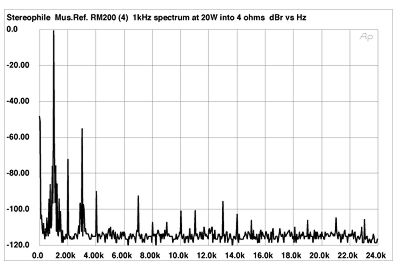 Fig.11 Music Reference RM-200, 4 ohm tap, spectrum of 1kHz sinewave, DC-1kHz, at 20W into 4 ohms (linear frequency scale). Because of the amplifier's increased nonlinearity above the audioband, the high-level, high-frequency intermodulation plot (fig.12) featured reasonably high levels of high-order products; for example, -50dB (0.3%) at 21kHz. The 1kHz difference tone was at a respectable -74dB (0.002%), however.
 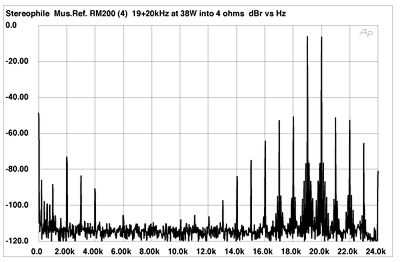 Fig.12 Music Reference RM-200, 4 ohm tap, HF intermodulation spectrum, DC-24kHz, 19+20kHz at 38W into 4 ohms (linear frequency scale).
Finally, figs. 13, 14, and 15 show how the Music Reference's THD+noise percentage changes with power level from each of the three transformer taps with both channels driven. With clipping defined as 1% THD, the amplifier does meet its 100Wpc specification from the 8 ohm tap into 8 ohms, giving 110W into this load (20.4dBW). However, the fairly "soft" clipping behavior means that the definition of clipping must be relaxed to 3% THD for the RM-200 to give its specified power from the 4 ohm tap (into 4 and 2 ohm loads). Nevertheless, the RAM still gives 95W into 4 ohms from the 4 ohm tap at 1% THD, which misses the specification by only a subjectively inconsequential 0.2dB.
Fig.12 Music Reference RM-200, 4 ohm tap, HF intermodulation spectrum, DC-24kHz, 19+20kHz at 38W into 4 ohms (linear frequency scale).
Finally, figs. 13, 14, and 15 show how the Music Reference's THD+noise percentage changes with power level from each of the three transformer taps with both channels driven. With clipping defined as 1% THD, the amplifier does meet its 100Wpc specification from the 8 ohm tap into 8 ohms, giving 110W into this load (20.4dBW). However, the fairly "soft" clipping behavior means that the definition of clipping must be relaxed to 3% THD for the RM-200 to give its specified power from the 4 ohm tap (into 4 and 2 ohm loads). Nevertheless, the RAM still gives 95W into 4 ohms from the 4 ohm tap at 1% THD, which misses the specification by only a subjectively inconsequential 0.2dB. 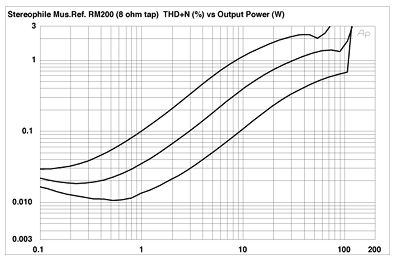 Fig.13 Music Reference RM-200, 8 ohm tap, distortion (%) vs continuous output power into (from bottom to top): 8 ohms, 4 ohms, 2 ohms.
 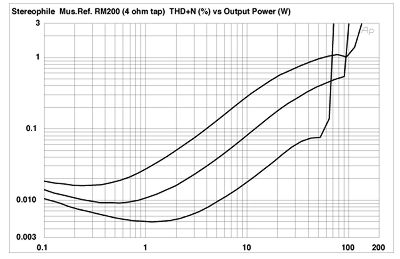 Fig.14 Music Reference RM-200, 4 ohm tap, distortion (%) vs continuous output power into (from bottom to top): 8 ohms, 4 ohms, 2 ohms.
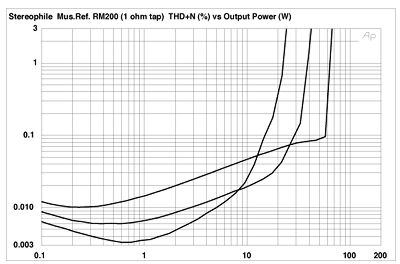 Fig.15 Music Reference RM-200, 1 ohm tap, distortion (%) vs continuous output power into (from bottom to top): 8 ohms, 4 ohms, 2 ohms. Fig.15 confirms the Music Reference's excellent linearity from its 1 ohm output. However, because of the low turns ratio of this transformer tap, only moderate power is available at 1% THD+N: 62W into 8 ohms (11.9dBW), 39.5W into 4 ohms (13dBW), or 22.2W into 2 ohms (13.5dBW). Although I was bothered by the Music Reference RM-200's poor linearity above the audioband, it struck me overall as a well-engineered amplifier. As long as it's matched with a loudspeaker whose impedance doesn't drop too far below the chosen transformer tap, its lack of noise and low levels of midband distortion are to be commended.—John Atkinson
Fig.9 Music Reference RM-200, 8 ohm tap, 1kHz waveform at 1W into 8 ohms (top), distortion and noise waveform with fundamental notched out (bottom, not to scale). Fig.10 Music Reference RM-200, 4 ohm tap, spectrum of 50Hz sinewave, DC-1kHz, at 39W into 4 ohms (linear frequency scale). Fig.11 Music Reference RM-200, 4 ohm tap, spectrum of 1kHz sinewave, DC-1kHz, at 20W into 4 ohms (linear frequency scale). Because of the amplifier's increased nonlinearity above the audioband, the high-level, high-frequency intermodulation plot (fig.12) featured reasonably high levels of high-order products; for example, -50dB (0.3%) at 21kHz. The 1kHz difference tone was at a respectable -74dB (0.002%), however. Fig.12 Music Reference RM-200, 4 ohm tap, HF intermodulation spectrum, DC-24kHz, 19+20kHz at 38W into 4 ohms (linear frequency scale). Fig.13 Music Reference RM-200, 8 ohm tap, distortion (%) vs continuous output power into (from bottom to top): 8 ohms, 4 ohms, 2 ohms. Fig.14 Music Reference RM-200, 4 ohm tap, distortion (%) vs continuous output power into (from bottom to top): 8 ohms, 4 ohms, 2 ohms. Fig.15 Music Reference RM-200, 1 ohm tap, distortion (%) vs continuous output power into (from bottom to top): 8 ohms, 4 ohms, 2 ohms. Fig.15 confirms the Music Reference's excellent linearity from its 1 ohm output. However, because of the low turns ratio of this transformer tap, only moderate power is available at 1% THD+N: 62W into 8 ohms (11.9dBW), 39.5W into 4 ohms (13dBW), or 22.2W into 2 ohms (13.5dBW). Although I was bothered by the Music Reference RM-200's poor linearity above the audioband, it struck me overall as a well-engineered amplifier. As long as it's matched with a loudspeaker whose impedance doesn't drop too far below the chosen transformer tap, its lack of noise and low levels of midband distortion are to be commended.—John Atkinson