Sidebar 3: Measurements
I used DRA Labs' MLSSA system and a calibrated DPA 4006 microphone to measure the Forte III's frequency response in the farfield and an Earthworks QTC-40 mike for the nearfield responses.
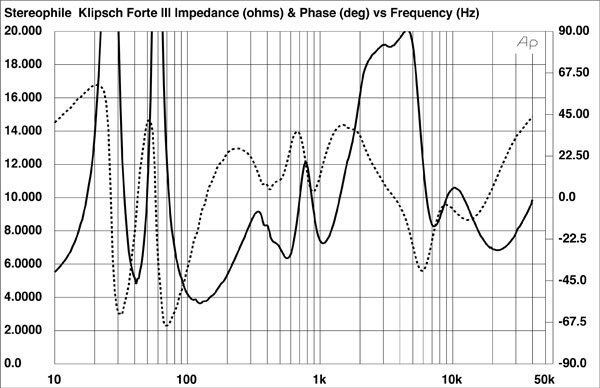
The Klipsch's specified sensitivity is an extraordinary 99dB/2.83V/m; my estimate was lower, at 95.2dB(B)/2.83V/m, but this is still 8dB higher than the average sensitivity of the speakers I have measured over the past 30 years. This speaker will play loudly with a mere handful of watts. Klipsch specifies the Forte III's nominal impedance as "8 ohms compatible." I found that the speaker's impedance magnitude (fig.1, solid trace) dropped below 6 ohms only in the upper bass and in the valley between the twin low-frequency peaks that define the reflex woofer loading. The minimum value is 3.65 ohms at 125Hz. However, the electrical phase angle (dotted trace) is sometimes extreme, and there is a current-hungry combination of 5 ohms and –49° phase angle at 90Hz. Despite its high sensitivity, the Forte III will work best with amplifiers that are comfortable driving 4-ohm loads. And the very large difference between the average impedance in the lower midrange and that in the treble means that the speaker might sound a touch bright with tube amplifiers having high output impedances.
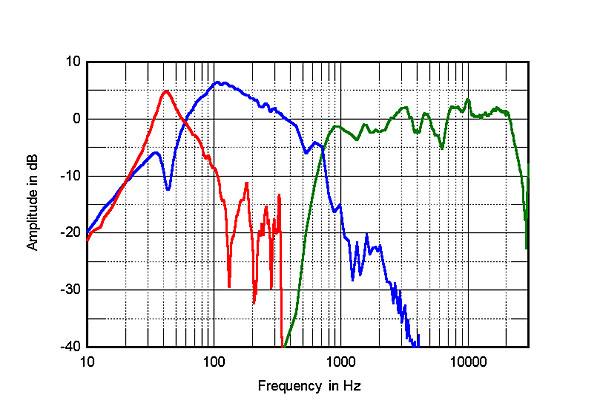 The crossover between the woofer's farfield output on the tweeter axis (fig.3, blue trace above 350Hz) and that of the midrange drive-unit (green trace) occurs slightly higher than the specified 650Hz. The filter slopes are asymmetrical, the output of the horn-loaded midrange unit rolling off very rapidly. The farfield response of the midrange unit and the horn-loaded tweeter, taken without the grille, has a flat trend but with some small peaks and dips, a suckout centered on the 5.2kHz upper crossover frequency, and a slight excess of energy in the top audio octave.
The black trace below 300Hz in fig.4 is the complex sum of the nearfield woofer and passive radiator responses taking into account acoustic phase and the different distances of the two diaphragms from a nominal farfield microphone distance. The rise in the mid- and upper bass is primarily due to the nearfield measurement technique, which assumes that the drive-units are mounted in a true infinite baffle—ie, one that extends to infinity in both the horizontal and vertical planes. But this rise does suggest that the Forte III's maximally flat low-frequency alignment will give a lot of bass in all but large rooms. Note that, despite its size, the Klipsch doesn't offer a lot of bass extension, it being tuned for sensitivity rather than extended lows.
The crossover between the woofer's farfield output on the tweeter axis (fig.3, blue trace above 350Hz) and that of the midrange drive-unit (green trace) occurs slightly higher than the specified 650Hz. The filter slopes are asymmetrical, the output of the horn-loaded midrange unit rolling off very rapidly. The farfield response of the midrange unit and the horn-loaded tweeter, taken without the grille, has a flat trend but with some small peaks and dips, a suckout centered on the 5.2kHz upper crossover frequency, and a slight excess of energy in the top audio octave.
The black trace below 300Hz in fig.4 is the complex sum of the nearfield woofer and passive radiator responses taking into account acoustic phase and the different distances of the two diaphragms from a nominal farfield microphone distance. The rise in the mid- and upper bass is primarily due to the nearfield measurement technique, which assumes that the drive-units are mounted in a true infinite baffle—ie, one that extends to infinity in both the horizontal and vertical planes. But this rise does suggest that the Forte III's maximally flat low-frequency alignment will give a lot of bass in all but large rooms. Note that, despite its size, the Klipsch doesn't offer a lot of bass extension, it being tuned for sensitivity rather than extended lows.
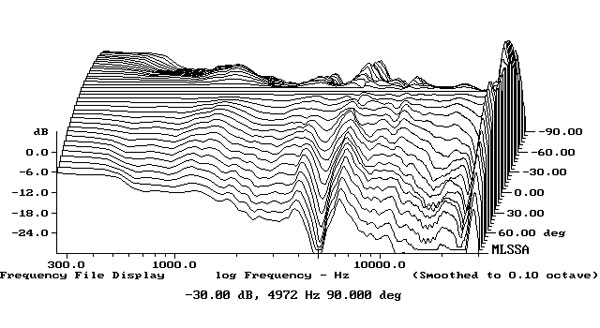
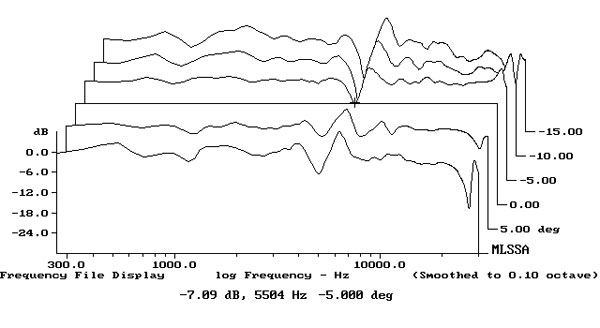
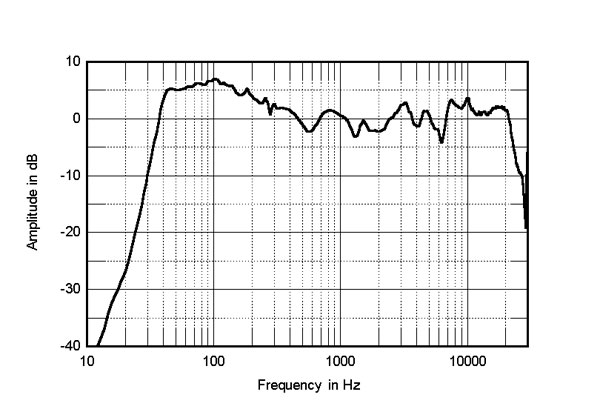 Higher in frequency in fig.4, the black trace shows the Klipsch's farfield response, averaged across a 30° horizontal window centered on the tweeter axis. Although the overall balance is even, several small suckouts and peaks are still evident between 1 and 20kHz. The plot of the Forte III's horizontal dispersion (fig.5) suggests that the suckout in the crossover region gets deeper to the speaker's sides. However, the speaker's radiation pattern is otherwise well-controlled and even up to 12kHz, above which the tweeter becomes fairly directional. In all but small rooms, this will tend to balance the slight excess of top-octave energy seen in figs. 3 and 4. In the vertical plane (fig.6), the on-axis crossover-region suckout appears to fill in 5° below the tweeter axis but deepens above it. As the tweeter is just 32" from the floor and the average (seated) listener's ears are 36" high, the Forte III might benefit from a slight amount of tiltback. However, as the suckout is very narrow, it might not be too much of an issue when it comes to treble sound quality.
 Turning to the time domain, the Forte III's step response (fig.7) is complicated. All three drive-units appear to be connected in inverted acoustic polarity, with the tweeter's output—the sharp down/up spike at 3.8ms—arriving first at the microphone. The output of the midrange unit is the lazier downward spike just before 4.5ms followed by the slow rise of the woofer's output. The decay of the midrange unit's step smoothly blends with that of the woofer, suggesting optimal crossover design. The difference in arrival times of the tweeter's output and that of the midrange unit can also be seen in the Klipsch's cumulative spectral-decay plot (fig.8). This is fairly clean in the region covered by the tweeter, but some delayed energy can be seen at lower frequencies.
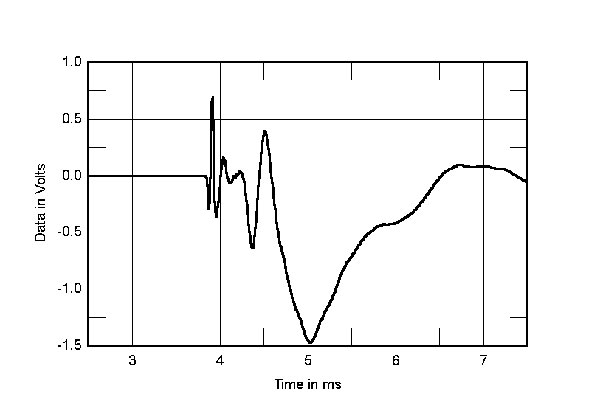
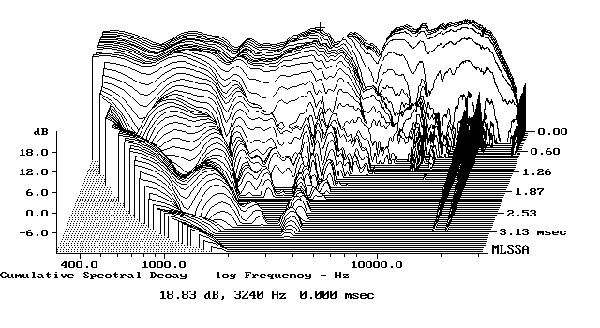
Fig.1 Klipsch Forte III, electrical impedance (solid) and phase (dashed) (2 ohms/vertical div.).
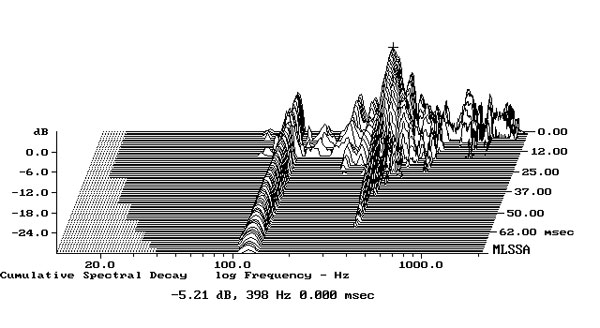
There are small discontinuities in the impedance traces, particularly around 125Hz and 400Hz, that would imply the presence of resonances of various kinds. When I investigated the enclosure's vibrational behavior with a plastic-tape accelerometer, I found a low-level resonant mode at 120Hz and a stronger one at 398Hz on the side panels (fig.2), and another at 434Hz on the top panel. Given the speaker's high sensitivity, these modes might not result in audible midrange congestion, however.
Fig.2 Klipsch Forte III, cumulative spectral-decay plot calculated from output of accelerometer fastened to sidewall level with midrange unit (MLS driving voltage to speaker, 7.55V; measurement bandwidth, 2kHz).
The Forte III's impedance-magnitude plot has a saddle in the bass centered on 43Hz, close to the frequency of the lowest note on the four-string electric bass and double bass, suggesting that this is the tuning frequency of the drone. The blue trace in fig.3 indicates that the output of the woofer, measured in the nearfield, has the expected minimum-motion notch at 43Hz, while the output of the passive radiator (red trace) peaks between 30 and 60Hz. Some midrange peaks are visible in the passive radiator's output. However, because this radiator is mounted on the rear panel, these modes shouldn't color the Forte III's midrange.
Fig.3 Klipsch Forte III, acoustic crossover on tweeter axis at 50", corrected for microphone response, with the nearfield woofer (blue) and port (red) responses, both plotted below 350Hz.
Fig.4 Klipsch Forte III, anechoic response on tweeter axis at 50", averaged across 30° horizontal window and corrected for microphone response, with the complex sum of the nearfield woofer and port responses plotted below 300Hz.
Fig.5 Klipsch Forte III, lateral response family at 50", normalized to response on tweeter axis, from back to front: differences in response 90–5° off axis, reference response, differences in response 5–90° off axis.
Fig.6 Klipsch Forte III, vertical response family at 50", normalized to response on tweeter axis, from back to front: differences in response 15–5° above axis, reference response, differences in response 5–10° below axis.
Fig.7 Klipsch Forte III, step response on tweeter axis at 50" (5ms time window, 30kHz bandwidth).
Fig.8 Klipsch Forte III, cumulative spectral-decay plot on tweeter axis at 50" (0.15ms risetime).
Multiway loudspeakers with horn-loaded upper-frequency drivers but a flat baffle can't be made time-coincident without the use of digital signal processing. Does this matter? Perhaps a more conventional speaker with time-aligned drive-units would give better-defined stereo imaging, but I keep coming back to the Forte III's astonishingly high sensitivity, one of the highest I have encountered. At typical listening levels, the drive-unit diaphragms will hardly be moving, which implies low distortion.—John Atkinson