During a recent e-mail exchange with
Music Direct's Josh Bizar, the topic turned to record cleaning. Josh shared with me his "Secret Record Cleaning Method."
Josh Bizar's Secret Record Cleaning Method
1. Buy a VPI 16.5.
2. Buy a simple record cleaning fluid.
3. Clamp a record on the cleaning machine.
4. Set platter in motion.
5. Apply about 12-15 drops of fluid and spread it around with a good (clean!) record brush.
6. Stop the platter and let the fluid sit there for a minute or so to loosen debris.
7. Scrub the LP on 1/4 of the record surface at a time using a back and forth motion. After a few cleanings, you'll be able to rotate the platter a quarter turn with a simple flick of the rotation switch on the VPI. Repeat the scrubbing on all four quadrants of the LP surface.
9. Move the vacuum pickup tube over the record surface.
10. Set the platter rotating. Turn on the vacuum and let it go around 2-3 revolutions MAX. Any more will just add static to the surface of the LP.
11. When you turn off the vacuum, gently lift the vacuum pickup tube off the surface of the record before stopping the platter rotation, so that you do not leave a line of fluid where the tube stops on the record surface.
12. Stop the platter rotation, unscrew the clamp and flip record.
13. Repeat the process on the other side of the LP, but first use the hard, stiff bristled brush that comes with the 16.5 to clean your record brush and the velvet lips of the vacuum pickup tube.
You'll notice that these steps are similar to
those that I outlined, but with a few wrinkles. Josh has owned his VPI HW-16.5 record cleaning machine for 15 years. He uses it every day and it is in perfect condition. Most vinyl lovers I know own a VPI HW-16.5. I have seen these machines in the back rooms of record shops and in the homes of audiophiles.
There are other options, of course. Find the machine that's right for you.
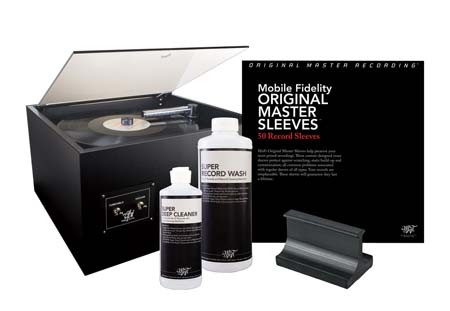
As for the "simple record cleaning fluid," Josh prefers Mobile Fidelity's Super Record Wash (Footnote) and he advises that you use an alcohol- and scent-free cleaner. Others would say that alcohol is completely safe for your records and even aids in removing dirt. I use a fluid that contains alcohol and, as far as I can tell, it hasn't damaged my LPs. I do, however, follow the alcohol cleaner with a pure water rinse. Just in case! I don't know about scented fluids, however. Josh says that any scents are derived from oils, and you wouldn't want to apply oil to your LPs. Makes sense (haw!) to me.
Josh uses Mobile Fidelity Record Brushes. He thinks the stock VPI brush is "a little stiff," but, as noted in his Step 13, he does use it to clean his other record brushes as well as the velvet pads on the VPI's vacuum pickup tube. While I do prefer the MoFi brushes, I have absolutely no problem with using the VPI brush to scrub my LPs. In fact, I sometimes even use the VPI brush as a sort of secret weapon against
really dirty records. Take that, scum! Like Josh, I have also gotten into the habit of using a VPI brush to clean my other brushes. It works well.
Josh's Step 7 was a surprise to me, and I have incorporated it into my own cleaning regimen. I am not sure, however, if it's any more effective than just scrubbing the LP back and forth while the platter is spinning. That said, stopping the platter and concentrating on one quarter of the LP at a time does allow you to apply more pressure while you scrub.
I find Josh's Step 11 to be unnecessary: When I turn off the VPI's vacuum, the pickup tube automatically pops up from the LP's surface. It may be that older models do not provide this convenience.
A few other things:
It makes sense to store your clean LPs in new inner sleeves. You won't want to put a freshly cleaned LP into an old, dusty sleeve. Some might disagree with this, preferring to use those old sleeves, especially when they're cool-looking (as they often are). As a compromise, I house my clean LPs in new sleeves, but place the old, colorful inner sleeves in between the LP jacket and outer sleeve. Is that crazy? Maybe. But I like it.
Josh recommends that you keep a few extra brushes handy. A couple reasons for this: Some people believe that you should even clean new records before playing them. Mold-release compound (a substance used to remove freshly pressed LPs from the pressing mold at the factory) remains on our new LPs and can degrade their sound. While I'm sorry to say that I
have found that cleaning brand new LPs results in better sound, I
have not gotten into the habit of cleaning all of my new records. It's just a bit tedious and I'm too impatient for it. In any case, you may not want to use the same brush to clean both your new LPs and your dirty old LPs. It would kind of be like using the same toothbrush to clean your teeth and the grout between your bathroom tiles. Also: If your record cleaning method involves more than one fluid—say, an enzymatic cleaner or an alcohol cleaner followed by a pure water rinse—you may want to have specific brushes for each fluid. You can label them: Clean and Rinse, Salt and Pepa, Love and Hate, Kid and Play, Sid and Nancy, DJ Jazzy Jeff and The Fresh Prince, whatever works for you.
Music Direct offers special packages to help get you started. The
VPI 16.5 Basic Bundle ($550), including bottles of MoFi's
Super Record Wash and
Super Deep Cleaner, one MoFi Record Brush, and a pack of 100 MoFi inner sleeves, is really an outstanding value. The VPI machine by itself costs $540.
While Josh Bizar believes that his method is the "simplest, fastest, and most effective way to clean a record," there are endless variations. Josh's method is the best method for him. You can have a completely different "simplest, fastest, and most effective" method. People will insist that a record cleaning machine is absolutely necessary if you really want to enjoy your LPs. It's not. A record cleaning machine is simply
the most effective tool for getting your LPs in good shape. If you can't afford one right now or if you're unconvinced, you can take a shot at cleaning your records without a machine. You can use
dust-free cloths, you can go old-school and stick your LPs in the sink, or you can dream up something completely new. Osage Audio, representing Audio Intelligent Vinyl Solutions, has
a webpage dedicated to cleaning your records without a record cleaning machine. Feeling especially thrifty and ambitious? You can even make your own record cleaning machine like our forum member,
dbowker. Yes,
you can!
As Black Sheep used to say, "The choice is yours."
***
Footnote: In 2001, Music Direct's Jim Davis purchased the proprietary mastering chain and all intellectual property associated with the Mobile Fidelity Sound Lab name. For more info on MoFi, click
here.