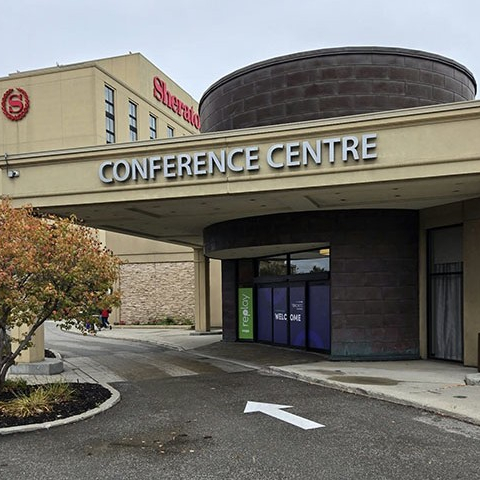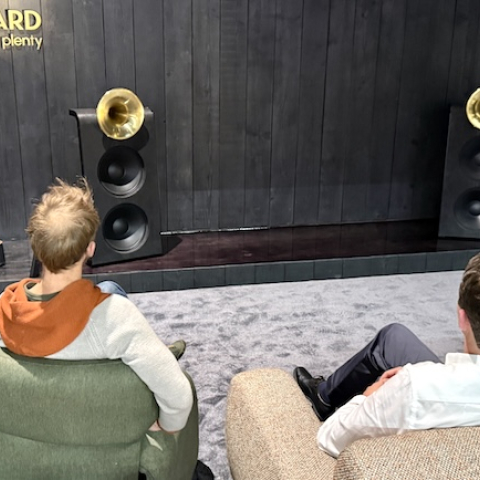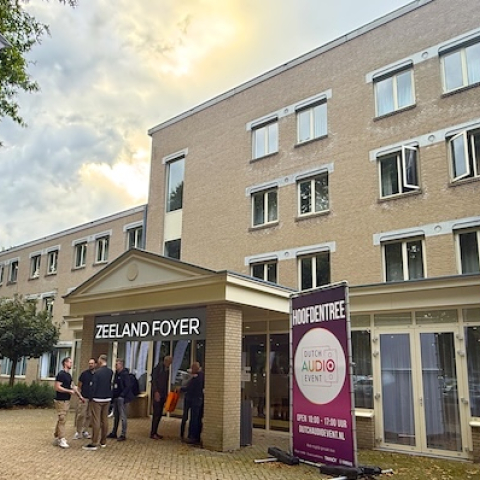
Definitive Audio of Bellevue, Washington (near Seattle), one of the premier dealerships in the Pacific Northwest, continued its 50th anniversary celebration with a September event it called "Icons and Innovators." Highlighted by showings of the new JBL Everest series and Bowers & Wilkins Nautilus and 801 Abbey Road edition loudspeakers, the event drew a full house to the first of two sessions on the afternoon of September 18.
JBL/D'Agostino/dCS/Clearaudio
My first stop was at the first showing of JBL's Summit Makalu loudspeakers ($60,000/pair). The speaker's name derives from Makalu mountain near Mt. Everest. On hand were Chris Hagen, the principal acoustic engineer for the series; Dave Tovissi, vice president and general manager of Harman's Luxury Audio division; and Jim Garrett, senior director of product strategy and planning for Harman's Luxury Audio division.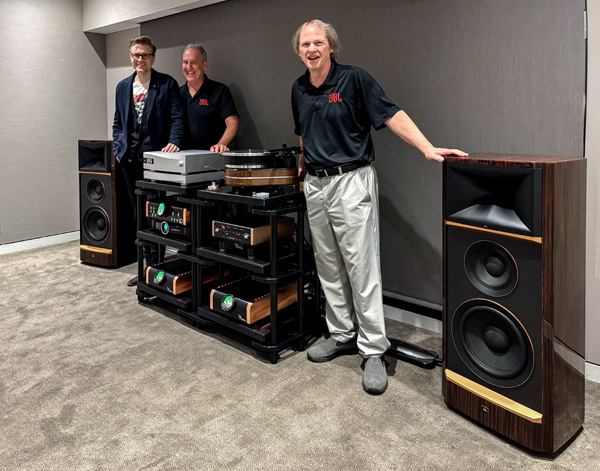 "The Summit series is JBL's latest effort to design a Project System consisting of the very best speakers that we can build right now," Hagen explained. "Created to celebrate JBL's 80th anniversary, which we'll celebrate in 2026, the Summit series blends current bleeding-edge technology with our proprietary technology that will push the industry further forward."
"Over JBL's 80-year history, there have only been five other Project Series speakers," Tovissi added. "The first was in 1954. This series replaces our flagship JBL Everest and K2 loudspeakers."
Garrett said that the Summit series currently includes The Summit Ama standmount ($25,000/pair, shown in another room with McIntosh and Innuos electronics), the smaller Summit Pumori 10" floorstander (which stood proud in Definitive's hallway), and the Summit Makalu with its 12" drivers (see photos). Two even-larger speakers are due in 2026. Each is considered JBL's finest loudspeaker of its size.
"Virtually everything is new, including the 12" woofer and midbass custom made for the Summit," Garrett said, in reference to the Makalu. "The woofer has a differential drive motor with two voice coils in two magnetic gaps that provide a great deal of control of the moving structure and keep the distortion very low. To complement it, we wanted to create a very low-distortion midbass that has a neodymium motor with a short voice coil suspended in a gap that ensures it remains in the magnetic field. It's the lowest-distortion type of motor you can get."
I asked, "Is this new technology?" Garrett replied, "Yes. We have designed differential drive motors before, but this motor has some specialized flux rings and was designed especially for this speaker. To help cut down distortion, we did a lot of work on the suspension and the neodymium motor to make sure that everything is very symmetrical. The general flavor of the motors is already out in the marketplace, but our approach is new.
"The high-frequency waveguide is the latest generation of our HDI (high-definition imaging) waveguide. It doesn't have as much amplification as a normal horn type of waveguide, and it avoids the typical in-your-face horn sound whose speed in the upper midrange doesn't sound natural. It also works extremely well with the D2 type of compression driver we use."
JBL favors horns and compression drivers because of their huge dynamic range, efficiency, and realistic-sounding highs. Garrett said, "The dynamics hit like you're listening to live music but with none of the drawbacks. Most loudspeakers have a hard time translating wide dynamics into something that sounds like real music. These speakers can do things that no other speakers anywhere in the store, regardless of price point, can do."
"Everything we do at Harman is very science-based. There's no guesswork to it. Chris is always going to help voice to the Harman Target Curve, which is a known performance metric that has been vetted for decades and proven in blind listening tests. But once we think we're there, we go into the sound room and listen."
I listened, too. On a few tracks, the volume was louder than I like, but bass was absolutely tight, the timbre of guitar, cymbals, and trumpet was true, and the music impressively alive and engaging. When Eva and Manu's "Melancholia" was played at an ideal volume for the space, treble clarity was every bit as excellent as the low bass on another track.
In addition to the speakers, the system included a D'Agostino Momentum C2 phono stage ($35,000); dCS Rossini Apex DAC ($34,500); Clearaudio Master Jubilee turntable with Unity 10" tonearm and Goldfinger Statement v2.1 cartridge ($77,500); Transparent Reference XL cabling; and HRS SXR frames and M3X2 Isolation Bases. This was one of my two favorite rooms at the event.
Bowers & Wilkins/JL Audio/McIntosh
"The Summit series is JBL's latest effort to design a Project System consisting of the very best speakers that we can build right now," Hagen explained. "Created to celebrate JBL's 80th anniversary, which we'll celebrate in 2026, the Summit series blends current bleeding-edge technology with our proprietary technology that will push the industry further forward."
"Over JBL's 80-year history, there have only been five other Project Series speakers," Tovissi added. "The first was in 1954. This series replaces our flagship JBL Everest and K2 loudspeakers."
Garrett said that the Summit series currently includes The Summit Ama standmount ($25,000/pair, shown in another room with McIntosh and Innuos electronics), the smaller Summit Pumori 10" floorstander (which stood proud in Definitive's hallway), and the Summit Makalu with its 12" drivers (see photos). Two even-larger speakers are due in 2026. Each is considered JBL's finest loudspeaker of its size.
"Virtually everything is new, including the 12" woofer and midbass custom made for the Summit," Garrett said, in reference to the Makalu. "The woofer has a differential drive motor with two voice coils in two magnetic gaps that provide a great deal of control of the moving structure and keep the distortion very low. To complement it, we wanted to create a very low-distortion midbass that has a neodymium motor with a short voice coil suspended in a gap that ensures it remains in the magnetic field. It's the lowest-distortion type of motor you can get."
I asked, "Is this new technology?" Garrett replied, "Yes. We have designed differential drive motors before, but this motor has some specialized flux rings and was designed especially for this speaker. To help cut down distortion, we did a lot of work on the suspension and the neodymium motor to make sure that everything is very symmetrical. The general flavor of the motors is already out in the marketplace, but our approach is new.
"The high-frequency waveguide is the latest generation of our HDI (high-definition imaging) waveguide. It doesn't have as much amplification as a normal horn type of waveguide, and it avoids the typical in-your-face horn sound whose speed in the upper midrange doesn't sound natural. It also works extremely well with the D2 type of compression driver we use."
JBL favors horns and compression drivers because of their huge dynamic range, efficiency, and realistic-sounding highs. Garrett said, "The dynamics hit like you're listening to live music but with none of the drawbacks. Most loudspeakers have a hard time translating wide dynamics into something that sounds like real music. These speakers can do things that no other speakers anywhere in the store, regardless of price point, can do."
"Everything we do at Harman is very science-based. There's no guesswork to it. Chris is always going to help voice to the Harman Target Curve, which is a known performance metric that has been vetted for decades and proven in blind listening tests. But once we think we're there, we go into the sound room and listen."
I listened, too. On a few tracks, the volume was louder than I like, but bass was absolutely tight, the timbre of guitar, cymbals, and trumpet was true, and the music impressively alive and engaging. When Eva and Manu's "Melancholia" was played at an ideal volume for the space, treble clarity was every bit as excellent as the low bass on another track.
In addition to the speakers, the system included a D'Agostino Momentum C2 phono stage ($35,000); dCS Rossini Apex DAC ($34,500); Clearaudio Master Jubilee turntable with Unity 10" tonearm and Goldfinger Statement v2.1 cartridge ($77,500); Transparent Reference XL cabling; and HRS SXR frames and M3X2 Isolation Bases. This was one of my two favorite rooms at the event.
Bowers & Wilkins/JL Audio/McIntosh
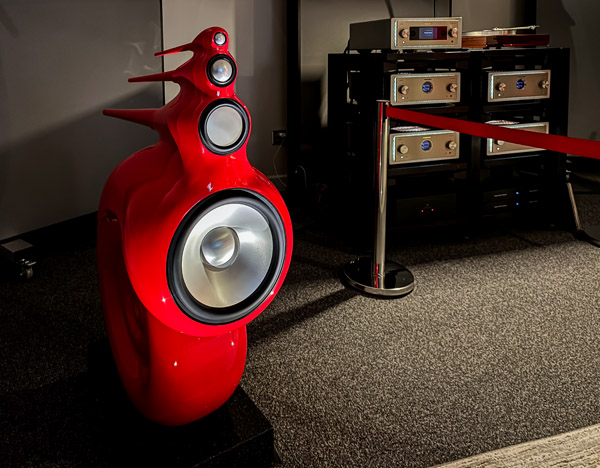
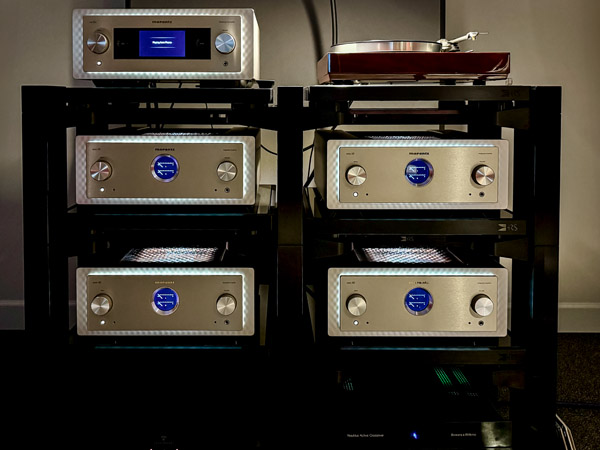
During the 32 years the Nautilus has been in production, nothing has changed acoustically save for a few internal components. A true four-way design in which each driver requires its own channel of amplification, the latest Nautilus ($110,000/pair, here in striking red) was driven by Marantz's new Reference Series 10 electronics.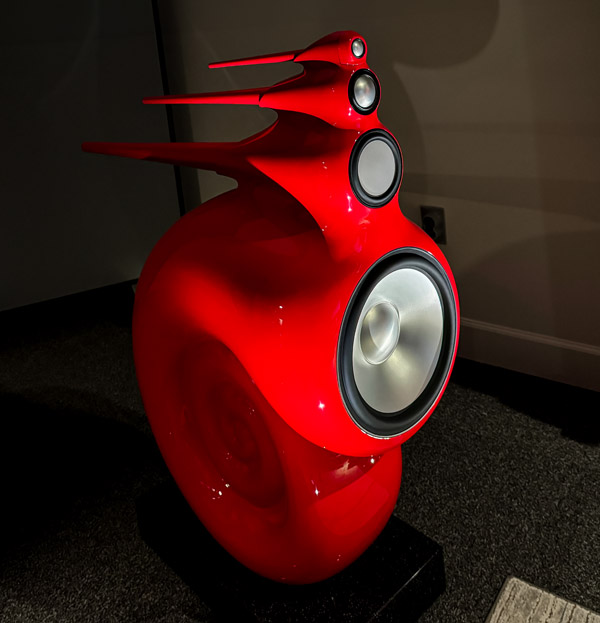 That meant four Marantz Model 10 stereo amplifiers ($14,999/ea.), two per speaker, each outputting 250Wpc into 8 ohms, and a Ref Link 10 streaming preamplifier with phono ($14,000). A Linn Selekt LP12 turntable ($14,956), Transparent cables and power, and HRS VXR component frame with M3X2 isolation bases rounded out the system.
 The hollow ceiling in the not-yet-finished demo room gobbled up bass like some monster that deserved to drown in the deep, yet Paul Simon's voice sounded wonderful, clean, and clear on his iconic "Graceland." Ditto for voice of Norah Jones, although this track was played too loud for the room. This classical buff even found Nirvana's "Come as You Are" quite listenable.
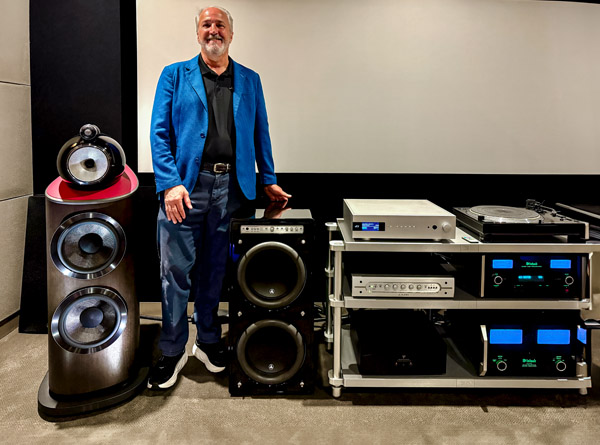 In a subsequent demo, Mike Sprague from Bowers & Wilkins and Doug Henderson, Director of Home Audio for Garmin International, the owner of JL Audio, presented the B&W 801D4 Signature Abbey Road Limited Edition speakers ($70,000/pair) with a pair of JL Audio F212v2 subwoofers ($10,000/ea.) and a JL Audio CR1 two-way crossover ($3500).
 Jason Victor Serinus.jpg) Like Definitive Audio, JL Audio is celebrating its 50th anniversary. Henderson explained that the F212v2 subwoofers—the top model in JL's Fathom range—has dual 12" drivers supplied with 3500W of amplification.
After measuring the room and setting the crossover point to 60Hz—the point where room-induced bass rolloff began—Henderson said he had achieved a flat response to below 20Hz. "What we're trying to do with JL Audio subs is reveal what's in the recording. We're not trying to add bass that's not there to begin with. The subwoofers are essentially linearizing the overall acoustic output of the 801D4s in a room whose acoustic sucks up bass."
The system produced beautifully smooth, clear sound and excellent bass. Among the highlights: John Williams' theme music from Raiders of the Lost Ark, the first recording made and monitored on 801s at Abbey Road Studios 45 years ago, and Hedegaard's "Ratchets," where the lowest bass line was so ideal that I vowed to see if it sounded as good on my own reference system.
Doing the honors, apart from the speakers: a McIntosh C2800 preamp ($10,500) and MC462 power amplifier ($11,500), a dCS Bartók Apex streaming DAC ($22,000), Transparent cabling, and HRS racks.
KEF/Moon/Clearaudio
Like Definitive Audio, JL Audio is celebrating its 50th anniversary. Henderson explained that the F212v2 subwoofers—the top model in JL's Fathom range—has dual 12" drivers supplied with 3500W of amplification.
After measuring the room and setting the crossover point to 60Hz—the point where room-induced bass rolloff began—Henderson said he had achieved a flat response to below 20Hz. "What we're trying to do with JL Audio subs is reveal what's in the recording. We're not trying to add bass that's not there to begin with. The subwoofers are essentially linearizing the overall acoustic output of the 801D4s in a room whose acoustic sucks up bass."
The system produced beautifully smooth, clear sound and excellent bass. Among the highlights: John Williams' theme music from Raiders of the Lost Ark, the first recording made and monitored on 801s at Abbey Road Studios 45 years ago, and Hedegaard's "Ratchets," where the lowest bass line was so ideal that I vowed to see if it sounded as good on my own reference system.
Doing the honors, apart from the speakers: a McIntosh C2800 preamp ($10,500) and MC462 power amplifier ($11,500), a dCS Bartók Apex streaming DAC ($22,000), Transparent cabling, and HRS racks.
KEF/Moon/Clearaudio
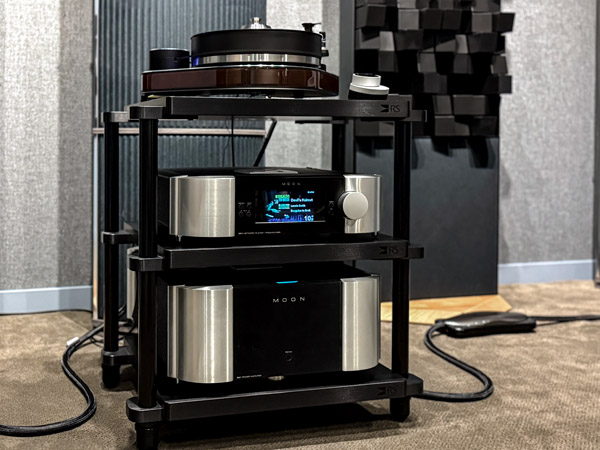
The stars of this system, which sounded great, were the KEF Blade II Meta speakers ($28,000/pair), Moon 891 streaming preamp ($25,000) and 861 300Wpc power amp ($22,000, double that when bridged to mono as an 800Wpc pair)—both glowingly reviewed by moi—and a Clearaudio Reference Jubilee turntable ($35,940). The ubiquitous Transparent/HRS combo held everything up and together.
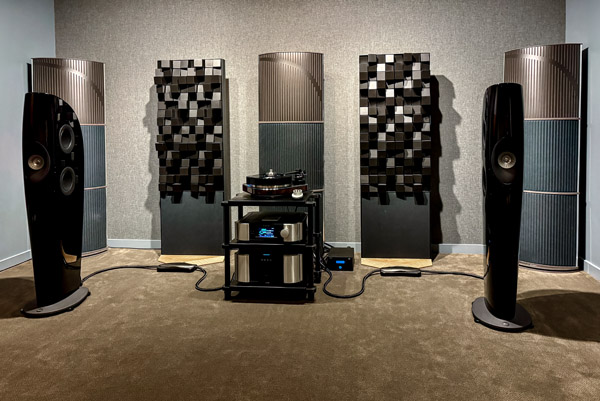 In a pre-show conversation, Simaudio's Ari Margolis explained that under the USMCA agreement, Moon's 99% Canadian products are exempt for US tariffs. That's great for the two Moon flagship products in the room, both from the Moon North collection.
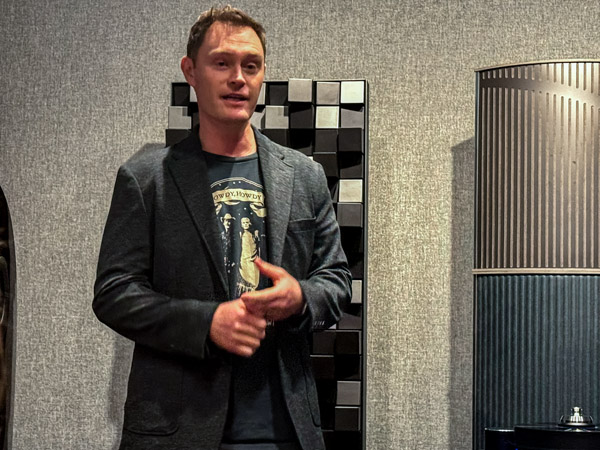 Margolis said Moon's goal was to recreate the experience of a live performance. After reminding me that the 861 is a zero feedback "MDC" (Moon Distortion Canceling) amplifier, he said, "The 891 all-in-one network player / preamp has one of the best volume controls in the industry. With these two boxes, you just need to add speakers and cables, and you're good to go. Our 10-year warranty is virtually unprecedented in the industry."
 Dave Donald of KEF claimed that KEF speakers offer "the best bang for the buck in the industry, anywhere. Thanks to our Uni-Q driver—a coincidental driver that serves as a pure point source—there are no other speakers in the world that do what KEF speakers do. We have a 160º dispersion characteristic that produce a very wide sweet spot. The Blade II Metas also have four separate bass drivers on their sides. … Other than the screws, we build everything in-house in England, in the same place where we started in 1961."
To my ears, the system transmitted everything on Margolis's great demo track, Lizzy McAlpine's "Erase Me" featuring Jacob Collier. The tracks that followed, including Bahamas' great sounding "Any Place," confirmed that the reference gear at the top of Moon's North Star collection can hold its own against, and sometimes outperform, far costlier electronics.
Dave Donald of KEF claimed that KEF speakers offer "the best bang for the buck in the industry, anywhere. Thanks to our Uni-Q driver—a coincidental driver that serves as a pure point source—there are no other speakers in the world that do what KEF speakers do. We have a 160º dispersion characteristic that produce a very wide sweet spot. The Blade II Metas also have four separate bass drivers on their sides. … Other than the screws, we build everything in-house in England, in the same place where we started in 1961."
To my ears, the system transmitted everything on Margolis's great demo track, Lizzy McAlpine's "Erase Me" featuring Jacob Collier. The tracks that followed, including Bahamas' great sounding "Any Place," confirmed that the reference gear at the top of Moon's North Star collection can hold its own against, and sometimes outperform, far costlier electronics.
My first stop was at the first showing of JBL's Summit Makalu loudspeakers ($60,000/pair). The speaker's name derives from Makalu mountain near Mt. Everest. On hand were Chris Hagen, the principal acoustic engineer for the series; Dave Tovissi, vice president and general manager of Harman's Luxury Audio division; and Jim Garrett, senior director of product strategy and planning for Harman's Luxury Audio division.
"The Summit series is JBL's latest effort to design a Project System consisting of the very best speakers that we can build right now," Hagen explained. "Created to celebrate JBL's 80th anniversary, which we'll celebrate in 2026, the Summit series blends current bleeding-edge technology with our proprietary technology that will push the industry further forward."
During the 32 years the Nautilus has been in production, nothing has changed acoustically save for a few internal components. A true four-way design in which each driver requires its own channel of amplification, the latest Nautilus ($110,000/pair, here in striking red) was driven by Marantz's new Reference Series 10 electronics.
That meant four Marantz Model 10 stereo amplifiers ($14,999/ea.), two per speaker, each outputting 250Wpc into 8 ohms, and a Ref Link 10 streaming preamplifier with phono ($14,000). A Linn Selekt LP12 turntable ($14,956), Transparent cables and power, and HRS VXR component frame with M3X2 isolation bases rounded out the system.
The hollow ceiling in the not-yet-finished demo room gobbled up bass like some monster that deserved to drown in the deep, yet Paul Simon's voice sounded wonderful, clean, and clear on his iconic "Graceland." Ditto for voice of Norah Jones, although this track was played too loud for the room. This classical buff even found Nirvana's "Come as You Are" quite listenable.
In a subsequent demo, Mike Sprague from Bowers & Wilkins and Doug Henderson, Director of Home Audio for Garmin International, the owner of JL Audio, presented the B&W 801D4 Signature Abbey Road Limited Edition speakers ($70,000/pair) with a pair of JL Audio F212v2 subwoofers ($10,000/ea.) and a JL Audio CR1 two-way crossover ($3500).
Like Definitive Audio, JL Audio is celebrating its 50th anniversary. Henderson explained that the F212v2 subwoofers—the top model in JL's Fathom range—has dual 12" drivers supplied with 3500W of amplification.
After measuring the room and setting the crossover point to 60Hz—the point where room-induced bass rolloff began—Henderson said he had achieved a flat response to below 20Hz. "What we're trying to do with JL Audio subs is reveal what's in the recording. We're not trying to add bass that's not there to begin with. The subwoofers are essentially linearizing the overall acoustic output of the 801D4s in a room whose acoustic sucks up bass."
The stars of this system, which sounded great, were the KEF Blade II Meta speakers ($28,000/pair), Moon 891 streaming preamp ($25,000) and 861 300Wpc power amp ($22,000, double that when bridged to mono as an 800Wpc pair)—both glowingly reviewed by moi—and a Clearaudio Reference Jubilee turntable ($35,940). The ubiquitous Transparent/HRS combo held everything up and together.
In a pre-show conversation, Simaudio's Ari Margolis explained that under the USMCA agreement, Moon's 99% Canadian products are exempt for US tariffs. That's great for the two Moon flagship products in the room, both from the Moon North collection.
Margolis said Moon's goal was to recreate the experience of a live performance. After reminding me that the 861 is a zero feedback "MDC" (Moon Distortion Canceling) amplifier, he said, "The 891 all-in-one network player / preamp has one of the best volume controls in the industry. With these two boxes, you just need to add speakers and cables, and you're good to go. Our 10-year warranty is virtually unprecedented in the industry."
Dave Donald of KEF claimed that KEF speakers offer "the best bang for the buck in the industry, anywhere. Thanks to our Uni-Q driver—a coincidental driver that serves as a pure point source—there are no other speakers in the world that do what KEF speakers do. We have a 160º dispersion characteristic that produce a very wide sweet spot. The Blade II Metas also have four separate bass drivers on their sides. … Other than the screws, we build everything in-house in England, in the same place where we started in 1961."