Just then I was struck by a memory from decades ago, of being in a corrugated-metal pole barn, in the middle of nowhere. It too was super-clean and filled with 50 years' worth of vintage Leica film cameras. While perusing the shelves, I stumbled on a dozen or so black-bodied Nikon rangefinders hidden in a remote corner. All these cameras were supremely beautiful—and timeless looking. I wanted one of each. Driving home from the Leica barn, I wondered which digital cameras might someday be considered timeless and beautiful.
After lunch, Sphere and I began our carefully orchestrated listening sessions.
Aerodynamic heads
First up was a system from the early 1990s: KEF 107 Reference speakers (with KUBE equalizer), powered by Sony's still-coveted TA-N77ES stereo amplifier, driven directly from the volume control of a Sony 707ESD CD player. Wires were all from Monster Cable.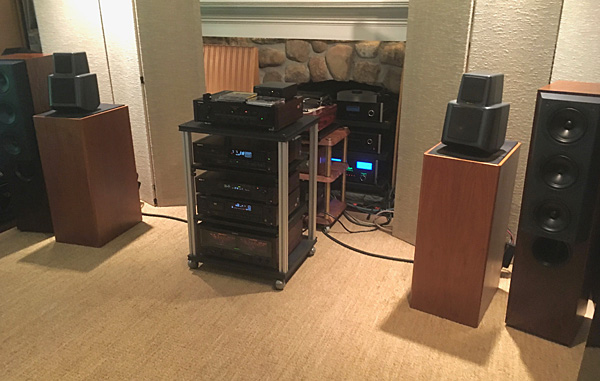 I remember that in 1990, speaker designers were all about minimizing diffraction and were creating speakers with aerodynamic heads—like the KEF 107 Reference and its primary competitor, the B&W Matrix 801 Monitor with its fiber-crete head and "free-field" mounted tweeter. The era of wide- baffle speakers had ended. The sound, from a Chesky CD (Wycliffe Gordon's Dreams of New Orleans), was initially all lumpy and round and monoistic. Then Sphere asked Ben Hase and Elliot White—Skyfi's senior audio technician and marketing director, respectively—if they could position the loudspeakers farther apart and toe them in a little. They did, and in short order the soundstage tripled in size. New detail appeared. Images became more distinct and more obviously three-dimensional. Everybody in the room praised this setup. I didn't. They raved about the imaging.
Next, we drifted back a decade to 1978 and auditioned a beautifully preserved pair of Magnepan Tympani I-D planar-magnetic loudspeakers—a real high high-end design. Some background color: Back in the day, after reviewing the Magnepan I-D for The Absolute Sound, that magazine's founder, the late Harry Pearson, and Magnepan's Wendell Diller tried an experiment: pairing the two bass panels from the three-panel I-D with the mid- and high-frequency panels of the Infinity QRS loudspeaker using a Van Alstine-modified Dahlquist DQLP-1 electronic crossover. The result was a hybrid speaker that Pearson dubbed the QRS-1D. He described it as "a system of genuine musical authority and accuracy, possibly the best now extant." (For a couple of years, until both the I-D and QRS were discontinued, affluent audiophiles went crazy for it.)
 You can't imagine how surprised I was to see these historic Maggies driven by a classic Marantz Model 7 preamp and the best-looking tube amplifier ever, the Marantz 8B. The sound was sweet and spatially huge—but! It was obvious the Marantz 8B's modest power supply was not pulling the Magnepan's current-hungry load. I had to ask, "Fernando, why the 8B?" Whereupon he switched in a Bryston 4B solid-state amplifier, also circa 1978—which got everything perked up, fast-accelerating, slamming, and focusing. The 4B put genuine slam in those illustrious Maggie bass panels. The well-drawn soundstage occupied the entire space in front of me. The source was a Garrard 301 turntable in a custom plinth with an SME 309 tonearm and Sumiko Songbird cartridge. This was classic Golden Era audiophile sound, and everybody loved it.
Puppies on a hot leash
You can't imagine how surprised I was to see these historic Maggies driven by a classic Marantz Model 7 preamp and the best-looking tube amplifier ever, the Marantz 8B. The sound was sweet and spatially huge—but! It was obvious the Marantz 8B's modest power supply was not pulling the Magnepan's current-hungry load. I had to ask, "Fernando, why the 8B?" Whereupon he switched in a Bryston 4B solid-state amplifier, also circa 1978—which got everything perked up, fast-accelerating, slamming, and focusing. The 4B put genuine slam in those illustrious Maggie bass panels. The well-drawn soundstage occupied the entire space in front of me. The source was a Garrard 301 turntable in a custom plinth with an SME 309 tonearm and Sumiko Songbird cartridge. This was classic Golden Era audiophile sound, and everybody loved it.
Puppies on a hot leash
Okay folks, right now is when the whole day exploded in front of me. There was a time, long ago, when I was making a living dealing in old tubes and dusty old Altec and Western Electric gear. I lived in a firehouse on Staten Island, and I had borrowed a friend's pair of Wilson Audio's Series 2 Tiny Tots (WATTs) and their associated Puppy woofers. I had them positioned between a widely spaced pair of 1947 Altec Voice of the Theatre speakers. I loved inviting people over to compare soundstage widths. Today in Jersey, though, I was not prepared for what I heard. Fernando had created a system around Wilson WATT/Puppy 5s using Spectral DMA-360 mono amps and a Krell KBL preamp. The source was a super-rare Nakamichi Dragon CD player/DAC. (It looked like an alien spaceship.) I never knew such a thing existed—and I never knew WATT Puppies could sound this juiced or this vivid. The Spectral amps' 533W into 4 ohms made the Wilsons boogie all over the room and steal my heart. This WATT-Spectral combo generated more rhythmic nuance and high-frequency detail than I ever imagined possible. I've always admired the Wilson speakers but only rarely enjoyed them. Today, I thought the WATT/Puppy 5s were the best speakers ever created. Obviously, I had never heard them with Spectral amps. On the Wilsons, the DMA-360s generated explosive dynamics. The sound was completely effortless. And 100% trans- parent. The fire-breathing Spectrals put on a fantastic show! (I would have loved to hear the Magnepan and KEF speakers with these amps.)
But here's the kicker: According to the Spectral's specs, the DMA-360 is 3dB down at 1.8MHz!
Therefore, its owner's manual mandates the use of MIT cables, which supposedly act as low-pass filters, preventing spurious high frequencies from destroying tweeters or sending the amp into oscillation. (The Skyfi system followed that dictum: All cables were from MIT.)
1950s firescreens
It's always good to end at the beginning—and I can't imagine a better speaker to follow the Amazing WATT/Puppy show than a beautiful pair of Quad ESLs. Along with Paul Klipsch's corner horns, the Quads were the beginning of audiophile audio as we know it.
Three out of five of my closest audio friends use Quad ESLs. They will never give them up. I've owned four pairs, because I admire their uncolored transparency, quality of detail, and trademark truth of timbre. But I prefer horn-level dynamics, and I hate sitting in the sweet spot. So I sold the lot and now stick to simple truths from Harbeth, Zu, Falcon, and DeVore. My day at Skyfi ended pleasantly with music streaming from ancient bronze firescreens sitting in front of a stone fireplace.
 The Quads were driven by a rare and extremely sexy (by my standards) 50Wpc Luxman 3600 stereo tube amplifier. Manufactured between 1979 and 1982, the Lux uses push-pull pairs of 8045G power triodes—an unusual tube that was manufactured by NEC exclusively for Luxman. Today, this KT88 lookalike is near unobtainium, and replacements are likely more expensive than the 3600 amplifier I auditioned.
On top of the short rack was a turntable I've always wanted: a belt-drive Thorens TD 125 Mk.II with an SME 3009 II tonearm and a Sumiko Moonstone cartridge. The Sumiko was connected to the phono stage of a Conrad-Johnson PV8 preamp.
Folks, this too was a Golden Era stereo system; to my old ears it sounded a little too golden and a little aged, but it made me slump down in the cushions, close my eyes, and fall dreamily into every black disc they played.
Truth in value
The Quads were driven by a rare and extremely sexy (by my standards) 50Wpc Luxman 3600 stereo tube amplifier. Manufactured between 1979 and 1982, the Lux uses push-pull pairs of 8045G power triodes—an unusual tube that was manufactured by NEC exclusively for Luxman. Today, this KT88 lookalike is near unobtainium, and replacements are likely more expensive than the 3600 amplifier I auditioned.
On top of the short rack was a turntable I've always wanted: a belt-drive Thorens TD 125 Mk.II with an SME 3009 II tonearm and a Sumiko Moonstone cartridge. The Sumiko was connected to the phono stage of a Conrad-Johnson PV8 preamp.
Folks, this too was a Golden Era stereo system; to my old ears it sounded a little too golden and a little aged, but it made me slump down in the cushions, close my eyes, and fall dreamily into every black disc they played.
Truth in value
WHAT I DISCOVERED AT SKYFI: a treasure trove of serious-quality components from some of audio's glory days, restored to last for another generation and beyond. WHAT I LEARNED: Fine-sounding, good-looking audio equipment never gets old or goes out of style. The best, like Western Electric horns, Garrard rim-drive turntables, and speakers like Quad ESLs and BBC LS3/5a's, will likely outlast the polar icecaps.
HOW IT SEEMS: The best of today's audio is just different—not really better or worse. Contemporary audio aims for squeaky-clean, uber-quiet sound—and ease of manufacture. Yesterday's audio aspired to conspicuous musicality, durability, pride of ownership, and pleasure of use.
WHAT I KNOW FOR SURE: Old audio gear maintains its value because it was designed by wizards, built like tanks, looks good in our homes, and reliably delivers satisfying sound.
It is also endlessly fascinating.
First up was a system from the early 1990s: KEF 107 Reference speakers (with KUBE equalizer), powered by Sony's still-coveted TA-N77ES stereo amplifier, driven directly from the volume control of a Sony 707ESD CD player. Wires were all from Monster Cable.
I remember that in 1990, speaker designers were all about minimizing diffraction and were creating speakers with aerodynamic heads—like the KEF 107 Reference and its primary competitor, the B&W Matrix 801 Monitor with its fiber-crete head and "free-field" mounted tweeter. The era of wide- baffle speakers had ended. The sound, from a Chesky CD (Wycliffe Gordon's Dreams of New Orleans), was initially all lumpy and round and monoistic. Then Sphere asked Ben Hase and Elliot White—Skyfi's senior audio technician and marketing director, respectively—if they could position the loudspeakers farther apart and toe them in a little. They did, and in short order the soundstage tripled in size. New detail appeared. Images became more distinct and more obviously three-dimensional. Everybody in the room praised this setup. I didn't. They raved about the imaging.
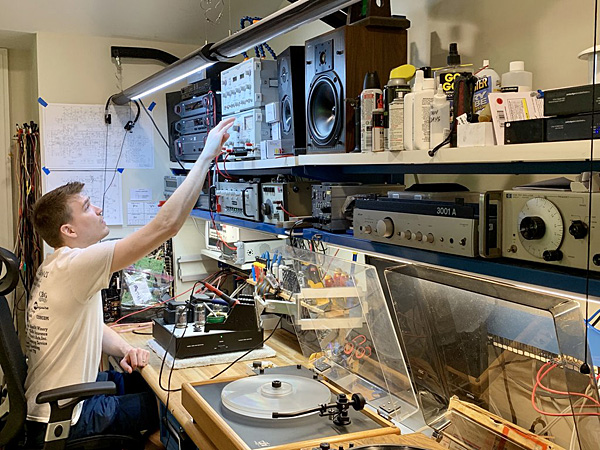
Skyfi's senior audio technician Ben Hase testing an amplifier.
I thought it sounded like the images were surrounded by dull, sluggish air. First, I blamed the bass cabinets. Then I blamed the Sony CD player. But maybe it was the Monster Cables?
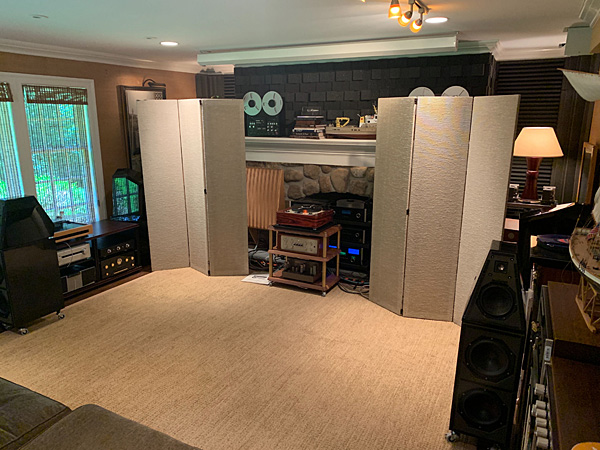
Beige room dividersNext, we drifted back a decade to 1978 and auditioned a beautifully preserved pair of Magnepan Tympani I-D planar-magnetic loudspeakers—a real high high-end design. Some background color: Back in the day, after reviewing the Magnepan I-D for The Absolute Sound, that magazine's founder, the late Harry Pearson, and Magnepan's Wendell Diller tried an experiment: pairing the two bass panels from the three-panel I-D with the mid- and high-frequency panels of the Infinity QRS loudspeaker using a Van Alstine-modified Dahlquist DQLP-1 electronic crossover. The result was a hybrid speaker that Pearson dubbed the QRS-1D. He described it as "a system of genuine musical authority and accuracy, possibly the best now extant." (For a couple of years, until both the I-D and QRS were discontinued, affluent audiophiles went crazy for it.)
You can't imagine how surprised I was to see these historic Maggies driven by a classic Marantz Model 7 preamp and the best-looking tube amplifier ever, the Marantz 8B. The sound was sweet and spatially huge—but! It was obvious the Marantz 8B's modest power supply was not pulling the Magnepan's current-hungry load. I had to ask, "Fernando, why the 8B?" Whereupon he switched in a Bryston 4B solid-state amplifier, also circa 1978—which got everything perked up, fast-accelerating, slamming, and focusing. The 4B put genuine slam in those illustrious Maggie bass panels. The well-drawn soundstage occupied the entire space in front of me. The source was a Garrard 301 turntable in a custom plinth with an SME 309 tonearm and Sumiko Songbird cartridge. This was classic Golden Era audiophile sound, and everybody loved it.
Puppies on a hot leashOkay folks, right now is when the whole day exploded in front of me. There was a time, long ago, when I was making a living dealing in old tubes and dusty old Altec and Western Electric gear. I lived in a firehouse on Staten Island, and I had borrowed a friend's pair of Wilson Audio's Series 2 Tiny Tots (WATTs) and their associated Puppy woofers. I had them positioned between a widely spaced pair of 1947 Altec Voice of the Theatre speakers. I loved inviting people over to compare soundstage widths. Today in Jersey, though, I was not prepared for what I heard. Fernando had created a system around Wilson WATT/Puppy 5s using Spectral DMA-360 mono amps and a Krell KBL preamp. The source was a super-rare Nakamichi Dragon CD player/DAC. (It looked like an alien spaceship.) I never knew such a thing existed—and I never knew WATT Puppies could sound this juiced or this vivid. The Spectral amps' 533W into 4 ohms made the Wilsons boogie all over the room and steal my heart. This WATT-Spectral combo generated more rhythmic nuance and high-frequency detail than I ever imagined possible. I've always admired the Wilson speakers but only rarely enjoyed them. Today, I thought the WATT/Puppy 5s were the best speakers ever created. Obviously, I had never heard them with Spectral amps. On the Wilsons, the DMA-360s generated explosive dynamics. The sound was completely effortless. And 100% trans- parent. The fire-breathing Spectrals put on a fantastic show! (I would have loved to hear the Magnepan and KEF speakers with these amps.)
It's always good to end at the beginning—and I can't imagine a better speaker to follow the Amazing WATT/Puppy show than a beautiful pair of Quad ESLs. Along with Paul Klipsch's corner horns, the Quads were the beginning of audiophile audio as we know it.
The Quads were driven by a rare and extremely sexy (by my standards) 50Wpc Luxman 3600 stereo tube amplifier. Manufactured between 1979 and 1982, the Lux uses push-pull pairs of 8045G power triodes—an unusual tube that was manufactured by NEC exclusively for Luxman. Today, this KT88 lookalike is near unobtainium, and replacements are likely more expensive than the 3600 amplifier I auditioned.
On top of the short rack was a turntable I've always wanted: a belt-drive Thorens TD 125 Mk.II with an SME 3009 II tonearm and a Sumiko Moonstone cartridge. The Sumiko was connected to the phono stage of a Conrad-Johnson PV8 preamp.
WHAT I DISCOVERED AT SKYFI: a treasure trove of serious-quality components from some of audio's glory days, restored to last for another generation and beyond. WHAT I LEARNED: Fine-sounding, good-looking audio equipment never gets old or goes out of style. The best, like Western Electric horns, Garrard rim-drive turntables, and speakers like Quad ESLs and BBC LS3/5a's, will likely outlast the polar icecaps.