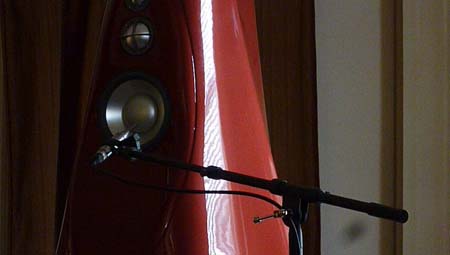
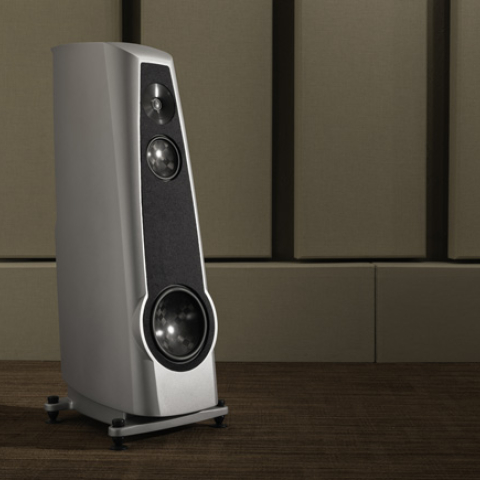
We’re currently working on our July 2010 issue, which will include Wes Phillips’ review of the Vivid Audio G1Giya loudspeaker ($65,000/pair). Near the end of Wes’ auditioning, the domes of both upper-midrange units were inexplicably damaged. As you can see from
the picture, it appears the domes were poked by some sort of dull object. Wes didn’t do it; Wes’ wife didn’t do it. We’ll never know how the damage occurred. What we do know is that the aluminum-dome midrange unit is incredibly delicate and has a strong magnetic pull.
The damage occurred after John Atkinson had performed in-room measurements, but before he had performed any of his other tests. Vivid shipped two new drive-units, but one arrived damaged in
the box!
See? We’ll never know how
that happened, either. Frustrated, but not defeated, John and I visited Wes last Thursday to replace the most severely damaged unit and redo the measurements. It was a fun day of work.
I arrived at John’s home just before 10am to find him loading the Land Cruiser with his measurement gear: a computer, a monitor, a tub of cables, mics, mic stands, measuring tape, a little camera, some blocks of wood, a jug of sand, a turntable platform spinnie thing, a dolly, and his magic wand. Just kidding about the magic wand.
Every job requires a specific tool and replacing the midrange unit would take a 6mm hex key, which we didn’t have. On our way to Wes’ place, therefore, we made a quick stop at the local hardware store and purchased
a hex key set. Now, we were all ready to go.
Removing the Giya’s midrange drive-unit is a two-man job. The drive-unit is connected to a tapered tube transmission line, which runs the depth of the speaker and attaches at the rear via a long hex screw. One man stands behind the speaker and loosens the long hex screw, while the other man wiggles and pulls the drive-unit from the front of the speaker. John Atkinson did the loosening; I handled wiggling and pulling.
Here we had an awkward situation: The extremely delicate dome is just a few millimeters clear of its crossbar face-cap [I just coined that word, “face-cap.” Thank you.]), leaving the wiggler/puller with little room for wiggling/pulling. The task wasn’t
difficult, but the drive-unit certainly didn’t
want to come out of the speaker. Which is ultimately a good thing, I’d say. Nevertheless, we got the unit out. A small success.
Here we see John Atkinson modeling the 2” drive-unit and its associated transmission line.
“Let’s take this to the kitchen,” JA said.
In the kitchen, we sat down and took a couple of deep breaths before moving on to the next few steps of the process, which I imagined would be infinitely more dangerous.
It was sort of like dismantling a bomb. I guess. We first rolled down the rubber band which held the wires in place, thus freeing the connector pins and allowing the drive-unit to be detached from the transmission line. Next, we unscrewed the drive-unit from the transmission line. There’s some magnetic force here which wants to keep the drive-unit in place. I told that magnetic force to screw off. Haw, get it, screw off? Inside the transmission line, you can see
some fibrous stuff. Cool. Next, we removed two O-rings—one from the inside and one from the outside of the drive-unit. These O-rings would be used for
the replacement unit. (Of course, we would forget one.) We set the damaged unit aside and we admired out work.
Ahh. Nice work.
Then we replaced the outer O-ring, and prepared to connect the new drive unit to the transmission line. (Here’s where we should’ve inserted the inner O-ring, but didn’t.) John Atkinson held the transmission line in place and I slowly brought the drive-unit to its mounting position, using just enough resistance to counteract the strong magnetic force. Once the drive-unit and transmission line were properly aligned, we screwed the pieces together and returned the rubber band to its original position, securing the wires in place. Done, we thought. Another small bit of success.
Now came the fun part, the part I was
really scared of: We had to reintroduce the whole get-up—transmission line and midrange unit—to
the Giya cabinet and lock it into place.
Without damaging the driver dome. John and I assumed our original positions—John behind the speaker with the hex key and screw, and me in front of the speaker, very carefully holding the replacement unit.
So. This part of the job was like landing a fighter jet on an aircraft carrier. Or, perhaps a better analogy: It was like refueling a fighter jet in midair. With a small flashlight, JA looked into
the tiny screw hole and searched for the tapered end of the transmission line, as I eased the unit into place. See me standing there, sweating, praying that I don’t fuck this up, begging The Good Lord that I don’t put another dent into this precious aluminum dome, wondering how much this thing costs, imaging JA sighing, with disappointment,
“Oh, Stephen,” when it turned out that I
had put another dent into the stupid thing…
But, don’t worry, that didn’t happen.
I inserted the unit and held fast, while JA directed me: “Up a little, down a little, now to your left, a little more, now to your right, and up a little, a little more…”
We went on and on like this until we thought we had the tapered end of the transmission line matched up with the tiny screw hole. “Okay, now!” There were several false starts. “Nope, nothing.” On and on for several minutes more, until we finally got lucky.
We high-fived and cursed. Well,
I cursed. It’s what I’m best known for.
Fuck yeah, bitch!
I sat down and relaxed then, while JA conducted an entire set of
measurements. Somewhere near the end, he said something like, “Oh, bugger!”
“What?”
“Tell me what’s missing from that drive-unit.”
“Oh, god. What?”
“The inner O-ring.”
“Fuck.”
“Do you have it in you to do it all over again?”
“Yes, definitely,” I replied.
When John was all done with his measurements, we removed the new drive-unit and took it to the kitchen. We disassembled the blasted contraption, inserted the stupid O-ring, and did it back up. We were like old pros. Getting the dang thing back into the speaker was more difficult the second time around, of course, but we eventually got it.
Finally, we cleaned up our mess.
“The idea,” John said, “is to make it seem as though we were never here.”
“Yup,” I said.
When we were all done, and Wes’ room was back to normal, we sat down to listen to some music. Primarily, we wanted to make sure that the replacement drive-unit was functioning properly, which it was. Wes selected a track from a mix CD compiled by Vivid’s US distributor, Philip O’Hanlon. The song was Grizzly Bear’s “Dory” from that band’s very fine
Veckatimest. Though we listened for only a short while, and at a very low volume, it was clear that the Vivid loudspeakers offered a wealth of inner detail, sounding especially relaxed—as if nothing had ever gone wrong.
Keep an eye out for Wes Phillips' complete coverage in the July 2010 issue of
Stereophile.