Sidebar 3: Martin's Measurements
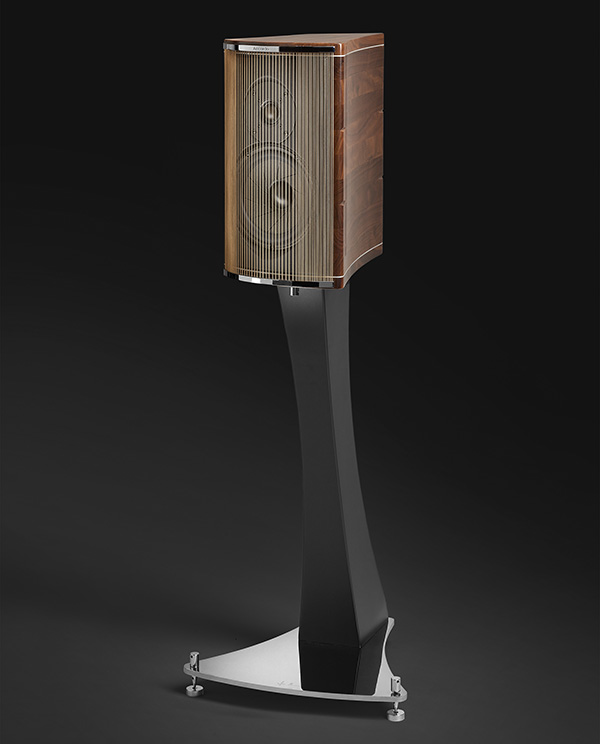 Basic measurements were undertaken to confirm the condition of these UK review samples and help coordinate with John Atkinson's full tech report on his US example. I checked the effect of the near-vestigial grille; I found little to note save errors of less than 1dB in the mid-treble from its addition, increasing to 1.5dB at 15kHz. I consider such changes negligible, as I could not reliably hear the effect. I think that is because the strand spacing is wider here than when I had previously encountered this design detail with a Sonus Faber design.
Consistency of output was very good both on and below axis, the latter consonant with the designed high-stand elevation. If you stand up, expect a loss of a few dB from 2–6kHz, heard as a mild dulling of the primary treble. For auditioning, please take a seat!
There was some diminution in axial output by 20kHz, here reading –3dB, but the output was otherwise flat to 16kHz marred only by a mild 2dB trough from 1.5kHz to 3.5kHz. This characteristic is often preferred, as it smooths the power transition from the over-the-crossover region. The primary frequency response from 400Hz to 15kHz measured very well, with a ±2dB uniformity in 1/3-octave analysis, ultimately leading to a deep if audibly harmless cancellation notch at 22kHz.
For a lateral 5° off-axis, the speaker again offers impressively uniform output from 200Hz to 16kHz ±2.5dB.
Sensitivity was measured at an average 87dB/2.83V/m, and the pair was seen to be well-matched. Off axis, the output was remarkably consistent, confirming excellent driver integration. Off-axis response begins to tail off beyond 9kHz.
Measured in room, with spatial averaging, the Accordo Goldberg achieved quite good bass reach, to 50Hz at –3dB and 40Hz at –6dB. Subjectively, the bass extended quite well to 40Hz in my large, open-plan room while avoiding any boominess. It was reflex-port–tuned to a low 41Hz with a sensibly overdamped alignment, in anticipation of some room gain at lowest frequencies. A moderate harmonic mode associated with the port was present at 800Hz, reading –18dB.
These results suggest that the bass output for this compact should be less critical of room placement than with other loudspeakers.—Martin Colloms
Basic measurements were undertaken to confirm the condition of these UK review samples and help coordinate with John Atkinson's full tech report on his US example. I checked the effect of the near-vestigial grille; I found little to note save errors of less than 1dB in the mid-treble from its addition, increasing to 1.5dB at 15kHz. I consider such changes negligible, as I could not reliably hear the effect. I think that is because the strand spacing is wider here than when I had previously encountered this design detail with a Sonus Faber design.
Consistency of output was very good both on and below axis, the latter consonant with the designed high-stand elevation. If you stand up, expect a loss of a few dB from 2–6kHz, heard as a mild dulling of the primary treble. For auditioning, please take a seat!
There was some diminution in axial output by 20kHz, here reading –3dB, but the output was otherwise flat to 16kHz marred only by a mild 2dB trough from 1.5kHz to 3.5kHz. This characteristic is often preferred, as it smooths the power transition from the over-the-crossover region. The primary frequency response from 400Hz to 15kHz measured very well, with a ±2dB uniformity in 1/3-octave analysis, ultimately leading to a deep if audibly harmless cancellation notch at 22kHz.
For a lateral 5° off-axis, the speaker again offers impressively uniform output from 200Hz to 16kHz ±2.5dB.
Sensitivity was measured at an average 87dB/2.83V/m, and the pair was seen to be well-matched. Off axis, the output was remarkably consistent, confirming excellent driver integration. Off-axis response begins to tail off beyond 9kHz.
Measured in room, with spatial averaging, the Accordo Goldberg achieved quite good bass reach, to 50Hz at –3dB and 40Hz at –6dB. Subjectively, the bass extended quite well to 40Hz in my large, open-plan room while avoiding any boominess. It was reflex-port–tuned to a low 41Hz with a sensibly overdamped alignment, in anticipation of some room gain at lowest frequencies. A moderate harmonic mode associated with the port was present at 800Hz, reading –18dB.
These results suggest that the bass output for this compact should be less critical of room placement than with other loudspeakers.—Martin Colloms
Basic measurements were undertaken to confirm the condition of these UK review samples and help coordinate with John Atkinson's full tech report on his US example. I checked the effect of the near-vestigial grille; I found little to note save errors of less than 1dB in the mid-treble from its addition, increasing to 1.5dB at 15kHz. I consider such changes negligible, as I could not reliably hear the effect. I think that is because the strand spacing is wider here than when I had previously encountered this design detail with a Sonus Faber design.
Consistency of output was very good both on and below axis, the latter consonant with the designed high-stand elevation. If you stand up, expect a loss of a few dB from 2–6kHz, heard as a mild dulling of the primary treble. For auditioning, please take a seat!
There was some diminution in axial output by 20kHz, here reading –3dB, but the output was otherwise flat to 16kHz marred only by a mild 2dB trough from 1.5kHz to 3.5kHz. This characteristic is often preferred, as it smooths the power transition from the over-the-crossover region. The primary frequency response from 400Hz to 15kHz measured very well, with a ±2dB uniformity in 1/3-octave analysis, ultimately leading to a deep if audibly harmless cancellation notch at 22kHz.