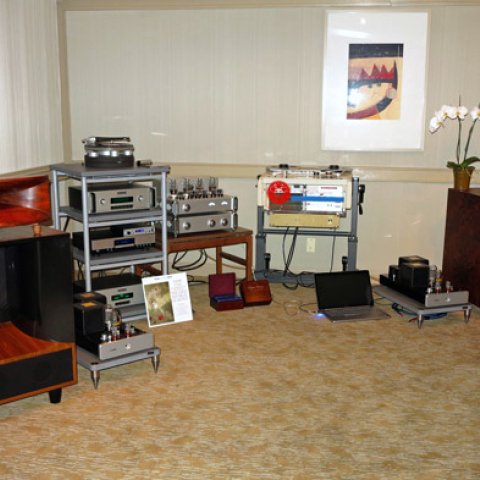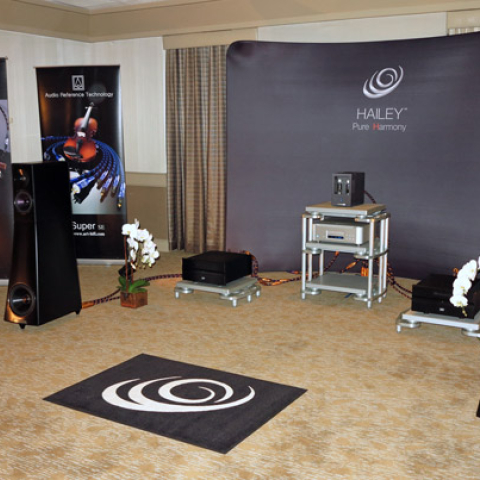
Snatching my prize for best sound on the third floor, the world premiere of the new Wells Audio Innamorata Signature amplifier ($13,000), enhanced by the new crystal technology in Jack Bybee's A/V Signal Enhancers ($119.95) and Bybee Technologies power cables ($1500), blew me away. Whoever expected, on Reference Recordings' new Kansas City Symphony recording of the suite from Prokofiev's Love for Three Oranges, such impeccably detailed, superbly controlled full-range sound in such a small room?
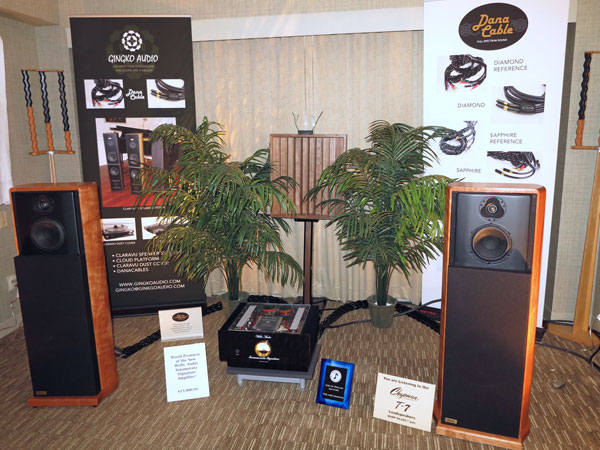 True, Jeff Wells is gifted with set-up acumen. This is reflected in his use of Shakti Halographs ($1200/pair), Gingko Mini Clouds ($100/set) and Cloud 10 platform ($349), and such Bybee Crystal curiosities as a droll, half-naked AC module, already in use by Oppo England. I can't help but note that this baby, which reportedly affects the energy of the presentation, even when positioned all by its lonesome, reminds me of the droll antlers Falstaff is saddled with in the marvelous final act of Verdi's opera, Falstaff.
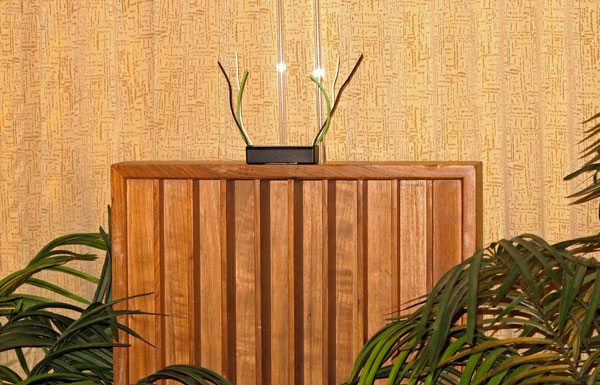 But set-up means nothing if the equipment (including cabling) is not up to snuff. Hats off, then, to the equipment mentioned above, as well as to Chapman T-7 loudspeakers ($12,995 with special finish), Wells Audio "Looking Glass" power conditioner ($5500), Jolida Fusion preamplifier modified by Wells Audio ($5000), Music Hall 25.3 modified DAC ($3500), Jolida DAC/Transport ($2299), and a host of Dana Cables Diamond Reference cabling. Given how clear naturally balanced, timbre-neutral and true, and musical this system sounded, I'd say the Wells Audio Innamorata Signature amplifier, reportedly carried by 12 dealers, deserves a place in a Stereophile reviewer's system and on John Atkinson's bench.
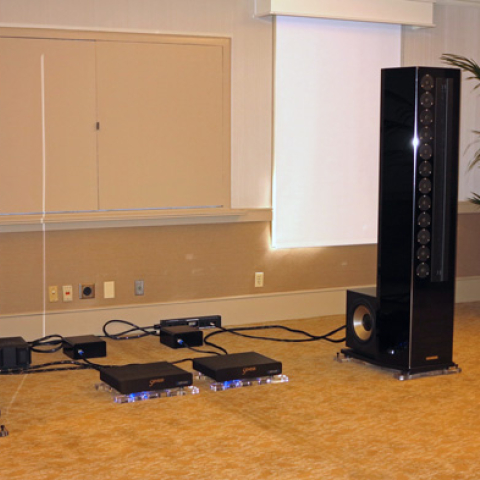
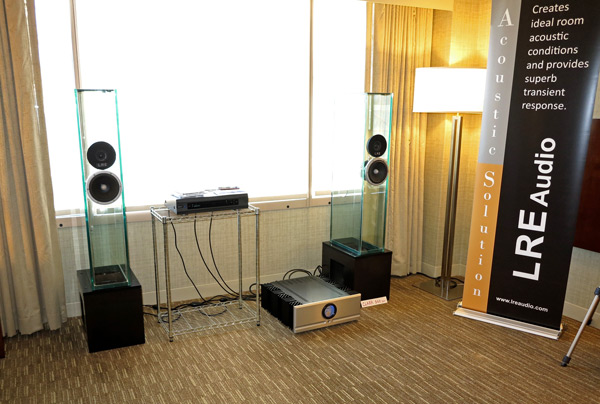 I really enjoyed LREAudio's set-up the first time I encountered it at a show. But here, the LRE Clara loudspeakers ($6000/pair), which are designed to be placed against a wall, sounded extra lively.
Matters got less noisy and far more listenable when, at my request, the curtains behind the speakers was closed. Nonetheless, even through the excellent Pass Labs XA30.8 amplifiers, Murray Perahia's piano had a metallic ring, and sounded far too distant and echo-laden. Given that the speaker cabinets are made of glass, which is claimed to have four times the density of wood, and its drivers are all open-baffle and configured in a way that "creates ideal acoustic conditions independent of listening room acoustics," I can't blame the room for what I heard. And I sure know the problem didn't lie with the amplification.
I really enjoyed LREAudio's set-up the first time I encountered it at a show. But here, the LRE Clara loudspeakers ($6000/pair), which are designed to be placed against a wall, sounded extra lively.
Matters got less noisy and far more listenable when, at my request, the curtains behind the speakers was closed. Nonetheless, even through the excellent Pass Labs XA30.8 amplifiers, Murray Perahia's piano had a metallic ring, and sounded far too distant and echo-laden. Given that the speaker cabinets are made of glass, which is claimed to have four times the density of wood, and its drivers are all open-baffle and configured in a way that "creates ideal acoustic conditions independent of listening room acoustics," I can't blame the room for what I heard. And I sure know the problem didn't lie with the amplification.
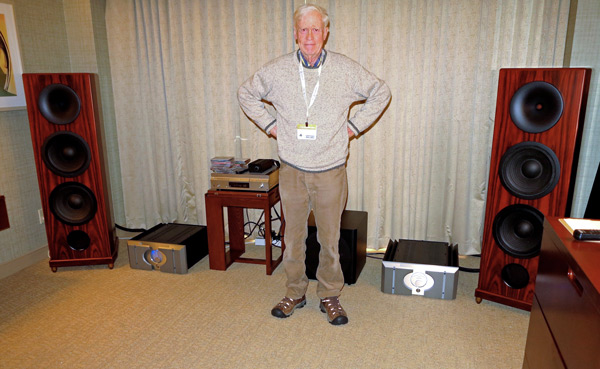 Linn Audio Loudspeakers of Oakland, CA paired its Lyceum speaker system ($19,500/pair) with the beautiful sound Pass Labs XA100.5 class-A amplifiers ($16,500/pair), a Sony XA9000ES player ($3000), a Linn Audio passive preamplifier (gain control) with remote ($1000), and AudioQuest cabling. The sense of air around Beverly Sills' heart-touching soprano on her priceless recording of Richard Strauss' "Breit über mein Haupt" was superb—p;the best I've ever heard—but the sound was a bit thin and wiry. Ditto for the recording of Piazzolla's Oblivion on Yarlung Records' Antonio Lysy at the Broad. Nonetheless, the superb treble reproduction and warmth of the Pass amplifiers came through. I'd love to hear this same system with a Pass Labs active preamp in the chain.
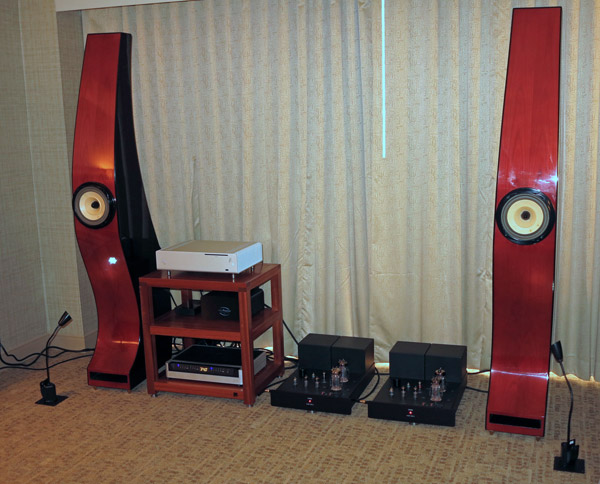 "It was the best of times, it was the worst of times . . ." Such thoughts come to mind as I reflect on the room dominated by Teresonic's Ingenium XR loudspeakers ($19,995/pair). Also in the room, in hardly shabby company, were Teresonic's new Clarison Silver EXP speaker cables (variously listed as $4485 and $4995/6ft pair), Gold interconnects ($3495/pair), and new Clarison Digital Gold BNC ($1995) and Gold AES ($2995). These joined Lamm Industries ML2.2 single-ended power amplifier ($37,950) and LL2.1 tube preamplifier ($6190); the new Berkeley Audio Design Reference DAC ($15,500); the new Baetis Reference Media Server ($13,995); and Stillpoints resonance control supports.
By all accounts, one would have expected this room to sound fantastic. Instead, music sounded more than a little thin, wiry, and metallic. The midrange was of realistic proportions on Andy Bey's "Tuesdays in Chinatown"—the core of his voice sounded gorgeous—but the piano was noticeably harsh and metallic. Ditto for the sound of soprano Julia Lezhnova's voice, also sourced from files on the Baetis server. Despite Mike Zivkovic's wonderful taste in music, something was very off.
"It was the best of times, it was the worst of times . . ." Such thoughts come to mind as I reflect on the room dominated by Teresonic's Ingenium XR loudspeakers ($19,995/pair). Also in the room, in hardly shabby company, were Teresonic's new Clarison Silver EXP speaker cables (variously listed as $4485 and $4995/6ft pair), Gold interconnects ($3495/pair), and new Clarison Digital Gold BNC ($1995) and Gold AES ($2995). These joined Lamm Industries ML2.2 single-ended power amplifier ($37,950) and LL2.1 tube preamplifier ($6190); the new Berkeley Audio Design Reference DAC ($15,500); the new Baetis Reference Media Server ($13,995); and Stillpoints resonance control supports.
By all accounts, one would have expected this room to sound fantastic. Instead, music sounded more than a little thin, wiry, and metallic. The midrange was of realistic proportions on Andy Bey's "Tuesdays in Chinatown"—the core of his voice sounded gorgeous—but the piano was noticeably harsh and metallic. Ditto for the sound of soprano Julia Lezhnova's voice, also sourced from files on the Baetis server. Despite Mike Zivkovic's wonderful taste in music, something was very off.
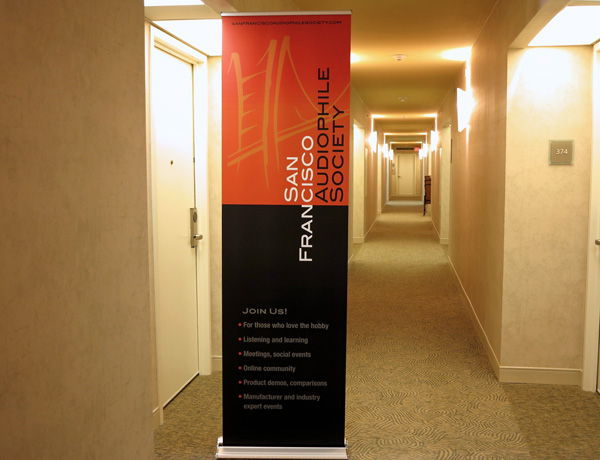 Boy oh boy, has the newly envisioned San Francisco Audiophile Society, formerly the Bay Area Audiophile Society (BAAS), come a long way in a short amount of time. Thanks to the graciousness of Constantine Soo, head honcho of the California Audio Show and DaGoGo.com, and the organizing acumen of Alón Sagee (blue t-shirt) and Leslie Lundin (orange top), not only did the organization receive a gratis hospitality suite in which it signed up at least 200 new members, but it also showed a brand new face. That included . . .
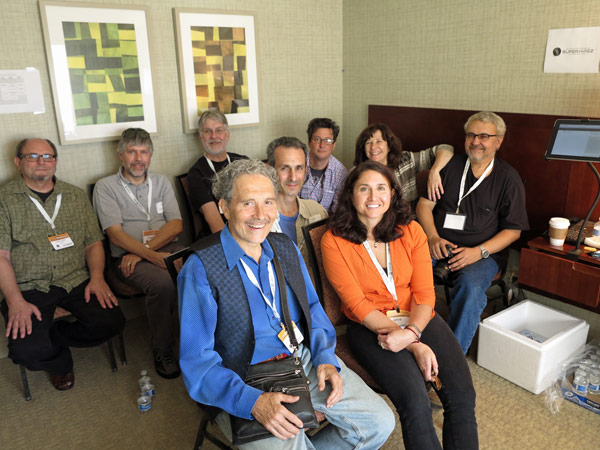 . . . a wonderful video presentation, some smiling new faces amongst familiar ones from the old days, and, as the photo attests, a Sunday afternoon visit by Channel D's Rob Robinson and his fabulous wife, Claudia.
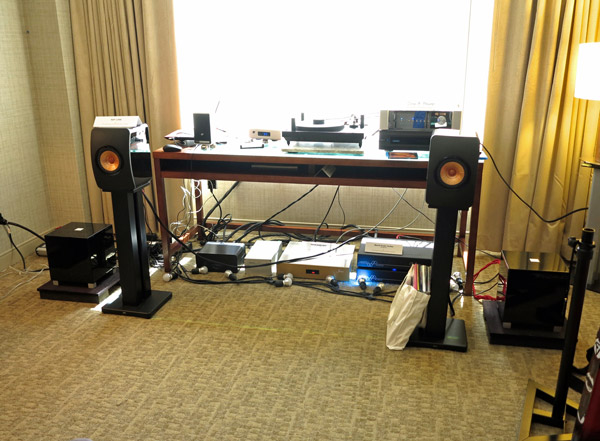 Truth be told, the energy in the room was more significant than the hodgepodge system, which changed frequently during the course of the weekend. Plans to compare equipment were abandoned when nothing sounded quite up to snuff. (Not to say that everything else in the adjacent rooms did either) But, hey, with 200 new members, for whom all new membership charges were waived, who's complaining? Now all the organization has to do is figure out is how to put on quality events that can serve large numbers of people without compromising sound quality or transforming the audio society into a source of raffle prizes that are subsequently unloaded on EBay by members with a seemingly lifelong dedication to either talking over the music or leaving once the raffle is over. This former BAAS president wishes everyone loads of luck on that score.
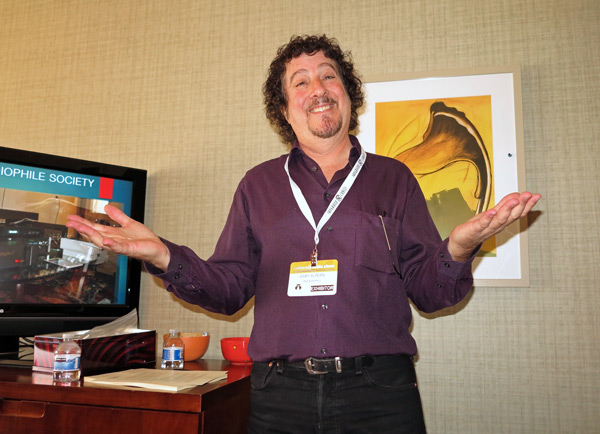 He may be mugging a bit here, but you should have seen the look of genuine disappointment on Gary Alpern's face when, after he walked into the SFAS room to thank his neighbors and let them know that his True Audiophile room was packing up early, he learned that he was doing so before I could blog the room for Stereophile.
"You're missing the big buzz of the show," I was told.
"Oh my," said I. But when I entered the room, I was relieved to discover, instead of any buzz, that I had at least covered Spatial Audio's loudspeakers in the past. New this time was the Spatial Audio Hologram M1 Open Baffle loudspeaker Turbo edition ($4000/pair) on Isoplane mechanical-diode platform ($295).
He may be mugging a bit here, but you should have seen the look of genuine disappointment on Gary Alpern's face when, after he walked into the SFAS room to thank his neighbors and let them know that his True Audiophile room was packing up early, he learned that he was doing so before I could blog the room for Stereophile.
"You're missing the big buzz of the show," I was told.
"Oh my," said I. But when I entered the room, I was relieved to discover, instead of any buzz, that I had at least covered Spatial Audio's loudspeakers in the past. New this time was the Spatial Audio Hologram M1 Open Baffle loudspeaker Turbo edition ($4000/pair) on Isoplane mechanical-diode platform ($295).
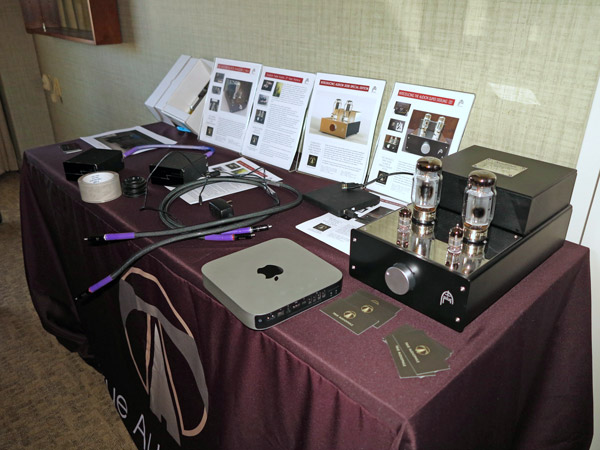 It was too late to get a shot of the active system, but this photo does give you an idea of the Audion 300B Special Edition Stereo amplifier ($6649), Revelation Audio Labs cabling, and IsoTek EVO3 Aquarius power conditioner with Premiere C19 AC cable ($2250) that joined Spatial Audio's open-baffle loudspeakers.
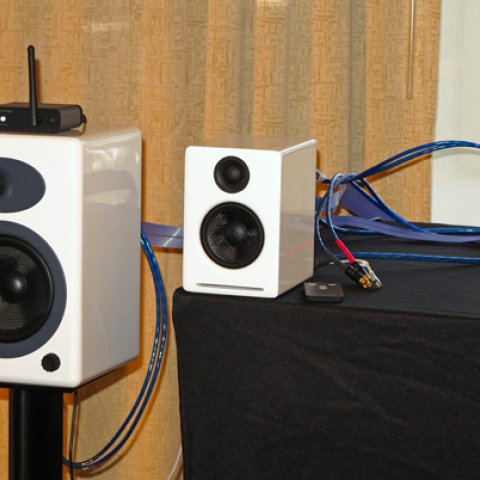
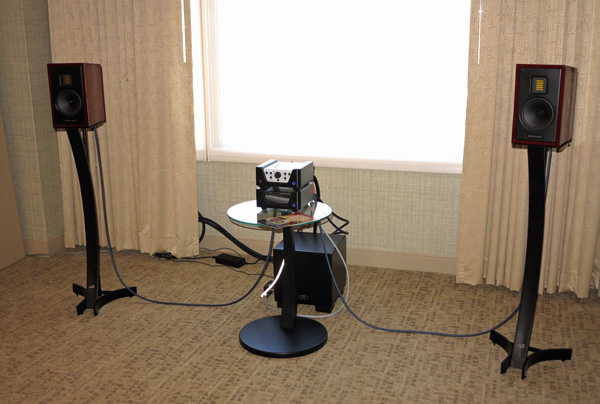 My head tucked between my legs, I shamefully shuffled into the Wyred 4 Sound room. This compact $4700 system delivered, on a Stevie Ray Vaughn track heard in nearfield, an amazingly high soundstage and very nice, fast, extremely three-dimensional sound. The combination of MartinLogan Motion 15 loudspeakers ($799/pair) and Wyred 4 Sound's W4S mINT integrated amplifier ($1499), new W4S bLINK Bluetooth reclocker ($499), W4S MS-1 music server ($1999), and the company's cabling ended the show on a high note.
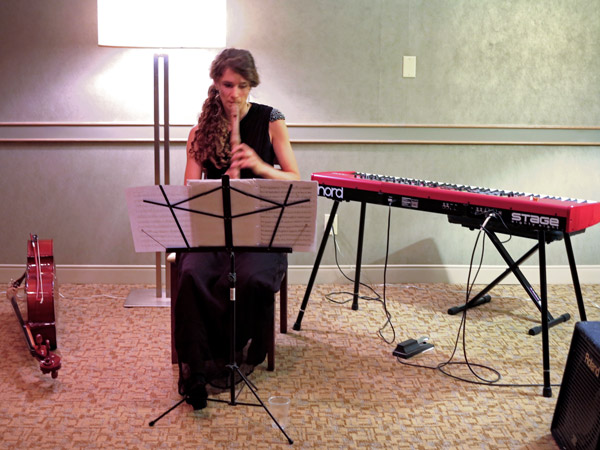 Just as I was leaving, I learned that classical and baroque multi-instrumentalist Ida Riegels had graciously invited people in for one final set. The ceilings may have been low, and the dryness of the acoustic hardly tailor-made for baroque instruments, but Riegels' baroque recorder playing music from Corelli's La Folia provided a welcome breath of fresh air after so much fine and not so fine canned sound. I extend thank yous to Riegel and show promoter Constantine Soo for music that satisfied far beyond the demands of the obligatory "live reference."
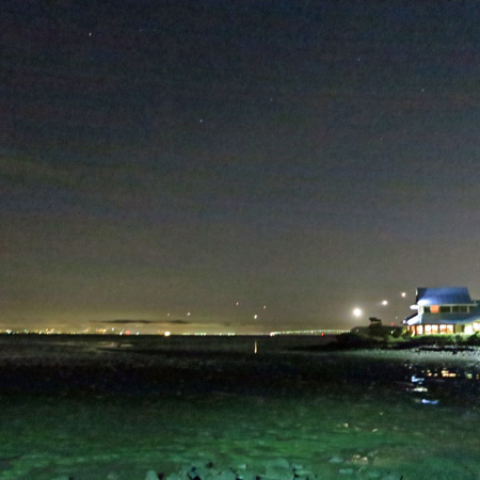
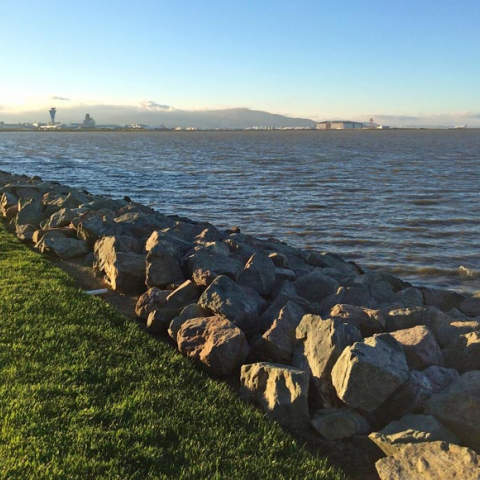
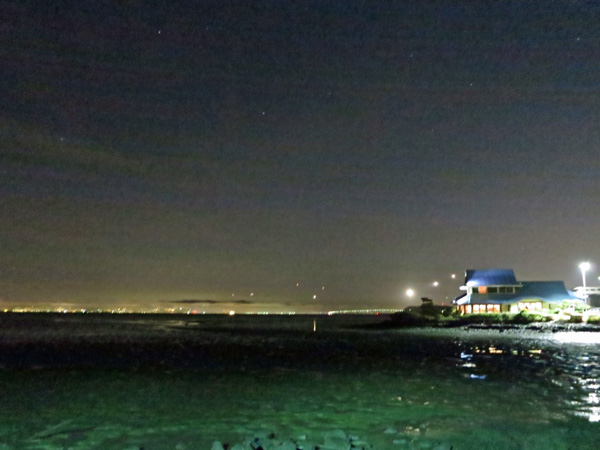
After the sun set on San Francisco Bay, I gazed back at the Benihana Restaurant where I had eaten dinner the night before the show began, and reflected upon what I had just experienced. First came the regrets that, due to time constraints, I had no choice but to skip Napa Acoustic's room, the second system in Sight & Sound Home Theater's room, VK Music's display, and all panels except the two I was on. I also had to pass on compelling headphone exhibits from Audionerd, Bob's Devices, HeadAmp, Olive Media, Oppo Digital, Sony, and the chance to bypass an offending tonearm cable and hear tapes on Genesis Audio loudspeakers.
Nonetheless, it was a joy to attend the grand opening AudioVision SF's new store—separate blog forthcoming—and experience all the good sound and musical revelations that the Fifth California Audio Show delivered. It was also great to discover the Wells Audio/Bybee /Jolida/Music Hall/Dana partnership joining a list of repeat show favorites that included Wilson Audio/Audio Research/Transparent/Synergistic Research/Grand Prix, YG Acoustics/Bryston/Esoteric/Audio Reference Technology, Dynaudio/Simaudio/Nordost, Audeze/Nordost, Sony/Pass Labs/Kimber, and Magico/Constellation/Berkeley Audio Design/Aurender/MIT. I can't speak for attendees and exhibitors, to whom attendance and exhibitor numbers mean more, but I thought it a very good show.
Now that we've relocated to Port Townsend, WA, I don't know when I'll next have the opportunity to see a lot of my Bay Area audiophile friends and cohorts. I thank you, one and all, for all the good energy and support you have shared with me and brought to Casa Bellecci-Serinus over multiple decades. Here's hoping we can all reconnect at the 2014 Rocky Mountain Audio Fest in Denver, which I will again cover for Stereophile.
Just as I was leaving, I learned that classical and baroque multi-instrumentalist Ida Riegels had graciously invited people in for one final set. The ceilings may have been low, and the dryness of the acoustic hardly tailor-made for baroque instruments, but Riegels' baroque recorder playing music from Corelli's La Folia provided a welcome breath of fresh air after so much fine and not so fine canned sound. I extend thank yous to Riegel and show promoter Constantine Soo for music that satisfied far beyond the demands of the obligatory "live reference."
After the sun set on San Francisco Bay, I gazed back at the Benihana Restaurant where I had eaten dinner the night before the show began, and reflected upon what I had just experienced. First came the regrets that, due to time constraints, I had no choice but to skip Napa Acoustic's room, the second system in Sight & Sound Home Theater's room, VK Music's display, and all panels except the two I was on. I also had to pass on compelling headphone exhibits from Audionerd, Bob's Devices, HeadAmp, Olive Media, Oppo Digital, Sony, and the chance to bypass an offending tonearm cable and hear tapes on Genesis Audio loudspeakers.
Nonetheless, it was a joy to attend the grand opening AudioVision SF's new store—separate blog forthcoming—and experience all the good sound and musical revelations that the Fifth California Audio Show delivered. It was also great to discover the Wells Audio/Bybee /Jolida/Music Hall/Dana partnership joining a list of repeat show favorites that included Wilson Audio/Audio Research/Transparent/Synergistic Research/Grand Prix, YG Acoustics/Bryston/Esoteric/Audio Reference Technology, Dynaudio/Simaudio/Nordost, Audeze/Nordost, Sony/Pass Labs/Kimber, and Magico/Constellation/Berkeley Audio Design/Aurender/MIT. I can't speak for attendees and exhibitors, to whom attendance and exhibitor numbers mean more, but I thought it a very good show.
Now that we've relocated to Port Townsend, WA, I don't know when I'll next have the opportunity to see a lot of my Bay Area audiophile friends and cohorts. I thank you, one and all, for all the good energy and support you have shared with me and brought to Casa Bellecci-Serinus over multiple decades. Here's hoping we can all reconnect at the 2014 Rocky Mountain Audio Fest in Denver, which I will again cover for Stereophile.
True, Jeff Wells is gifted with set-up acumen. This is reflected in his use of Shakti Halographs ($1200/pair), Gingko Mini Clouds ($100/set) and Cloud 10 platform ($349), and such Bybee Crystal curiosities as a droll, half-naked AC module, already in use by Oppo England. I can't help but note that this baby, which reportedly affects the energy of the presentation, even when positioned all by its lonesome, reminds me of the droll antlers Falstaff is saddled with in the marvelous final act of Verdi's opera, Falstaff.
But set-up means nothing if the equipment (including cabling) is not up to snuff. Hats off, then, to the equipment mentioned above, as well as to Chapman T-7 loudspeakers ($12,995 with special finish), Wells Audio "Looking Glass" power conditioner ($5500), Jolida Fusion preamplifier modified by Wells Audio ($5000), Music Hall 25.3 modified DAC ($3500), Jolida DAC/Transport ($2299), and a host of Dana Cables Diamond Reference cabling. Given how clear naturally balanced, timbre-neutral and true, and musical this system sounded, I'd say the Wells Audio Innamorata Signature amplifier, reportedly carried by 12 dealers, deserves a place in a Stereophile reviewer's system and on John Atkinson's bench.
I really enjoyed LREAudio's set-up the first time I encountered it at a show. But here, the LRE Clara loudspeakers ($6000/pair), which are designed to be placed against a wall, sounded extra lively.
Matters got less noisy and far more listenable when, at my request, the curtains behind the speakers was closed. Nonetheless, even through the excellent Pass Labs XA30.8 amplifiers, Murray Perahia's piano had a metallic ring, and sounded far too distant and echo-laden. Given that the speaker cabinets are made of glass, which is claimed to have four times the density of wood, and its drivers are all open-baffle and configured in a way that "creates ideal acoustic conditions independent of listening room acoustics," I can't blame the room for what I heard. And I sure know the problem didn't lie with the amplification.
Linn Audio Loudspeakers of Oakland, CA paired its Lyceum speaker system ($19,500/pair) with the beautiful sound Pass Labs XA100.5 class-A amplifiers ($16,500/pair), a Sony XA9000ES player ($3000), a Linn Audio passive preamplifier (gain control) with remote ($1000), and AudioQuest cabling. The sense of air around Beverly Sills' heart-touching soprano on her priceless recording of Richard Strauss' "Breit über mein Haupt" was superb—p;the best I've ever heard—but the sound was a bit thin and wiry. Ditto for the recording of Piazzolla's Oblivion on Yarlung Records' Antonio Lysy at the Broad. Nonetheless, the superb treble reproduction and warmth of the Pass amplifiers came through. I'd love to hear this same system with a Pass Labs active preamp in the chain.
"It was the best of times, it was the worst of times . . ." Such thoughts come to mind as I reflect on the room dominated by Teresonic's Ingenium XR loudspeakers ($19,995/pair). Also in the room, in hardly shabby company, were Teresonic's new Clarison Silver EXP speaker cables (variously listed as $4485 and $4995/6ft pair), Gold interconnects ($3495/pair), and new Clarison Digital Gold BNC ($1995) and Gold AES ($2995). These joined Lamm Industries ML2.2 single-ended power amplifier ($37,950) and LL2.1 tube preamplifier ($6190); the new Berkeley Audio Design Reference DAC ($15,500); the new Baetis Reference Media Server ($13,995); and Stillpoints resonance control supports.
By all accounts, one would have expected this room to sound fantastic. Instead, music sounded more than a little thin, wiry, and metallic. The midrange was of realistic proportions on Andy Bey's "Tuesdays in Chinatown"—the core of his voice sounded gorgeous—but the piano was noticeably harsh and metallic. Ditto for the sound of soprano Julia Lezhnova's voice, also sourced from files on the Baetis server. Despite Mike Zivkovic's wonderful taste in music, something was very off.
Boy oh boy, has the newly envisioned San Francisco Audiophile Society, formerly the Bay Area Audiophile Society (BAAS), come a long way in a short amount of time. Thanks to the graciousness of Constantine Soo, head honcho of the California Audio Show and DaGoGo.com, and the organizing acumen of Alón Sagee (blue t-shirt) and Leslie Lundin (orange top), not only did the organization receive a gratis hospitality suite in which it signed up at least 200 new members, but it also showed a brand new face. That included . . .
. . . a wonderful video presentation, some smiling new faces amongst familiar ones from the old days, and, as the photo attests, a Sunday afternoon visit by Channel D's Rob Robinson and his fabulous wife, Claudia.
Truth be told, the energy in the room was more significant than the hodgepodge system, which changed frequently during the course of the weekend. Plans to compare equipment were abandoned when nothing sounded quite up to snuff. (Not to say that everything else in the adjacent rooms did either) But, hey, with 200 new members, for whom all new membership charges were waived, who's complaining? Now all the organization has to do is figure out is how to put on quality events that can serve large numbers of people without compromising sound quality or transforming the audio society into a source of raffle prizes that are subsequently unloaded on EBay by members with a seemingly lifelong dedication to either talking over the music or leaving once the raffle is over. This former BAAS president wishes everyone loads of luck on that score.
He may be mugging a bit here, but you should have seen the look of genuine disappointment on Gary Alpern's face when, after he walked into the SFAS room to thank his neighbors and let them know that his True Audiophile room was packing up early, he learned that he was doing so before I could blog the room for Stereophile.
It was too late to get a shot of the active system, but this photo does give you an idea of the Audion 300B Special Edition Stereo amplifier ($6649), Revelation Audio Labs cabling, and IsoTek EVO3 Aquarius power conditioner with Premiere C19 AC cable ($2250) that joined Spatial Audio's open-baffle loudspeakers.
My head tucked between my legs, I shamefully shuffled into the Wyred 4 Sound room. This compact $4700 system delivered, on a Stevie Ray Vaughn track heard in nearfield, an amazingly high soundstage and very nice, fast, extremely three-dimensional sound. The combination of MartinLogan Motion 15 loudspeakers ($799/pair) and Wyred 4 Sound's W4S mINT integrated amplifier ($1499), new W4S bLINK Bluetooth reclocker ($499), W4S MS-1 music server ($1999), and the company's cabling ended the show on a high note.
Just as I was leaving, I learned that classical and baroque multi-instrumentalist Ida Riegels had graciously invited people in for one final set. The ceilings may have been low, and the dryness of the acoustic hardly tailor-made for baroque instruments, but Riegels' baroque recorder playing music from Corelli's La Folia provided a welcome breath of fresh air after so much fine and not so fine canned sound. I extend thank yous to Riegel and show promoter Constantine Soo for music that satisfied far beyond the demands of the obligatory "live reference."
After the sun set on San Francisco Bay, I gazed back at the Benihana Restaurant where I had eaten dinner the night before the show began, and reflected upon what I had just experienced. First came the regrets that, due to time constraints, I had no choice but to skip Napa Acoustic's room, the second system in Sight & Sound Home Theater's room, VK Music's display, and all panels except the two I was on. I also had to pass on compelling headphone exhibits from Audionerd, Bob's Devices, HeadAmp, Olive Media, Oppo Digital, Sony, and the chance to bypass an offending tonearm cable and hear tapes on Genesis Audio loudspeakers.
Nonetheless, it was a joy to attend the grand opening AudioVision SF's new store—separate blog forthcoming—and experience all the good sound and musical revelations that the Fifth California Audio Show delivered. It was also great to discover the Wells Audio/Bybee /Jolida/Music Hall/Dana partnership joining a list of repeat show favorites that included Wilson Audio/Audio Research/Transparent/Synergistic Research/Grand Prix, YG Acoustics/Bryston/Esoteric/Audio Reference Technology, Dynaudio/Simaudio/Nordost, Audeze/Nordost, Sony/Pass Labs/Kimber, and Magico/Constellation/Berkeley Audio Design/Aurender/MIT. I can't speak for attendees and exhibitors, to whom attendance and exhibitor numbers mean more, but I thought it a very good show.